Consent Notification UX Patterns for Meeting Recording Bots
Design choices for recording bot notifications shape both legal defensibility and meeting behavior.

A bot joins the call, a small avatar labeled "Notetaker" slides into the participant list, and someone, usually a few minutes in, types into chat: "who is that?" That moment is the whole problem in miniature. Meeting recording bots sit at a genuine collision point between two forces that do not want to cooperate: the law demands disclosure and friction at the exact moment a given meeting is happening, and the product is engineered to join, listen, and disappear into the background as quickly as possible. Consent notification design for these tools shapes whether the recording is legal and shapes how the people in the meeting behave once they know, or suspect, that a machine is listening. Even where full consent exists on paper, a visible bot changes what gets said. When a named account sits in the room watching, people choose their words differently. That leaves two distinct faces: one is legal defensibility, whether a court would recognize what happened as consent; the other is behavioral, whether the meeting still functions as a meeting once everyone knows a permanent record is being made. The patterns available to product teams, audio announcements, in-chat messages, pre-meeting consent gates, platform-native banners, are not interchangeable skins on the same feature. Each sits at a different point on a spectrum from high visibility and high friction to low visibility and low friction, and picking the wrong one for a given context produces either legal exposure or a meeting nobody wants to attend.
Consent requirements for recording vary by jurisdiction, and the strictest rule in the room governs everyone
No single consent standard governs meeting recording across the country, and the distance between the most permissive rule and the most demanding one is wide enough to turn an adequate notification pattern into a felony-level failure depending on where the participants happen to be sitting. Federal law sets a floor, not a ceiling: under the federal wiretap statute, one party to a conversation can consent on behalf of the recording, so the person operating the recorder can simply be that one party. A dozen or so states hold a far stricter line, requiring all parties to a conversation to consent before any recording is lawful. Enterprise teams get exposed at the seams between these two regimes. A meeting with nine participants in Texas, a one-party consent state, and a single participant dialing in from Illinois, an all-party consent state, is legally an Illinois meeting for consent purposes, in full. That asymmetry is precisely why a blanket opt-in default, applied uniformly across every meeting, is the only enterprise policy that holds up: per-meeting calculations about who is dialing in from where cannot be tracked reliably enough to justify a looser default.
But add a second axis: what if a participant is subject to a foreign data protection regime? Three lawful bases exist for processing that data: legitimate interests, which requires a documented balancing test weighing the company's interest against the individual's privacy; contractual necessity; or explicit consent. Explicit consent is often the weakest of the three in a workplace context, because regulators tend to ask whether an employee recorded by their own employer's tooling can really refuse without professional consequence, and that undermines the voluntariness consent is supposed to represent.
A third layer sits on top of both frameworks and is frequently missed entirely: biometric data law. Notice that a recording is happening and consent to that recording are two separate legal questions, and a UX pattern that handles one does not automatically handle the other. That distinction is the hinge the rest of this analysis turns on.
The Otter.ai litigation and the "third-party eavesdropper" theory restructure liability for every bot architecture
The legal question that actually matters for an AI meeting bot is not whether it records. Courts are increasingly asking whether the bot functions as the meeting host's own tool, an extension of the host's authority to record, or as an unauthorized third party intercepting a conversation it was never invited to be part of in any meaningful legal sense. Recent rulings suggest the third-party framing is surviving motions to dismiss, which changes the stakes for every architecture on the market, not just the one named in the complaint.
A privacy litigation case consolidated against a transcription vendor, now pending before a federal district court, gives you the clearest signal so far. On August 13, 2026, Judge Eumi K. The federal Wiretap Act claim survived. So did the California Invasion of Privacy Act claim and both Illinois BIPA claims, on the theory that Otter plausibly operated as a third-party eavesdropper intercepting the meeting independent of the host's authority. The allegations in the consolidated cases are, as of this ruling, unproven claims rather than established facts, but they describe a specific pattern: that OtterPilot joined meetings without the knowledge of participants, that voiceprints were collected to identify speakers without the written consent BIPA requires, and that the bot continued auto-joining meetings even after individual users had disabled the feature. Otter.ai, makes a narrower and sharper allegation: that the default configuration gave no notice to participants who were not themselves Otter users, with meaningful notification reserved for the Enterprise plan, making the strength of disclosure a participant receives depend on which pricing tier the host happens to be paying for.
If the third-party eavesdropper theory holds up through further litigation, it carries a structural implication that extends well past any single vendor. A vendor's terms of service, agreed to by the meeting host during installation, do not bind the other people in the meeting. Liability under this theory flows through to the host's employer as a co-collector of the data, not only to the software vendor that built the bot. A separate ruling against another platform provider, in a related case before a federal district court, denied that provider's motion to dismiss on a related theory: that a vendor capable of using intercepted meeting data for its own benefit, such as training an AI model, can be treated as a third party at the pleading stage even when it is the platform itself providing the AI feature, not an independent add-on bot. That extends the exposure well beyond standalone recording tools like Otter and into any platform-native AI feature that touches meeting audio.
What these rulings establish, taken together, is that visible notice and provable consent are not the same evidentiary achievement, and a product team choosing a UX pattern needs a way to evaluate which patterns produce the latter, not just the former.
Audio announcements: high reach, low evidentiary value, appropriate for recurring internal sessions
You see the audio announcement everywhere because it needs the least custom engineering and reaches every participant with working speakers. The standard implementation has a bot play a spoken message upon joining, something to the effect of "this meeting is being recorded for quality assurance and training purposes," and in more careful deployments, the bot repeats the announcement whenever a new participant joins mid-meeting, so a latecomer is not left out of the loop.
The pattern's ceiling is low: an audio announcement notifies but cannot capture affirmative consent. An audio announcement notifies; it does not collect anything. In an all-party consent jurisdiction, the law requires affirmative agreement from everyone on the call, and an announcement gives a participant information without giving them any mechanism to respond yes or no, short of leaving the meeting entirely, which is an exit, not a consent flow. The pattern also leaves out an entire category of participant by design: anyone who is deaf or hard of hearing receives no notice at all from an audio-only announcement. This is why accessibility guidance treats in-chat text disclosure as a necessary companion method.
None of this means the audio announcement is a bad pattern. It is the right pattern for a specific, narrower context: recurring internal sessions, where every participant is an employee already operating under a documented org-level recording policy, and where the spoken announcement functions as a reminder of consent already established by that policy, with that policy serving as the mechanism actually securing consent.
In-chat disclosures: better for accessibility and auditability, still insufficient as standalone consent in strict jurisdictions
The in-chat disclosure improves on the audio announcement in two concrete ways. That opt-out instruction is not a courtesy addition. A disclosure with no path to object is not functioning as a consent mechanism at all; it is a notice with nowhere for the recipient to go.
The auditability gain is genuine but partial. The strongest version of this approach pairs the chat message with the audio announcement, since one method catches the people who miss the spoken notice and the other catches the people who miss the written one. A related variant, a persistent visual element such as a "Recording in Progress" banner or avatar displayed within the meeting interface, serves participants who find a spoken interruption disruptive, functioning as an ongoing reminder rather than a message that appears once and then scrolls out of view.
Even combined, audio and chat disclosure share the same underlying ceiling. Both are built to satisfy notice, the weaker of the two legal requirements, and neither one captures the stronger requirement: an affirmative, individually attributable act of consent from each participant before recording begins. That gap is what the next two patterns exist to close.
Pre-meeting consent gates: the only pattern that captures affirmative consent before recording begins
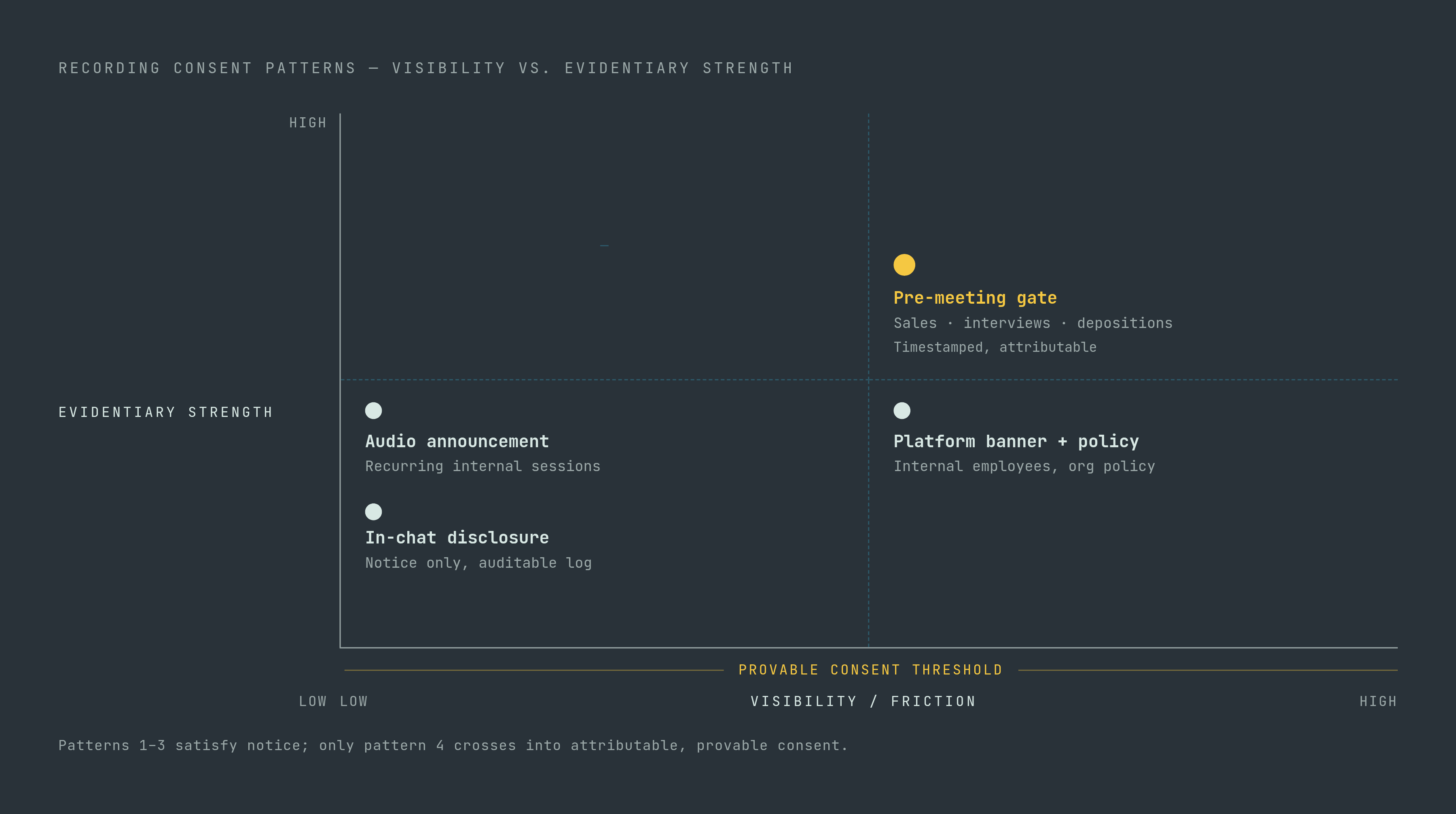
A pre-meeting consent gate redirects a participant, before they ever enter the meeting itself, to a landing page disclosing that the session will be recorded and stating that entering constitutes consent, with a visible path to decline. So the meeting link distributed in the calendar invite points to this intermediary page. When a participant declines, Fellow surfaces a real-time warning to the meeting organizer inside the recording controls, so the host knows before the call starts that not everyone present has agreed to be recorded.
This is the only pattern among the ones in wide use that produces a timestamped, individually attributable record of a participant seeing the disclosure and affirmatively choosing to proceed. That record is the closest digital analog to a signed consent form that a meeting flow built for speed can realistically produce, and it is the piece of evidence that would actually matter if a dispute like the ones alleged in the Otter litigation reached a courtroom.
The context where this pattern earns its cost is external-facing meetings: sales calls, candidate interviews, client sessions, depositions, any situation where the people on the call are not employees bound by an org-level policy and where the host has no pre-existing consent relationship with the person joining. Legal professionals carry an obligation here that goes beyond the recording statutes themselves. The NYC Bar's Formal Opinion 2026-2 holds that undisclosed AI recording is deceptive under Rule 8.4 of the rules of professional conduct, even if the jurisdiction in question only requires one-party consent as a matter of wiretap law. An attorney conducting a deposition or a client call is bound by a professional conduct standard that a one-party consent statute does not satisfy on its own, and the landing-page gate is the pattern best positioned to meet that higher bar.
None of this comes free. If you insert a redirect before every external meeting, you add measurable drop-off and confusion, especially among participants who don't know the tool generating the consent page. A calendar-integrated variant softens the friction somewhat: Granola's "Heads Up" feature, delivered through a Google Calendar add-on, surfaces a consent notification screen for participants before they join, folding the disclosure into a step they were already taking rather than adding an entirely separate page to click through. The trade-off does not disappear with a smoother delivery mechanism, but the cost can be narrowed.
Platform-native consent banners and org-level policy controls: the enterprise default that reduces per-meeting friction
Where the pre-meeting gate asks each external participant to clear a consent step individually, platform-native banners and org-level policy controls move that decision up a level, to the organization itself, and apply it uniformly across every meeting an employee runs. A platform-level recording banner, built into the conferencing software rather than bolted on by a third-party bot, notifies every participant the moment recording starts, and the host doesn't need to configure anything meeting by meeting. Pair this with an org-wide policy, communicated once to employees and documented as the basis for a legitimate-interest or contractual-necessity lawful basis under frameworks like the GDPR, and you no longer need to re-litigate consent at the start of every single call.
The trade-off runs the opposite way from the landing-page gate. What the enterprise default gains in reduced per-meeting friction, it gives up in individualized, attributable proof of consent from any one participant. It is a strong fit for internal meetings among employees already covered by a documented policy, where the organization has done the balancing-test work once and does not need to repeat it. It is a weaker fit for the external, adversarial, or legally sensitive contexts where the pre-meeting consent gate earns its cost: interviews, sales calls, depositions, anywhere the person on the other end of the call has never agreed to anything the organization's internal policy covers. Choosing between these two enterprise-scale patterns, banner-and-policy versus landing-page gate, is really a choice about which meetings in an organization's calendar are internal in substance and which ones are not, and building consent UX that applies the right pattern to each is the actual design problem this entire category of product has to solve.