Audio Preprocessing for Meeting Recordings Before Transcription
Preparing messy meeting audio for transcription cuts errors that vendor benchmarks never see.
Meeting recordings break transcription in ways that clean studio audio never does, because the problems stack: overlapping speakers, mics sitting at different distances from different mouths, HVAC hum, codec artifacts from whatever platform recorded the call, and volume levels that swing wildly between a laptop mic and a conference-room speakerphone. Vendors report accuracy near 99% under optimal conditions, but "optimal" is doing a lot of work in that sentence Sonix Sommelier: Scalable Open Multi-turn Audio Pre-processing for Full-dup…. Meeting audio rarely qualifies Sonix Sommelier: Scalable Open Multi-turn Audio Pre-processing for Full-dup….
Crosstalk is the sharpest version of the problem. Most speech recognition systems assume one speaker at a time, so when people talk over each other, error rates can jump past 50%, even though each voice would be recognized correctly in isolation. The vendor benchmarks everyone quotes, on datasets like LibriSpeech, CHiME-6, and CALLHOME, were derived from standard datasets whose conditions diverge from real meeting audio. That gap between benchmark and reality is what preprocessing exists to close.
Word Error Rate is the yardstick to define before going further, because everything downstream gets measured against it. WER equals the sum of substitutions, insertions, and deletions divided by total words spoken, so a WER of 5% means 95 of every 100 words landed correctly Speech-to-Text Accuracy in 2025: Benchmarks and Best Practices - DEV…. Preprocessing doesn't touch the recognition model itself.
Step 1: Format standardization (sample rate, bit depth, and channel count)
Every tool later in the pipeline, from the voice activity detector to the diarization model, assumes it's getting audio in a consistent format. Mismatched sample rates or channel layouts don't just cause one bad transcript if this step is skipped; they quietly corrupt everything built on top of that audio.
The target most practitioners converge on is 16 kHz mono PCM WAV at 16-bit depth. That's not an arbitrary choice: Whisper and most other modern speech models were trained on 16 kHz audio, and feeding them anything else causes the model to misread timing and phonetics, the acoustic cues it relies on to tell one sound from another Robust Assamese Speech Recognition through Controlled Fine-Tuning of… How to Master Automated Transcription in 2026: A Step-by-Step Guide -…. Resampling audio down to 16 kHz is not lossy in any way that matters for speech, since intelligible speech lives well below the Nyquist limit of 8 kHz captured by a 16 kHz sampling rate Robust Assamese Speech Recognition through Controlled Fine-Tuning of… How to Master Automated Transcription in 2026: A Step-by-Step Guide -….
Codec choice affects signal fidelity through the whole pipeline. Lossless formats like FLAC hold signal fidelity through the whole pipeline; Microsoft's transcription patent, for instance, describes encoding microphone-array audio via FLAC for exactly this reason. Lossy codecs, by contrast, bake in artifacts that compound once noise reduction and enhancement start operating on the file. And because most meeting platforms don't export WAV by default, they hand back MP4 audio, OGG, or Opus, format conversion has to happen before anything else touches the file, not as an afterthought once something downstream breaks. This is the cheapest step in the entire pipeline, a few seconds of processing, and it's also the one most likely to get skipped, which makes it the most common source of failures nobody can explain later.
Step 2: Loudness normalization (balancing volume across speakers and sessions)
Volume inconsistency isn't an edge case in meeting audio, it's the default state. A remote participant on a laptop mic, someone across the room from a conference speakerphone, and a guest dialing in by phone will never arrive at the same amplitude, and no single gain setting fixes all three at once.
The fix is loudness normalization, applied after the format conversion from Step 1, typically pushing everything to a target of around −20 dBFS using standard audio libraries such as pydub and librosa Robust Assamese Speech Recognition through Controlled Fine-Tuning of… Sommelier: Scalable Open Multi-turn Audio Pre-processing for Full-dup… How to Master Automated Transcription in 2026: A Step-by-Step Guide -…. Underneath, this runs on an RMS-based calculation that measures the audio's average energy and adjusts it to that target decibel level, which standardizes volume across speakers and keeps distortion from creeping in when intensity swings too far in either direction.
This step doesn't remove noise, doesn't separate speakers, and doesn't do anything beyond what follows. It doesn't remove noise, and it doesn't separate speakers. All it guarantees is that everything downstream, the voice activity detector, the denoiser, the diarization model, sees amplitude in a predictable range. If this step is skipped, a quiet speaker's voice can fall below whatever noise floor the denoiser was calibrated for, while a loud participant clips after enhancement pushes their signal further. Diarization, which depends on comparing voice embeddings across speakers, gets unreliable fast when amplitude varies this much from one segment to the next.
Step 3: Voice activity detection (finding speech before transcribing it)
Voice activity detection, VAD for short, finds the parts of a recording that actually contain speech and discards the rest. In practice that means slicing the audio stream into utterances roughly 3 to 30 seconds long, a window wide enough to hold a full conversational turn but short enough to exclude fragments too brief to carry any real acoustic context.
The payoff appears at scale. Skipping silence saves compute, since there's no reason to run a transcription model over dead air. It also cuts down on hallucination: feed Whisper a stretch of silence or pure background noise, and it doesn't fail gracefully, it invents words, producing confident, fabricated text where nothing was said. The mechanical flow is straightforward once set up: load the audio, run VAD, extract the time ranges that contain speech, slice the file into those segments, transcribe each one, then reassemble the pieces using the original timestamps.
Silero VAD is the tool most teams reach for here, and it's stable enough to be a default choice across production pipelines. Getting the threshold wrong produces noticeably worse detection results. Rather than defaulting to 0.5, test the 0.3 to 0.5 range against the specific audio domain in question, since a threshold tuned for a quiet studio podcast behaves differently on a noisy conference room recording Sommelier: Scalable Open Multi-turn Audio Pre-processing for Full-dup…. The tradeoff between false negatives, missing real speech, and false positives, transcribing noise as if it were speech, runs beneath threshold tuning and is measured directly in the final transcript. Both hurt the final transcript, just in different ways: missed speech leaves gaps, misfired detection produces hallucinated text. Some pipelines now integrate ASR word-level timestamps with frame-level VAD predictions in a hybrid approach that reduces both failure modes at once, though it adds real complexity to the pipeline. VAD sits at the front of everything that follows: every segment it lets through gets denoised and diarized, so a miscalibrated threshold here doesn't just cause one error, it propagates through the whole chain.
Step 4: Noise reduction (cleaning the signal without erasing the speech)
HVAC hum, keyboard clicks, room reverb, the occasional network artifact from a dropped packet, these degrade both what the transcription model hears and what the diarization model uses to tell speakers apart. Noise reduction exists to strip that out before either process runs.
Krisp is a widely deployed neural suppressor that runs in under 15 milliseconds on a single CPU core, handles both stationary and non-stationary noise, and preserves speech naturalness better than classical DSP Speech Recognition Accuracy in Noise: 2026 Playbook. It ships as an SDK embedded in a wide range of communication products, separate from whatever built-in noise cancellation a given platform already runs Speech Recognition Accuracy in Noise: 2026 Playbook.
More filtering isn't automatically better. Stripping out too much noise can erase the subtle consonant transitions and tonal patterns that a neural network like Whisper is already trained to decode on its own. Whisper was trained on enormous corpora full of real acoustic variability, so aggressive enhancement, however good it sounds to a human ear, can strip out exactly the information the model uses to make its own decisions, hurting accuracy even as perceived audio quality improves.
The resolution some pipelines use is to split the signal down two separate paths. Speech enhancement runs only inside the branch feeding diarization to clean the signal for diarization embeddings, while the branch feeding transcription keeps the original signal preserved. That separation resolves a tension between two goals that otherwise pull against each other.
Step 5: Speaker diarization (assigning speech segments to individual participants)
Meeting transcription isn't just converting speech to text, it's answering who said what, and that attribution is the whole point. Without it, summarization and topic extraction downstream have nothing reliable to work from. That's what makes diarization a distinct, necessary stage rather than a nice-to-have.
In practice, diarization runs on audio already converted to a uniform format and sample rate, then segments it into speaker turns, separates distinct channels where they exist, and assigns speaker labels to each segment. The reason Step 4 comes before Step 5, and not after, is measurable: denoising improves Diarization Error Rate more on noisier recordings, precisely because there's more noise for it to remove. Order the pipeline the other way and diarization has to work with dirtier embeddings than it needs to.
Overlap is the specific hazard that makes meetings harder to diarize than almost any other audio domain. The MISP 2025 Challenge dataset shows overlap ratios running roughly 47% to 57% across its development and evaluation sets, meaning nearly half to more than half of meeting audio involves simultaneous speech. Any diarization system built for single-speaker-at-a-time audio is going to struggle against numbers like that.
A few tools dominate this space, each suited to a different kind of team. PyAnnote 3.1 fits research teams with machine learning expertise who want something self-hosted and fine-tunable. NeMo's Sortformer takes a different architectural approach, treating diarization as a unified problem rather than a multi-stage pipeline, running an 18-layer NEST/Fast-Conformer encoder followed by an 18-layer Transformer encoder, and supporting both oracle and system VAD, GPU-optimized. AssemblyAI's Universal-3.5 Pro leads that company's own benchmark at a 30.17 average cpWER for word-aligned accuracy 8 Best Speaker Diarization Solutions & APIs in 2026. If diarization is skipped entirely, the transcript might be word-for-word accurate and still be useless, because nobody reading it can tell which of the five voices in the room said which line.
Step 6: Chunking long recordings to manage memory and model limits
A 90-minute all-hands or a multi-hour workshop recording will exceed the memory limits of both the diarization model and the transcription engine if it's fed through whole. That's a hard ceiling rather than a hypothetical, and chunking is the step that keeps the rest of the pipeline from simply failing on long files.
Research pipelines put concrete numbers on this. To avoid out-of-memory failures, diarization models generally need audio split into units under 5 minutes before processing. Some research setups go further and discard any recording longer than 4,000 seconds outright to keep compute costs down, a constraint built for benchmark efficiency rather than production use, but it marks where the ceiling sits. WhisperX handles this in an integrated way: it chops input audio into roughly 30-second chunks, but only at points where VAD has already detected sound activity, before sending those chunks to transcription and alignment.
The constraint that actually matters here is where the cuts land. Chunks have to break at VAD-detected silence, never at an arbitrary timestamp, because slicing through the middle of a word or a sentence damages transcription accuracy on both halves of the cut. Once each chunk comes back from the transcription model, segments must be stitched back together with original timestamps preserved. The VAD-derived timing data from Step 3 pays off here. VAD identifies silence and non-speech regions so only genuine speech segments pass downstream, cutting the audio stream into utterances of 3–30 seconds, a window accommodating both short conversational turns and longer narrative segments while excluding very short fragments lacking acoustic context, separating two goals that pull in opposite directions.
How the steps interact as a complete pipeline
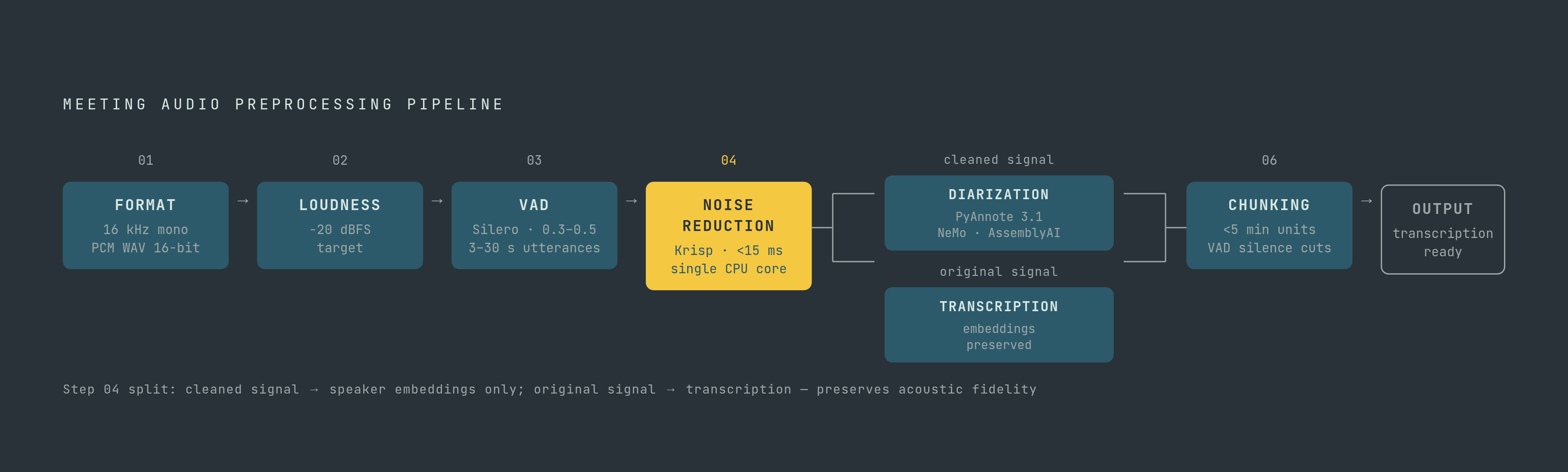
Format standardization guarantees every later tool receives audio it was built to handle, with no silent resampling errors sneaking through. Loudness normalization puts amplitude into the range where VAD and denoising thresholds are actually calibrated to work. VAD then marks the speech regions that noise reduction and diarization should focus on, and it defines the boundaries chunking will later cut along.
Noise reduction splits from there: it cleans the signal feeding diarization's speaker embeddings, while the branch feeding transcription keeps the original acoustic signal intact. Diarization assigns speaker labels to that cleaned, segmented audio before the transcription engine turns any of it into text. Chunking, finally, is what makes the whole sequence executable on a recording of realistic length instead of a five-minute demo clip.
WhisperX is the clearest working example of this chain assembled into one system: it adds forced alignment and speaker diarization via Pyannote on top of Whisper's transcription, producing word-level timestamps alongside speaker labels. The dual-path split, enhancement in the diarization branch, original signal in the ASR branch, is the most sophisticated pattern in the pipeline. VAD sensitivity, chunk length, and whether to run enhancement at all depend on the noise profile of wherever the recording came from, and this parameter set doesn't hold constant across deployments. The sequence is fixed. The settings inside it are not.
Transcription engines that receive the preprocessed audio
Preprocessing itself doesn't care which transcription engine sits at the end of the pipeline, but the engine's own characteristics, latency, baseline WER, which languages it supports well, should shape how much preprocessing gets applied before the audio reaches it. A real-time engine handling a live call has far less tolerance for extra processing time than a batch system chewing through a recording after the fact.
For recorded media processed after the fact, Whisper Large v3 Turbo is a clear option.
Sources
- How to Master Automated Transcription in 2026: A Step-by-Step Guide - Verbit
- 25 Meeting Transcription Adoption Statistics Every Professional Should Know in 2026 • Sonix
- The Multimodal Information Based Speech Processing (MISP) 2025 Challenge: Audio-Visual Diarization and Recognition
- Speech-to-Text Accuracy in 2025: Benchmarks and Best Practices - DEV Community
- Speech Recognition Accuracy in Noise: 2026 Playbook
- Robust Assamese Speech Recognition through Controlled Fine-Tuning of Whisper Models
- Sommelier: Scalable Open Multi-turn Audio Pre-processing for Full-duplex Speech Language Models
- 8 Best Speaker Diarization Solutions & APIs in 2026