End-to-End Meeting Data Pipeline Architecture for SaaS Products
How to build the pipeline layer that makes or breaks meeting AI products.
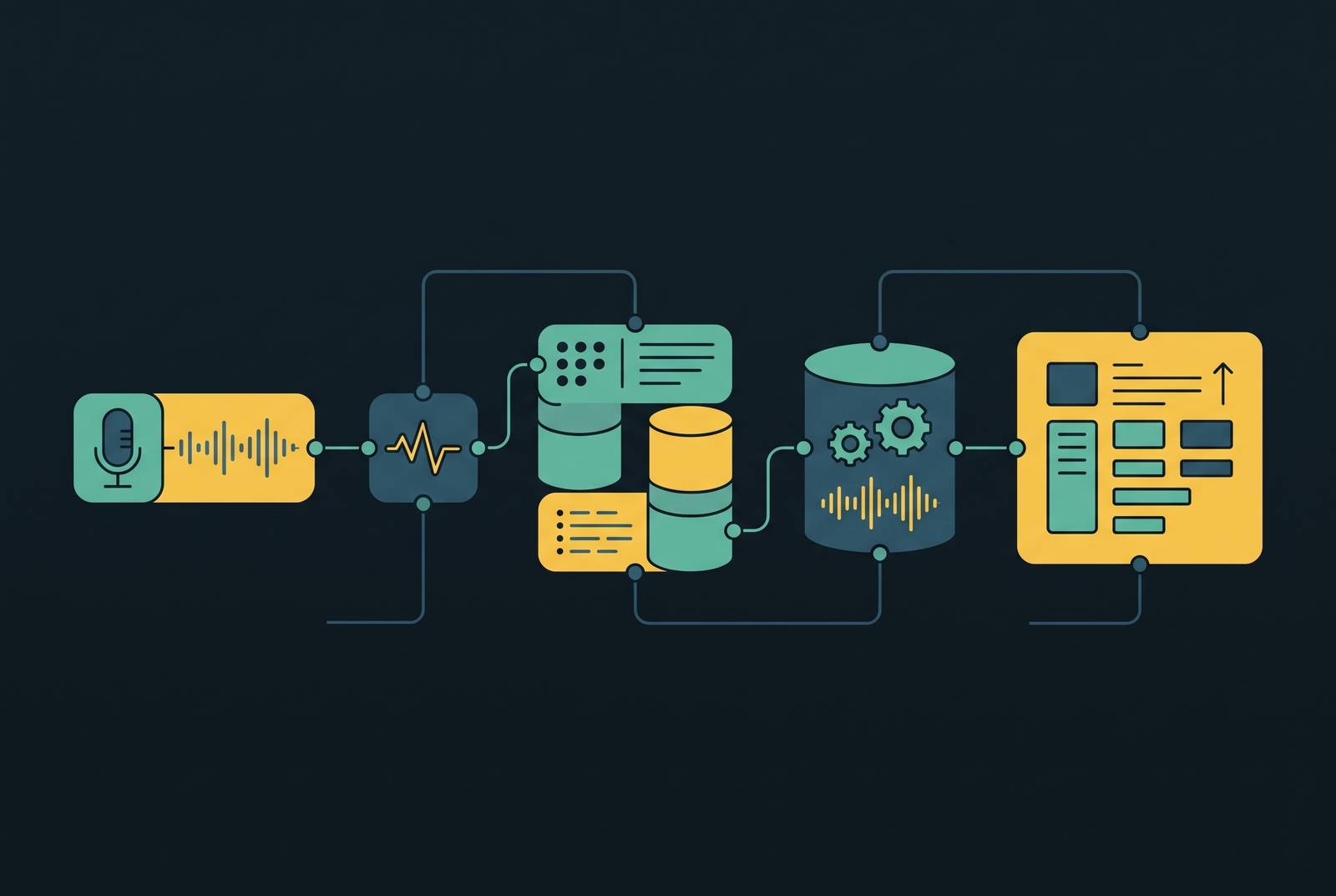
Meeting data pipelines are having a moment, and most of the SaaS companies building on top of Zoom, Google Meet, and Teams are making architectural decisions today that will either scale cleanly or quietly rot from the inside. Whether an AI meeting assistant produces trustworthy output two years and ten million meetings from now depends on the layer where most teams cut corners: ingestion, transcription, diarization, storage, or governance.
The case for deliberate architecture in the meeting data pipeline market now
The AI meeting assistant market was valued at 3.5 billion dollars in 2025 and is projected to hit 21.5 billion by 2033, a 25.8% compound annual growth rate that puts it among the faster-growing corners of enterprise software. The top 10 players hold just 25.3% of total revenue between them, in a market that has not yet consolidated. There's no dominant winner yet buying its way to safety on brand recognition alone. Execution is the differentiator, not name recognition, and execution starts with the pipeline that produces the product.
The volume backdrop makes the stakes concrete. Over 85% of business applications will run as SaaS by 2026, and a mid-sized SaaS company already processes more than a terabyte of data daily across product analytics, billing, customer events, and integrations. Meeting data, being multi-modal and continuous, adds real weight to that load. And when the pipeline handling that weight breaks, Unity Technologies lost a substantial sum in revenue after bad data ingested from a large customer corrupted the training sets behind its advertising models. That's a company reporting a material loss to investors because a pipeline let bad input flow downstream unchecked, not a data quality footnote. That's a company reporting a material loss to investors because a pipeline let bad input flow downstream unchecked.
Bot-based capture versus native streaming for meeting data ingestion
Most meeting intelligence products today rely on what's called the bot-based model. A recorder bot joins the Zoom, Google Meet, or Teams call as if it were a participant, captures the audio, video, and transcript feed, and pushes that data out to the host application through webhooks and a media WebSocket. It works, and it's the reason nearly every AI notetaker on the market today can support all three major platforms without needing a formal partnership with each one.
That bot moves through six distinct stages: authenticate, join, wait, capture, process, and deliver. Each stage carries a failure mode that looks trivial in a demo and can eat weeks of engineering time in production. A bot that fails to authenticate against a rotated API token, or one that joins the meeting but sits in a waiting room because the host hasn't admitted it yet, produces the same visible symptom (no transcript) from completely different root causes. Debugging that distinction across thousands of concurrent meetings is where teams lose time they didn't budget for.
Given how much infrastructure this represents, a market of managed bot APIs has grown around solving it so individual SaaS teams don't have to build and maintain their own. Recall.ai is the largest of these, having raised a substantial Series B at a reported valuation several times that size in September 2025, with more than 2,000 companies building on its infrastructure. It advertises data delivery within 10 seconds of a meeting ending, regardless of the meeting's length, and prices around 80 cents per meeting hour. Competitors occupy different points on the price and feature spectrum: Skribby runs at 35 cents an hour as a lower-cost managed option, MeetStream focuses on per-speaker real-time audio and in-meeting agents at roughly 45 cents all-in, MeetingBaaS offers another managed path, and Nylas provides a single-request Notetaker API for teams that want the simplest possible integration surface. For teams that need to self-host rather than depend on a third party, Vexa and Attendee.dev offer open-source alternatives.
Native streaming is the newer path, and it skips the bot. Zoom opened its Realtime Media Streams (RTMS) to all developers on June 25, 2025, delivering live per-participant audio, video, transcripts, screen share, and participant events directly over WebSockets, with no bot ever joining the call as a visible participant. That's a meaningfully different trust model for end users, since the participant list does not announce that a recording is underway, and it removes an entire class of failure modes tied to bots getting stuck in waiting rooms or failing to authenticate. Native streaming becoming the default over bot-based capture will depend heavily on Google and Microsoft following Zoom's lead with equivalent offerings on their own platforms.
Where errors compound across the four processing stages
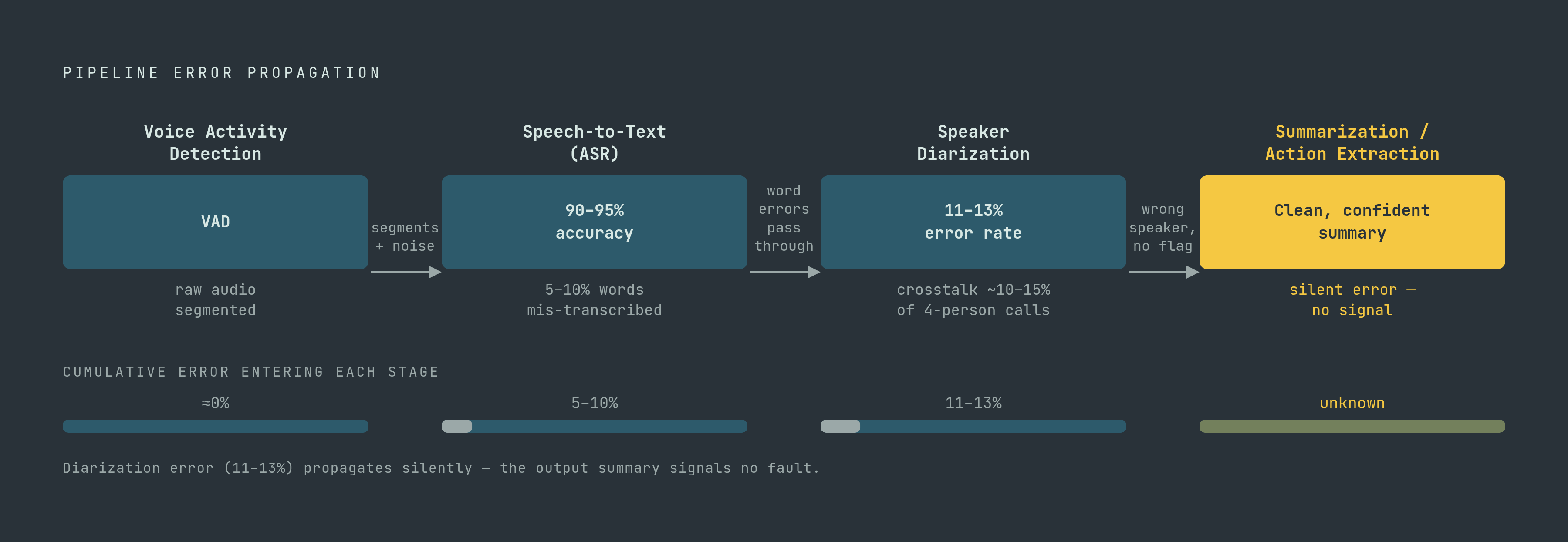
Once audio and video reach the pipeline, four processing stages turn raw recording into usable text: voice activity detection, speech-to-text transcription, speaker diarization, and summarization with action item extraction handled by a language model. Each stage feeds the next, so an error introduced early doesn't stay contained. It compounds.
Voice Activity Detection (VAD) comes first, and its job is unglamorous but foundational: separate speech from silence, background noise, and non-verbal sound so the compute-heavy transcription stage isn't wasted processing dead air. Modern VAD models use neural architectures trained across a wide range of audio conditions, from clean studio recordings to noisy conference-room pickup with background hum from building climate systems. There's no single accuracy figure that captures VAD's job the way there is for transcription, because its real function is reducing the noise floor before the next stage even starts. When VAD fails, it fails by passing noise through as if it were speech, and that noise then becomes the transcription engine's problem.
Speech-to-text, the ASR stage, has largely converged across the leading vendors: most tools now hit somewhere between 90 and 95% accuracy on clear audio with standard accents. As of 2026, the tool choice often comes down less to raw accuracy and more to deployment fit. Deepgram is recommended for real-time use cases needing live captions and streaming word display, self-hosted Whisper suits teams that require on-premise processing or want to avoid per-minute API pricing at volume, and AssemblyAI offers a low-friction integration path for teams that want a straightforward integration surface. That 90 to 95% figure sounds solid until you notice what it sets up: the remaining share of words transcribed incorrectly don't disappear, they get carried forward into diarization, where they can get attributed to the wrong person.
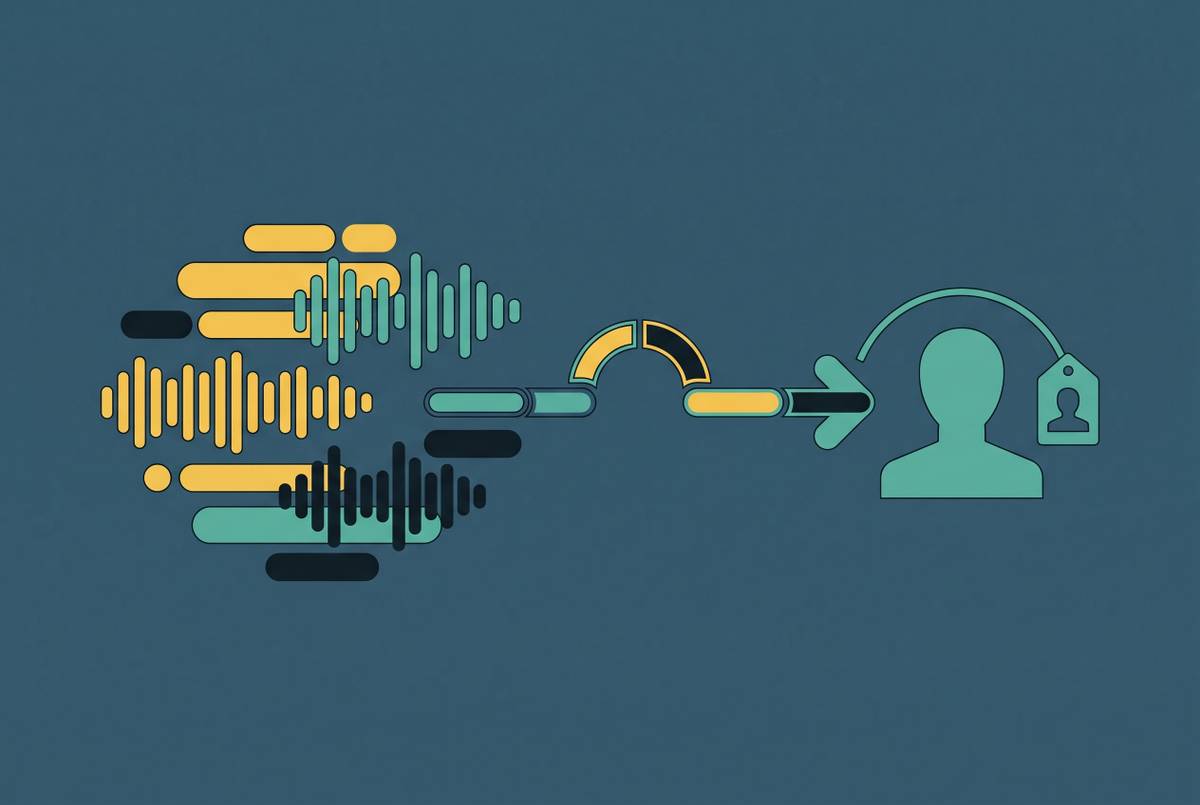
Speaker diarization is the highest-stakes decision in the entire processing chain, and it deserves to be treated that way rather than as a commodity step. The pipeline runs in two stages: a VAD model segments audio into speaker turns, and then a speaker embedding model generates a voice fingerprint for each segment, clustering similar fingerprints together as the same speaker. State-of-the-art error rates run between 11 and 13%, and the primary driver of that error is crosstalk. In a typical four-person meeting, overlapping speech happens roughly 10 to 15% of the time: people interrupt each other, finish one another's sentences, or drop in a quick "yeah, exactly" while someone else is still talking.
That error rate affects downstream processing, because it propagates through the pipeline. If diarization assigns one person's spoken commitment to a colleague sitting next to them, the downstream action-item extraction stage will confidently hand that task to the wrong name, and nothing in the output signals that a mistake happened. The error is silent, and it reaches the end user dressed up as a clean, confident summary. That silence is the real risk, not the 11 to 13% figure itself. Among the vendors building in this space, pyannoteAI maintains an open-source Community-1 model, available self-hosted or through its API, alongside a commercial Precision-2 model aimed at teams that need the highest accuracy available, offered via API or self-hosted on Enterprise plans.
There's also a structural trade-off between batch and streaming diarization that shapes which product experiences are even possible. Batch, or asynchronous, diarization waits for the full recording before processing, which makes it the most accurate option and the natural fit for post-call analytics and meeting summaries generated after the fact. Streaming diarization assigns speaker labels live, as the meeting happens; it can't look ahead, and its first few speaker turns are inherently the least stable output the system produces. Streaming only earns its complexity when speaker identity has to drive behavior in real time, such as a voice agent that needs to tell the customer talking from its own agent talking, mid-conversation.
Storage architecture choices for meeting data at scale
Meeting data doesn't fit neatly into one storage format, and that's the core design problem at this layer. A single meeting produces structured metadata (participant list, duration, timestamps), semi-structured JSON (speaker-turn segments with timing and confidence scores), and unstructured blobs (the audio and video files themselves). No single storage primitive, whether that's a relational database, a document store, or a plain object store, handles all three well on its own.
The common answer at growth-stage SaaS companies is a lakehouse architecture, built on something like Databricks or Snowflake with external stages, which combines the structured query performance of a data warehouse with the cheap, scalable raw storage of a data lake. Inside that lakehouse, most teams organize data using a medallion, or layered, structure. The bronze layer holds raw ingested data exactly as it arrived, untouched and fully reprocessable if a downstream model improves later. The silver layer holds cleaned, normalized data after the core processing stages have run. The gold layer holds business-ready aggregates that power dashboards and product features.
Separating storage from compute is one of the more consequential decisions in modern pipeline design. When storage and compute scale independently, a spike in query volume from a new analytics feature doesn't force a matching spike in storage spend, and a growing archive of historical meeting recordings doesn't force the company to pay for bigger compute clusters it isn't using most of the time.
Orchestration patterns that keep the pipeline reliable across meeting volume spikes and API changes
Orchestration is the control plane that schedules jobs, manages dependencies between processing steps, recovers from failures, and enables parallel processing when volume spikes. Without it, a single missed webhook can silently stop a pipeline dead, and nobody notices until a customer asks where their meeting summary went.
Meeting data doesn't arrive on a schedule the way a nightly billing job does. A meeting ends whenever it ends, at 11:47 PM or during a lunch hour, and the pipeline has to react to that moment rather than wait for a cron job to sweep through at 2 AM. That reality makes event-driven orchestration the natural architecture here, not merely a preference. Instead of pipeline stages pulling data on a fixed interval, downstream stages subscribe to events (meeting ended, transcript ready, diarization complete) and fire only once their specific input actually exists.
Two broader architectural patterns govern how teams structure this at scale. Lambda architecture runs two parallel paths: a real-time streaming path for low-latency features and a separate batch path for accuracy-sensitive and historical workloads. The cost is operational complexity, since two pipelines means two systems to monitor, debug, and keep in sync. Kappa architecture cuts that complexity by running everything through one streaming pipeline, reprocessing historical data through the same path. It's simpler to operate, but it demands that the streaming layer be sturdy enough to handle reprocessing at batch scale without falling over. In practice, many teams settle on a hybrid approach: real-time streams handle the operational, in-the-moment response, and batch processing handles historical analysis and heavier workloads.
Governance and observability as the layer that determines whether the pipeline is trustworthy at scale
Every layer above this one can fail in a way that still produces output that looks fine on the surface. Diarization errors, schema drift between one API version and the next, dropped records during a volume spike, action items attributed to the wrong person: none of these announce themselves. Without active monitoring, they travel straight through to the AI features and analytics dashboards that customers actually see, and they get treated as fact.
Governance is the layer built to catch that before it reaches a user. Core components include data lineage tracking, so a team can trace a given gold-layer summary all the way back to the raw bronze-layer transcript it came from, and, more broadly, ongoing monitoring for the kinds of drift and dropped-record failures described above. None of that is optional at scale. A pipeline that fails loudly gets an engineer paged and fixes it, while one that fails quietly hands a customer a confidently wrong meeting summary with no way of knowing it's wrong. The second failure mode is the one that costs a company its customers' trust, and trust, once spent in an AI product, is expensive to earn back.