Whisper vs Deepgram for Real-Time Meeting Transcription
Deepgram streams live; Whisper needs custom plumbing to keep pace.
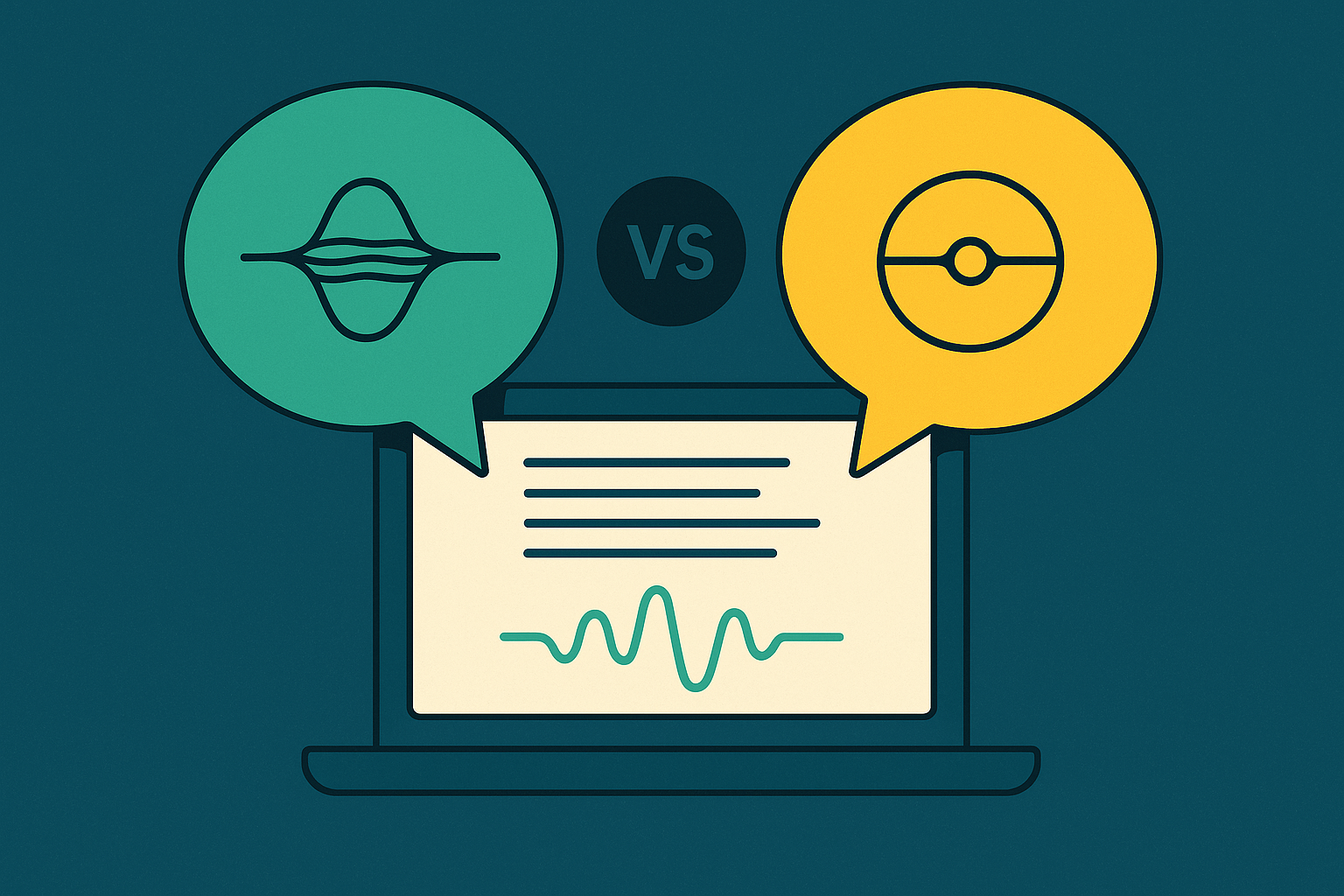
Whisper and Deepgram both do speech-to-text, but they were built to win different races. Whisper was engineered to squeeze maximum accuracy out of audio that already exists; Deepgram was engineered to keep pace with audio as it happens. Meeting transcription forces both jobs into the same room at once: long recordings, several people talking over each other, and a growing expectation that captions show up on screen before the sentence even finishes. Which one actually holds up depends less on marketing claims and more on how each system is built underneath, so that's where this starts.
How Whisper's encoder-decoder design creates a streaming problem
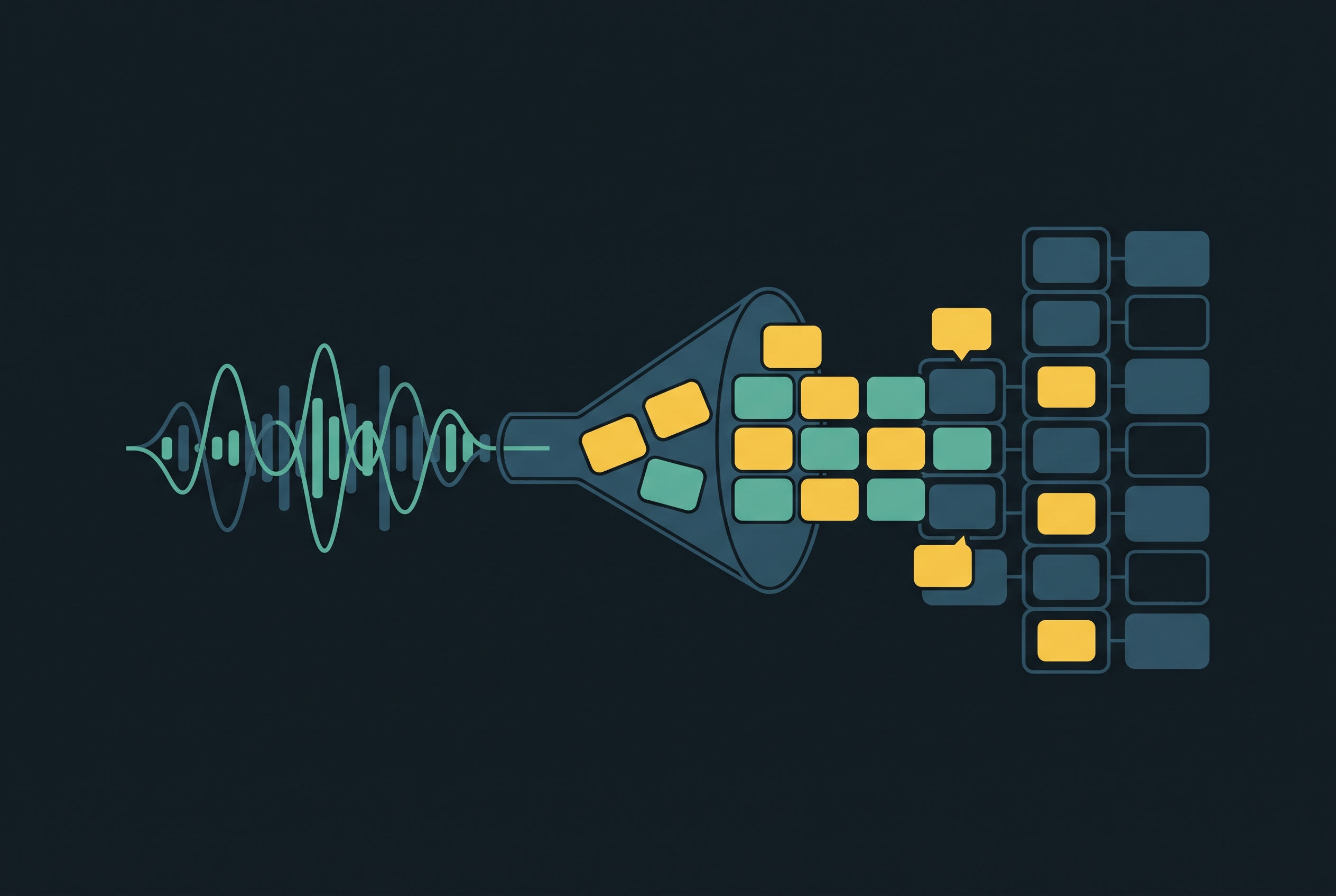
Whisper works in two stages. An encoder takes in a fixed window of audio, and a decoder then generates the transcript one token at a time, in sequence. That second step is the catch: the decoder can't start producing words until it has processed the chunk of audio in front of it, which means there's no way to emit partial output while sound is still coming in. Whisper wasn't built to listen and talk at the same time; it listens, then it talks.
That has a direct consequence for anyone trying to use it live. There's no native WebSocket connection, no built-in way to stream audio in and get words out as they're spoken. Teams that want Whisper in a live meeting have to build their own plumbing: buffer incoming audio, cut it into segments, run each segment through the model, then stitch the output back together in order. It works, but it's homemade, and homemade pipelines break in predictable places.
The classic failure shows up at chunk boundaries. Say a segment cutoff lands in the middle of the word "understanding." The model might drop the tail end, double it up in the next chunk, or just mangle it entirely. It's a small thing, but multiply it across a 90-minute meeting cut into 5-to-30-second segments, and the transcript ends up with noticeable, recurring errors at each seam. Feeding Whisper in those short segments narrows the delay, but it never gets close to true real time, and now there's separate synchronization logic to maintain on top of the transcription itself.
Model size adds another wrinkle. Whisper ships in sizes from tiny (tens of millions of parameters) up to large (over a billion parameters), and the bigger models buy accuracy at the cost of time-per-chunk. Whisper Large V3 Turbo, released in October 2024, cut the decoder from 32 layers down to 4 specifically to claw back some speed. That's a meaningful improvement, but it's still a batch-shaped model with a faster decoder; the underlying architecture hasn't changed.
OpenAI's own answer to all this was to build something else entirely. The Realtime API runs on a separate streaming model and is priced for live transcription at roughly $0.017 per minute. It's a workable solution, but it underscores the point: Whisper itself isn't a streaming tool, and getting streaming-grade performance out of the Whisper family means either building the chunking pipeline by hand or paying for a different product that was designed for the job from the start.
How Deepgram's streaming-native architecture handles the same conditions
Deepgram took the opposite starting point. Nova-3, its current flagship model, runs on its own end-to-end neural network rather than the transformer decoder stack Whisper uses, and it was built to treat audio as a continuous stream rather than a finished file waiting to be read.
The practical result: a WebSocket connection that returns transcription with end-to-end latency around 200 to 300 milliseconds under normal conditions. That's fast enough to be functionally invisible in a live meeting; by the time a viewer notices captions lagging, the gap has usually closed. Because the model emits partial transcripts continuously as audio arrives, there's no chunking, no boundary stitching, no client-side reassembly logic to write and debug.
That speed isn't free, though. Nova-3's streaming word error rate sits at 6.84%, compared to 5.26% in batch mode. That gap is the direct cost of giving up bidirectional context: a streaming model can't look ahead at the rest of the sentence to disambiguate a tricky word, because the rest of the sentence hasn't been spoken yet. Deepgram treats that gap as a design tradeoff rather than a flaw, and it's a reasonable one. A live caption that's 98.9% right today beats one that's 99.5% right five seconds from now, at least for anyone trying to follow a meeting in the moment.
Scale is where the architecture pays off further. Concurrent streaming requests scale with plan tier, which matters a lot for any organization running several meeting rooms simultaneously. There's a catch worth flagging early, though: Deepgram's v2 diarizer doesn't work in streaming mode at all. That's a real gap, and it deserves its own section, because it turns out neither system solves this cleanly.
What happens to diarization and speaker separation when meetings get crowded
Ask anyone who's used automated meeting transcripts what they actually want fixed, and diarization, figuring out who said what, comes up constantly. It's also the area where both systems show real seams.
Whisper doesn't do diarization at all out of the box. Teams have to bolt on a separate library, typically pyannote-audio, which means running multiple models in sequence: Whisper Large v3 for transcription, wav2vec2 for alignment, and pyannote's speaker-diarization-3.1 for speaker labeling. That three-stage pipeline needs roughly 5 to 6GB of VRAM combined. Each added component is also an added failure point, so what starts as a single feature addition turns into an ongoing commitment to maintain three interacting models instead of one.
Deepgram handles it differently. Its diarizer can detect speakers without needing to know in advance how many people are on the call, which is genuinely useful when meeting size is unpredictable and attendance shifts at the last minute. But the same limitation from the last section resurfaces here: the v2 diarizer isn't available in streaming mode, and trying to invoke it returns a validation error. So a live meeting with real-time diarization isn't something either platform supports cleanly today.
Here's the honest way to frame it: neither system offers low-latency, multi-speaker diarization for live meetings without extra engineering. The difference is where the workaround lives. With Whisper, it's an infrastructure problem: more models, more VRAM, more moving parts. With Deepgram, it's a feature-availability problem: the tool you want simply isn't turned on for streaming yet. For post-meeting transcripts, where latency doesn't matter and diarization quality does, the Whisper-plus-pyannote combination can produce genuinely good speaker-labeled output. It just takes setup time and adequate GPU resources.
And overlapping speech punishes both systems regardless of pipeline. Research on multi-speaker production audio documents word error rates climbing 2.8 to 5.7 times worse than clean benchmark conditions, with WER in crosstalk-heavy settings sometimes topping 50%. That's not a limitation specific to either architecture; it reflects how difficult overlapping human speech is to parse, and no architecture has fully solved it.
Accuracy benchmarks and what they actually measure in a meeting context
Start with the degradation number, because it reframes everything else in this section. Clean, controlled dictation studies put word error rates around 8.7% for modern ASR systems. Multi-speaker clinical conversations, a reasonable stand-in for a real meeting with crosstalk and mumbling, push that same class of model past 50% WER. That's not a small dip; it's a 2.8-to-5.7-times degradation, and it means most of the clean-benchmark comparisons floating around the internet tell readers almost nothing about how a system behaves once people start talking over each other.
With that caveat sitting up front, here's what the published numbers actually say. Deepgram reports Nova-3 batch accuracy at 5.26% WER, or 94.74% accuracy, under controlled conditions. An independent benchmark run in January 2025 put Whisper first for both formatted and unformatted transcription, with Deepgram and Google's Gemini trailing within about 2 percentage points of WER. So on clean audio, it's close, and Whisper edges ahead.
Then a peer-reviewed study on psychiatric interviews, arguably a closer match to messy, conversational meeting audio than any lab benchmark, recorded Whisper at a median 14.8% WER (interquartile range 11.1 to 19.7%). That's worse than Amazon Transcribe's 8.9% in the same study, though still better than Zoom or Otter at 19.2%. The lesson isn't that Whisper is bad; it's that Whisper's lab advantage compresses, and can even flip, once the audio gets conversational and multi-voiced. That's exactly the terrain most business meetings live in.
Deepgram's answer to vocabulary gaps is Keyterm Prompting, which lets a team feed in domain-specific words, product names, acronyms, internal jargon, capped at 100 terms, with 20 to 50 recommended for reliability. Push past that and false positives start creeping in, so it's a tool to use with restraint rather than as a catch-all fix.
Worth noting for completeness: OpenAI's newer transcription models, including gpt-4o-mini-transcribe, are a relevant option for teams where raw accuracy is the only variable that matters and latency is someone else's problem.
The real takeaway here: a clean-audio WER number is a floor, not a ceiling. The actual question for meeting transcription is which system degrades more gracefully once noise, accents, and overlapping speech enter the picture, and that's a much harder thing to put a single number on.
Multilingual meetings and how language support differs between the two systems
Whisper was trained on a large multilingual audio dataset pulled from the open web, and it supports more than 99 languages. That's a real advantage for any organization where meeting participants might switch between English, Mandarin, and Portuguese depending on who's in the room that week.
Deepgram's Nova-3, at its February 2025 launch, supported streaming code-switching, meaning it can follow a speaker who shifts languages mid-sentence, across 10 languages: English, Spanish, French, German, Hindi, Russian, Portuguese, Japanese, Italian, and Dutch. Code-switching support matters more than the raw language count suggests, because it's a genuinely common meeting-room behavior in multilingual teams, where a speaker starts a sentence in one language and finishes it in another. Ten languages is a smaller net than Whisper's, but it's a deliberately built net rather than an incidental one.
Outside of streaming, Deepgram's broader API covers more than 45 languages, so the constraint really only bites in live use. For organizations whose meetings regularly happen in languages outside that streaming list of 10, Whisper is the more workable path without extra engineering effort.
One more distinction worth flagging: Deepgram offers Nova-3 Medical, trained specifically on clinical audio and built to be HIPAA-compliant, which matters for healthcare organizations transcribing patient-facing meetings. Whisper has no equivalent specialized variant out of the box; whatever domain tuning a team needs, it has to build itself.
What self-hosting Whisper actually costs versus paying for Deepgram's API
Whisper's MIT license means no licensing fee at all. Deepgram charges by the minute of audio processed. That sounds like an easy win for Whisper, but the comparison gets more interesting once the full cost picture comes into view.
Deepgram's Nova-3 pricing runs $0.0043 per minute in batch mode, or $0.26 per hour, and $0.0077 per minute streaming, $0.46 per hour, a 79% premium over batch that reflects the real infrastructure cost of holding a live connection open. For reference, OpenAI's own API options land at $0.006 per minute for whisper-1 in batch mode, roughly $0.003 per minute for gpt-4o-mini-transcribe (currently the cheapest managed option in that family), and about $0.017 per minute for streaming through gpt-realtime.
Self-hosting Whisper on rented GPU infrastructure can get down to roughly $0.0003 per minute, which sounds like a 14-times discount against Deepgram. That number is technically true, but it leaves out the ongoing costs behind it. Cloud GPU rental runs $150 to $400 a month whether anyone transcribes a single minute of audio or ten thousand hours of it. Standing up the pipeline takes 4 to 16 hours of engineering time up front, and keeping it running adds another 2 to 4 hours a month indefinitely. At the high end of scale, a single H100 PCIe GPU can handle more than 150 concurrent Large v3 streams at $2.01 an hour, which works out to about $0.013 per hour per concurrent session, genuinely cheap, but renting and managing H100s is its own specialized job.
The break-even point lands somewhere around hundreds of thousands of minutes of audio a month. Above that volume, self-hosted Whisper infrastructure can plausibly undercut managed API pricing. Below it, the fixed GPU cost plus the engineering hours needed to keep the pipeline healthy usually make a managed API the cheaper option once total cost of ownership is counted rather than just the per-minute rate. For meeting transcription specifically, that total cost includes not just GPU rental but the chunking and boundary-stitching work Whisper needs for anything approaching real time, work that tends to favor Deepgram for any team without a dedicated ML engineering group on staff.
Which system fits which meeting transcription scenario
Deepgram Nova-3 is the stronger fit when latency is the deciding constraint. Live captioning, real-time meeting overlays, voice-bot or agent-assist tools that need to act on what's being said while it's still being said, all of these depend on the 200-to-300-millisecond response window Deepgram's architecture delivers. It's also the simpler choice for teams that want transcription as an API call with nothing to host, for healthcare organizations that need Nova-3 Medical's HIPAA-compliant handling of clinical audio, and for any organization running many meeting rooms at once that needs concurrency to scale predictably rather than fall over at the worst possible moment.
Whisper, whether self-hosted or accessed through OpenAI's API, fits better when the recording is already finished and latency isn't part of the equation. That covers post-meeting transcription where clean-audio accuracy matters most, multinational teams whose meetings happen in languages outside Deepgram's ten streaming-supported options, organizations with the ML engineering capacity and the volume, north of 100,000 minutes a month, to make self-hosting economics work, and any team that needs transcription to run entirely on its own servers for data-sovereignty or compliance reasons.
GPT-4o-transcribe deserves a mention on its own merits too: when peak accuracy on a recorded meeting is the single priority and the per-minute API cost is acceptable, it currently outperforms both Whisper and Deepgram on published benchmarks.
A hybrid pattern is worth considering for teams that don't want to pick just one. Run Deepgram streaming during the live meeting for real-time captions, then run the full recording back through Whisper or gpt-4o-transcribe afterward for the archival transcript. It separates the latency job from the accuracy job instead of asking one system to be excellent at both.
One thing neither system solves cleanly yet: live, multi-speaker diarization with low latency. Any team that genuinely needs accurate real-time speaker attribution should treat that as its own custom engineering problem, independent of which ASR engine sits underneath. And for teams building meeting-to-content pipelines, turning recorded calls and interviews into articles, show notes, or internal knowledge bases, the post-meeting accuracy of Whisper or gpt-4o-transcribe usually matters more than shaving a few hundred milliseconds off a live caption. The transcript there isn't the end product; it's raw material feeding into something bigger, and it's worth choosing the tool that gets that raw material right.
Sources
- https://deepgram.com/learn/whisper-vs-deepgram
Provided comparative details on Deepgram's streaming architecture and accuracy figures versus Whisper.
- https://deepgram.com/learn/best-speech-to-text-apis-2026
Supplied benchmark accuracy figures for Nova-3 and other speech-to-text APIs referenced in the accuracy section.
- https://developers.deepgram.com/docs/diarization
Confirmed that invoking Deepgram's v2 diarizer in streaming mode returns a validation error.