Why speaker attribution breaks in meeting transcripts, and what separate audio streams fix
Separate audio streams solve a structural problem that algorithmic sophistication alone cannot fix.
Speaker attribution in meeting transcripts fails more often than most people realize, and the root cause is almost always the same: a single mixed audio stream being asked to do a job it was never designed for. Once you understand why, the solution becomes obvious.
The Problem Starts Before Anyone Opens Their Mouth
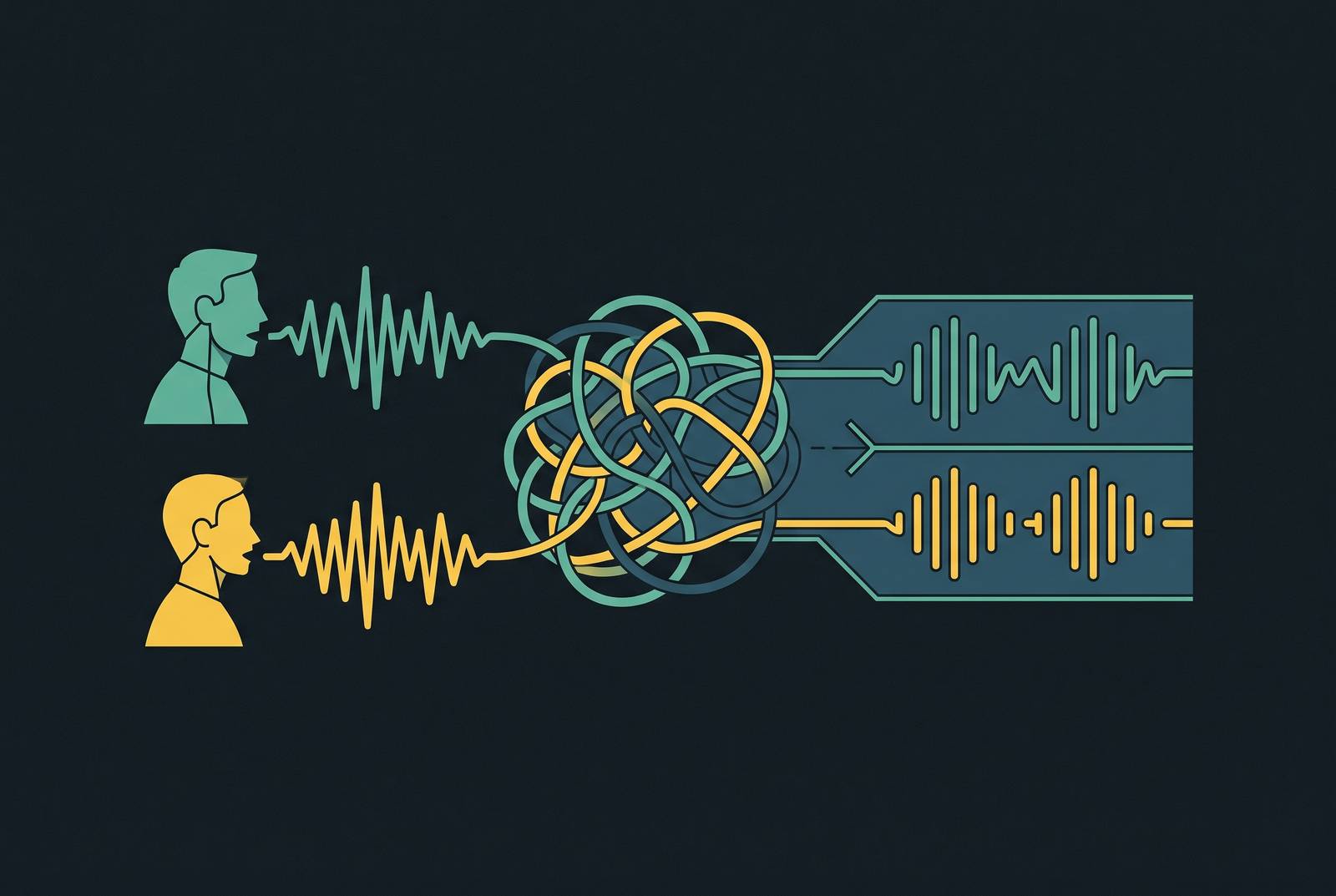
When you join a video call, the platform captures one composite audio feed. Every voice, every background noise, every acoustic overlap gets flattened into a single channel. The transcription engine then receives this blended signal and has to do two distinct things at once: figure out what was said, and figure out who said it.
That second task is called diarization. It works by analyzing acoustic signatures, the subtle patterns in pitch, cadence, and timbre that differentiate one voice from another. Under controlled conditions, with clean audio and deliberate pauses between speakers, modern diarization is impressively accurate. Vendor benchmarks often cite accuracy in the low 90s. But a real business meeting is not a controlled condition. Not even close.
What's Actually Happening in the Audio
People talk over each other. Someone laughs while another person is mid-sentence. A remote participant's audio compresses differently than an in-room participant's. Background noise from a home office bleeds into the stream at unpredictable intervals. The signal the diarization model receives is genuinely ambiguous, and ambiguous input produces unreliable output.
The model is making probabilistic inferences about identity from acoustic fragments. When two voices overlap, even briefly, it has to guess. And that guess propagates forward through the transcript, because diarization models use contextual continuity to smooth their predictions. One misattributed interjection quietly corrupts a chain of subsequent attributions. You don't notice it happening in real time. That's precisely what makes it insidious: by the time someone catches a misattribution, the context needed to correct it is already gone.
This isn't a failure of sophistication. The models are genuinely sophisticated. It's a structural limitation imposed by the input format itself, and no amount of algorithmic refinement fully overcomes it.
Why Separate Streams Change Everything
Per-participant audio capture, where each microphone signal is stored independently before any mixing occurs, eliminates the ambiguity at the source. When a transcription engine receives a dedicated feed per speaker, attribution becomes nearly trivial. You are no longer asking the model to infer who spoke. You are telling it, by design.
The acoustic separation that diarization tries to reconstruct computationally is simply built into the data architecture. There is no overlap problem, because overlapping voices live on parallel tracks rather than a single blended channel. There is no propagation error, because each speaker's identity is fixed to their own stream from the start.
This is why systems built on per-participant audio capture produce transcripts that are categorically more accurate, not incrementally so. The problem is being solved at a different layer entirely. Mixed-stream diarization is like being handed a smoothie and asked to identify every ingredient — per-participant capture just keeps the ingredients separate to begin with. I've pulled enough mixed-stream transcripts from sensitive business conversations, staring at a collapsed attribution chain trying to reconstruct who actually committed to what, to know that this distinction stops feeling architectural very fast.
What This Tells You When Evaluating Tools
If you're evaluating meeting transcription tools for any serious business use case, the single most diagnostic question you can ask is: how does this system handle speaker identity? The answer tells you almost everything about the quality of what you'll actually receive.
Tools that rely entirely on post-hoc diarization of a mixed stream are working against a structural disadvantage. They can be excellent within that constraint, but the constraint is real and it has a ceiling. Tools that integrate directly with call infrastructure, or that capture separate streams through platform APIs or purpose-built hardware, start with a fundamentally better input.
Several platforms have moved seriously in this direction. Fireflies.ai and Otter.ai have both made speaker identification a central feature, pairing voice profile enrollment with diarization to improve accuracy on mixed streams. Grain and Fathom focus heavily on meeting capture workflows and have invested in tighter API integration with video conferencing platforms to get closer to the source signal. Among dedicated transcription engines, AssemblyAI and Deepgram both offer diarization with configurable speaker count parameters, giving developers meaningful control over how attribution is handled programmatically.
Notta takes a similar architectural approach, leveraging participant metadata from major conferencing platforms to reinforce speaker attribution alongside acoustic diarization. Anchoring probabilistic inference to known participant identities, rather than leaving the model to guess purely from sound, narrows the problem significantly — a bit like the difference between picking someone out of a crowd by their voice alone versus already knowing their seat assignment. It's a real advantage, and it's one that any serious evaluation should surface explicitly.
None of these tools are identical, and the right choice depends on your workflow, your call volume, and how much attribution accuracy matters downstream. For a team using transcripts as loose reference notes, a small error rate is tolerable. For legal, compliance, medical, or high-stakes business contexts where the record of who said what carries real consequences, the architectural difference matters enormously.
The Number No One Talks About
Transcription accuracy gets most of the attention in product comparisons, and word-error rate is a legitimate metric worth scrutinizing. But for most professional use cases, speaker attribution accuracy is the more consequential number, and it's almost never surfaced with the same rigor in vendor materials. The industry has spent years optimizing for getting the words right while being comparatively incurious about whose words they were.
The gap between a good mixed-stream diarization system and one built on separate audio capture is not a feature gap. It is a design philosophy gap. One is trying to recover information that was discarded at the point of capture. The other never discards it in the first place. That distinction is worth understanding before you commit to any platform, because meeting infrastructure, once embedded in organizational workflows, is genuinely difficult to replace.