Multi-Language Speaker Identification in International Meeting Environments
Systems trained on clean audio fail when speakers switch languages mid-sentence.
A meeting with people spread across several distant cities breaks nearly every assumption baked into speaker identification systems. Cameras go off, accents shift mid-sentence, three people talk over each other on a compressed video codec, and the model has to make sense of it anyway. Knowledge workers sit through roughly 18 hours of meetings a week, and when identification fails, the record fails with it: decisions and action items go unlogged until someone asks who actually agreed to what. This piece traces three specific failure points, language-shift degradation, missing-modality collapse, and overlapping speech, and looks at how current systems hold up against each one. Most of them don't hold up nearly as well as their benchmark numbers suggest.
What the signal pipeline does before any AI model sees a speaker
Audio has to clear a gate called voice activity detection, or VAD, before any model makes a call about who's talking. VAD's job is narrow: split speech from silence, background hum, keyboard noise, the cough someone forgot to mute. Everything downstream depends on that gate working, because a diarization system fed a false positive will treat a slammed door as someone's speaking turn.
Segmentation comes next, and international meetings start to hurt right here. Segmentation has to track speaker turns, catch interruptions, and flag the moments when two people talk at once. That job gets much harder once speech stops following one language's rhythm and pause structure.
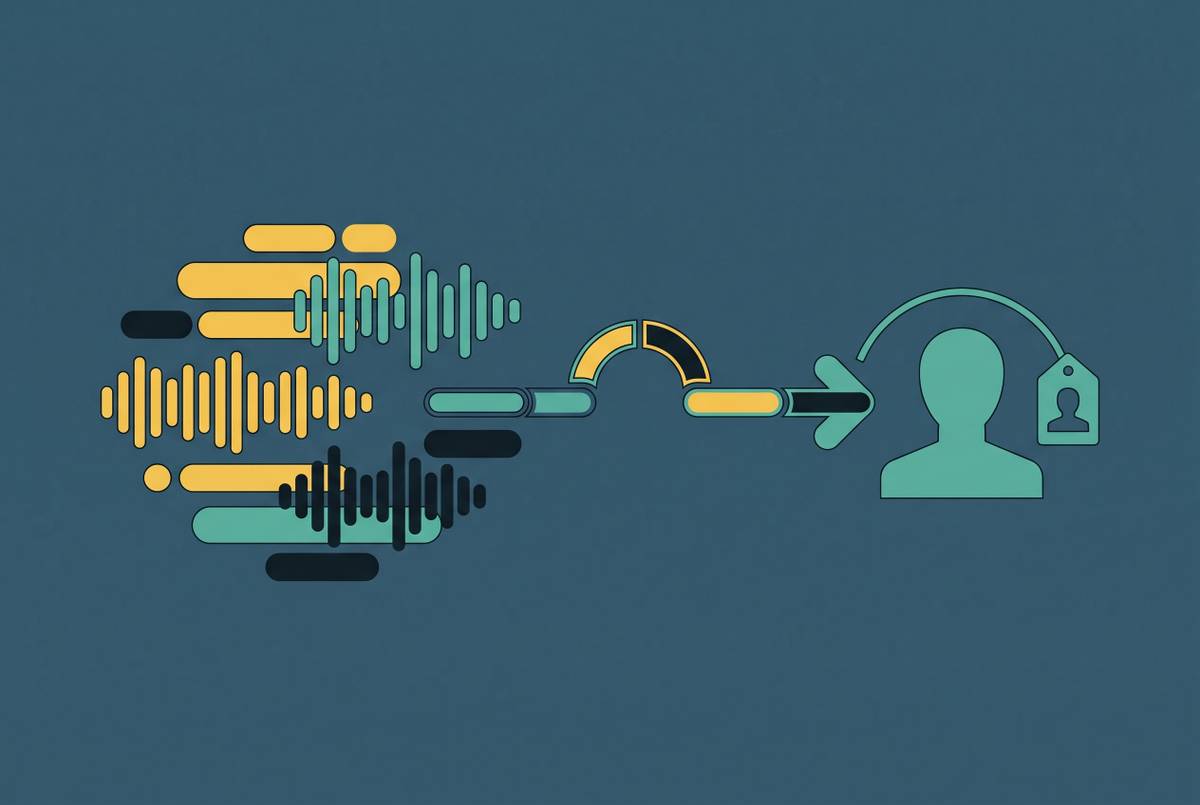
Each speech segment then becomes a speaker embedding, a high-dimensional vector meant to capture pitch, formant frequencies, and speaking style regardless of the words themselves. These embeddings are supposed to be language-independent, tracking the person rather than the language. They aren't nearly that clean in practice, and the next section explains why that promise breaks down.
Diarization answers who spoke when. Transcription answers what was said. They run on different signals, fail in different ways, and a system can nail one while badly missing the other. Anyone building on top of these systems needs to know which one just failed, because the fix for a diarization error and the fix for a transcription error don't look anything alike.
Language-shift degradation: what happens when the test language differs from the training language
Speaker embeddings trained on one language don't carry over cleanly to another. The acoustic and phonetic patterns that mark someone's voice in English aren't the same patterns that mark that same person's voice in German or Urdu. A voice fingerprint isn't fixed: it shifts depending on what language is being spoken and how.
The clearest active proving ground for this problem is the POLY-SIM Grand Challenge 2026, built specifically to stress-test multimodal speaker identification under cross-lingual and missing-modality conditions. Its dataset draws from a benchmark corpus of 70 bilingual speakers across one language pair, pulled from a broader corpus of 154 identities with multilingual annotations.
The challenge runs four evaluation protocols, and the order they're arranged in tells its own story. P3 and P5 are the complete-modality settings, where both face and voice are available. P4 and P6 are the missing-face settings, where the system must work from audio alone. Every system's weak points appear together in the missing-face conditions.
Missing-modality robustness: engineering a system that holds when the camera goes dark
Cameras go dark constantly in real meetings. Sometimes it's company policy, sometimes someone's on a train with bad lighting, sometimes bandwidth throttling just kills the video feed. A system trained on face-plus-voice pairs has to do something sensible the moment the face half of that pair stops showing up.
Zero-padding the missing input is the obvious fix, and it's the wrong one. The model learned to fuse two real signals, not one real signal plus a wall of zeros pretending to be a face, and that mismatch costs accuracy exactly when the system most needs to hold steady.
MRAF, short for Missing-Token Prompted Reliability-Aware Fusion, out of Hefei University of Technology, takes a more deliberate approach built from three pieces. A learnable missing token stands in for the absent face input, a trained representation of "no face here" rather than a placeholder of zeros. A reliability-aware cross-attention module scores how trustworthy the face and audio signals are, sample by sample, and turns those scores into weights so the system leans on whichever signal is actually informative in that moment. Audio-only knowledge distillation during training closes the gap between how the model trains (full modality) and how it often has to run (audio only).
On POLY-SIM 2026, that design gets MRAF to 1.00000 accuracy on P3 and P5, the complete-modality settings, and 0.98948 on P4 with 0.99320 on P6, the missing-face settings. Averaged across all four protocols, MRAF is 0.99568, good for second place overall. The gap between complete and degraded conditions stays narrow, which is the entire point: zero-padding never closes that gap, a trained missing-token representation does.
Overlapping speech and turn-taking: the hardest real-time challenge
Overlapping speech is where cascaded diarization-then-transcription pipelines break down in the most visible way. If diarization draws the wrong boundary around who's speaking, transcription inherits that mistake with no way to fix it further down the chain. There's no feedback loop. The error just propagates.
Code-switching, one speaker mixing languages inside a single sentence, is the meanest version of this problem. Diarization tends to survive it fine, since embeddings track a voice rather than a language. Transcription doesn't get off so easy, because the system has to swap acoustic-phonetic decoding models mid-utterance, sometimes mid-word, a much harder ask than diarization's job of recognizing "same voice, different language."
Turn-taking prediction hands practitioners an odd result. Research has found that large language models can outperform supervised models and human subjects at next-speaker prediction from conversational context alone. When MM-LLMs receive raw audio-visual signal, however, performance on addressee detection and turn-change prediction has been found to fall below human levels. The model reasons better from text alone than from the actual sensory signal humans read without effort.
Both humans and LLMs struggled hardest during stretches with frequent turn changes, and that convergence matters. It means the difficulty here is a genuinely hard perceptual problem inherent to the task itself, waiting for no one to engineer it away through model architecture.
How diarization-conditioned spoken language models handle far-field multi-speaker audio
Spoken language models that process raw audio end to end are simpler to build architecturally, but they tend to struggle exactly where international meetings live: far-field audio with multiple talkers in a room, picked up by a single mic array instead of close headsets. Room acoustics and speaker overlap compound in that setting in ways single-speaker benchmarks never test for.
Dixtral, from Brno University of Technology and Carnegie Mellon, takes a different route than fine-tuning the whole model on multi-speaker data, which risks wiping out everything the model already knew (catastrophic forgetting, in the term of art). Instead it conditions the acoustic encoder on diarization masks to pull out target-speaker representations, while keeping the decoder frozen. The diarization signal tells the encoder who to listen for. The decoder, untouched, keeps doing what it already does well.
On speaker-attributed transcription, Dixtral beats Gemini 3.0 Flash by 29.0 absolute points of cpWER on AMI, and by meaningful margins on additional multi-speaker benchmarks. It also beats VibeVoice and Voxtral Mini Transcribe V2 across those same benchmarks. On a separate long-form multi-speaker QA benchmark, zero-shot Dixtral matches Gemini's far-field content understanding, and the fine-tuned version beats both Gemini and Voxtral even when those two are handed the easier job of close-talk, single-speaker audio.
What production accuracy looks like across leading commercial systems
Lab benchmarks and production numbers are not the same thing, and the gap between them is not small. A clean-room WER figure degrades several times over once a system hits real production conditions, which makes a vendor's headline accuracy a shaky basis for picking an API.
A study tested five systems across 196.6 hours of multilingual audio spanning English, Mandarin, German, Japanese, and Spanish. pyannote.ai came out on top at 11.2% diarization error rate (DER), with the next-best system at 13.3%. A two-point gap sounds small until you remember errors compound across an hour-long meeting, one wrong speaker boundary early on throws off every turn attribution after it.
On the Pipecat open speech-to-text benchmark, which tests real voice-agent conversations instead of curated audio, Speechmatics Universal-3.5 Pro Realtime posted 6.99% WER against Deepgram Flux's 15.58%. ElevenLabs Scribe v2, meanwhile, posts 35.26 cpWER on direct runs, ahead of Deepgram and Gladia on that specific metric. These numbers don't agree with each other because they measure different things under different conditions, and that disagreement is itself the lesson: a vendor's accuracy claim only means something once you know what test produced it.
Where the major commercial meeting platforms fall short of research-grade capability
Zoom asks users to set a meeting's primary language before transcription starts, and its own documentation admits that in meetings where people switch languages often, both transcripts and AI summaries get less reliable, since the system is built to follow one dominant language. Zoom offers translated captions in 46 languages, with availability varying by plan tier.
Microsoft Teams ties translated captions and transcription to whether the meeting organizer holds Teams Premium or Microsoft 365 Copilot, and once the organizer has either license, every participant in that meeting gets the benefit. Interpreter access works on a different rule entirely: that one requires Microsoft 365 Copilot for each participant, not Teams Premium.
Google Meet, for eligible Workspace teams, also offers speech-to-speech translation capabilities. None of these platforms claim to solve cross-lingual diarization at the level POLY-SIM 2026 tests for. They're built to handle one dominant language with translation support layered on top, and that's a fundamentally easier problem than the one this piece has been describing.
What the remaining unsolved problems tell practitioners about where to set their expectations
Even MRAF, the strongest system discussed here, leaves a measurable gap in P6, the cross-lingual, missing-face condition. That remaining error is a combination of several failures at once. It's absent visual cues, pronunciation variation, room noise, and cross-lingual acoustic shift landing on the system all at once, and that combination is far harder to engineer away than any single factor would be on its own.
POLY-SIM 2026 tests a controlled two-language pair, English and Urdu, across 70 known speakers. Real international meetings routinely run four or more languages, speakers the system has never seen before, and acoustic conditions worse than anything in a benchmark dataset: a bad hotel wifi connection, a conference room with echo bouncing off bare walls.
Turn-taking research adds one more reason for caution. MM-LLMs, tested on just one language's data, already fall below human performance on addressee detection and turn-change prediction, even while beating humans at next-speaker prediction from text context alone. Nothing in that result suggests multiple languages make the problem easier. If anything, every piece of evidence here points the other way: cross-lingual conditions make hard problems harder, not simpler. Anyone evaluating these systems should plan around that fact rather than assume a benchmark result from one language will hold up in a room full of them.
Sources
- Missing-Token Prompted Reliability-Aware Fusion for Robust Polyglot Speaker Identification
- Evaluating Large Language Models Abilities for Addressee, Turn-change, and Next Speaker Prediction in Meetings
- Grounding Spoken LLMs in Multi-Speaker Audio via Diarization Conditioning
- Learning Speaker Identity Beyond Language and Modality Constraints: Insights from the POLY-SIM 2026 Challenge
- arxiv.org
- arxiv.org
- assemblyai.com