Real-Time Speaker Identification Latency Requirements and Trade-Offs
Speaker ID latency varies wildly depending on where the system lives and what it's attached to.
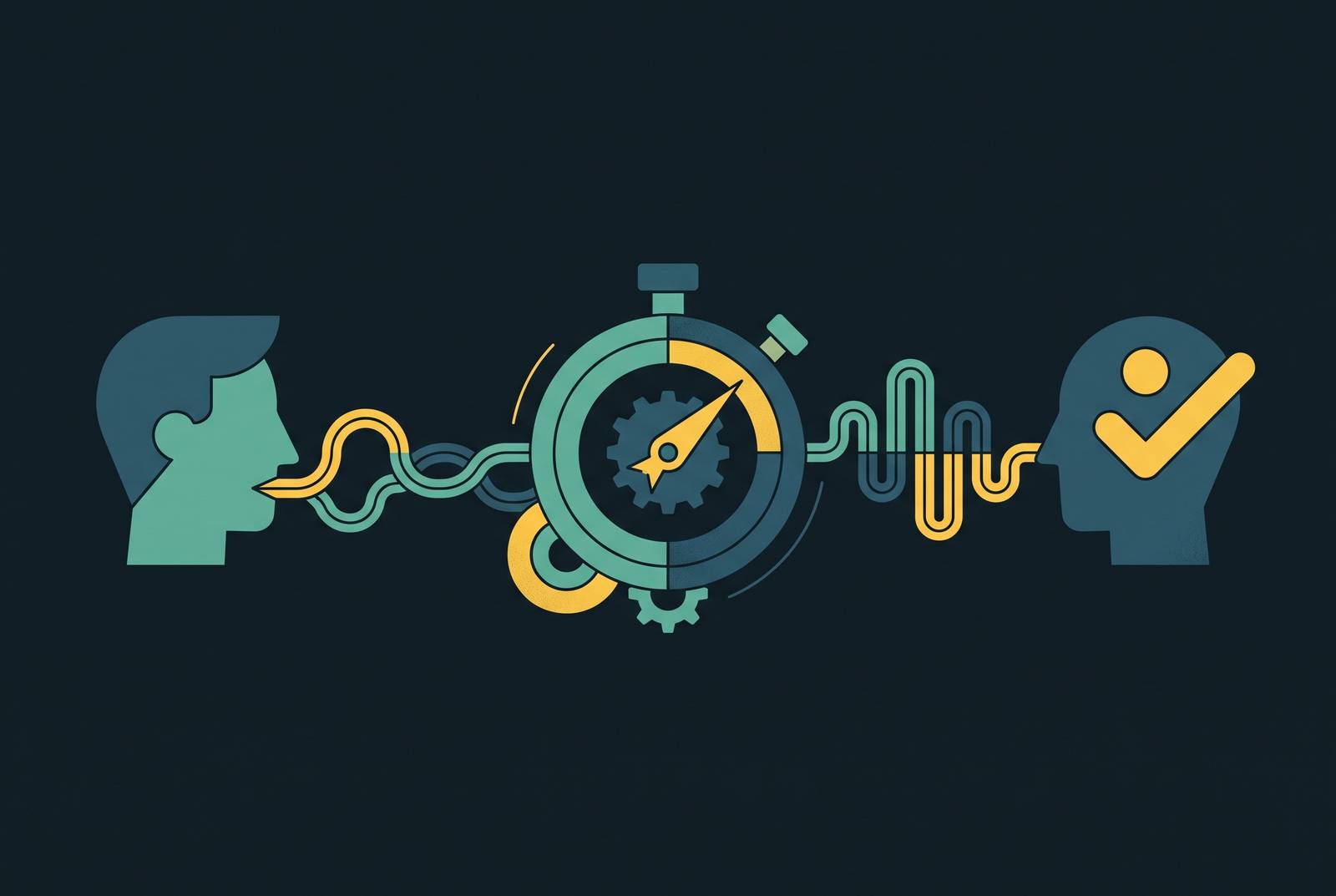
Real-time speaker identification has no single latency number to hit. What counts as "fast enough" swings by orders of magnitude depending on where the system sits, and getting the architecture right means fixing that number before touching a model.
The industry's working definition of real-time speech recognition is sub-second latency over a streaming WebSocket connection. That definition sounds precise until you notice how much room "sub-second" actually contains. Nine hundred milliseconds and ninety milliseconds both qualify, but one produces a system that works and the other produces one that doesn't, depending entirely on what it's attached to. A captioning feed running at that same delay feels perfectly natural. A hearing aid running at that same speed is unusable.
Three forces pull on any speaker identification pipeline at once: how fast it responds, how correct it is, and how much compute it burns doing both. Pushing on one force moves the other two, regardless of intent. Batch transcription sidesteps the tension almost entirely, since it has the full audio file in hand before it starts and no clock running against it. Streaming transcription gets no such luxury. It only has the past, never the future, so every latency decision it makes is a bet placed on incomplete information, one that has to pay off in under a second, and often in under a tenth of that.
How different deployment contexts set their own latency ceilings
Four categories of deployment carry four different tolerances, and none of them are interchangeable.
Hearing aids sit at the extreme end. Target speaker identification pipelines for hearing-aid applications must operate at latencies as low as 10 milliseconds, and any perceptible delay degrades the sense that the amplified sound is arriving in sync with the world. That's not a design preference; it's a physiological constraint on how the brain processes auditory timing. No other category in speech tech demands this little slack.
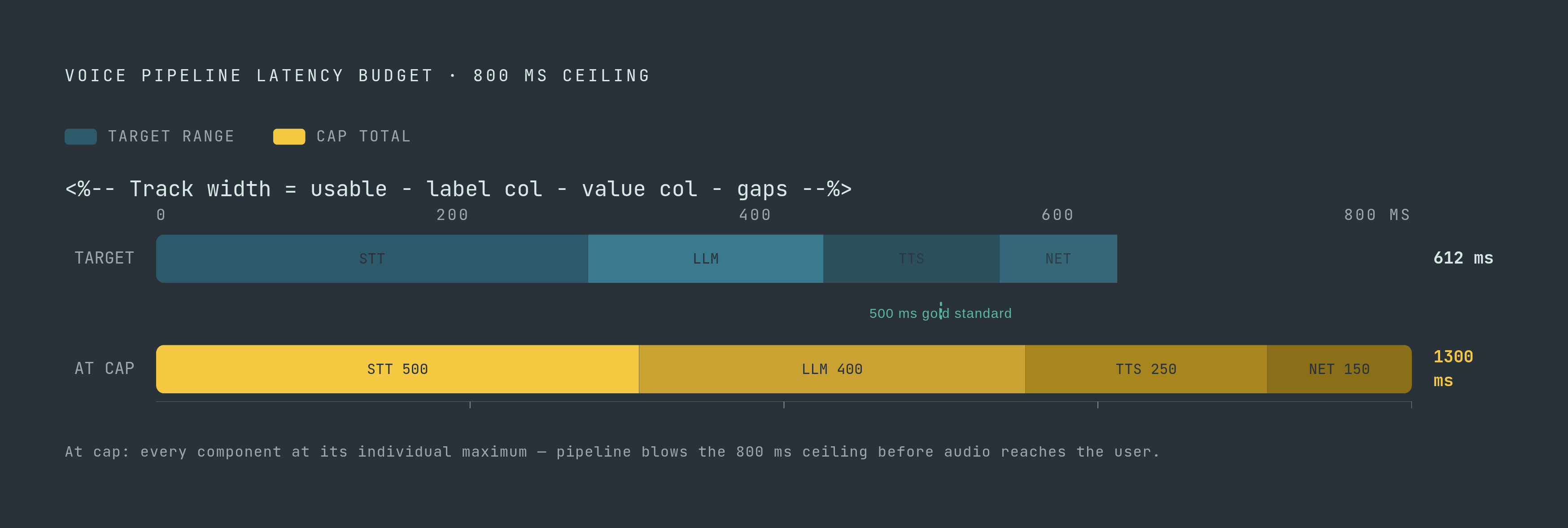
Conversational voice agents work under a different but still unforgiving ceiling. The end-to-end mouth-to-ear target sits under 800 milliseconds, and anything under 500 milliseconds counts as gold standard. Within that budget, the speech-to-text component alone should be between 200 and 350 milliseconds, with 500 milliseconds as a hard upper limit, because everything downstream, the language model and the voice synthesis, still needs its own slice of time.
Live captioning tolerates far more slack. Delays of one to three seconds are acceptable given the nature of the use case, since a viewer reading captions a beat behind the speaker experiences no real disruption. Lower is still better for accessibility, but the ceiling sits meaningfully higher than anything a voice agent could get away with.
Voice commands and interactive controls fall somewhere in between. Latency beyond a short threshold makes the feature start to feel sluggish, tapping into a different kind of user frustration than lag in a phone call. Because many of these commands are short and discrete, some systems serve them through a synchronous HTTP call instead of a persistent WebSocket connection, since there's no ongoing stream to maintain.
The voice agent case deserves a closer look, because its 800-millisecond ceiling isn't one number, it's a sum of several. Speech-to-text gets 200 to 350 milliseconds, with 500 as the ceiling. The language model's time to first token gets 100 to 200 milliseconds, capped at 400. Text-to-speech time to first byte gets 75 to 150 milliseconds, capped at 250. Network transit and orchestration overhead get 50 to 100 milliseconds, capped at 150. Those ceilings added together already reach the edge of what a "gold standard" agent can tolerate. If the speech-to-text stage alone eats its full 500-millisecond allowance, there's effectively no budget left for the model or the voice output, and the conversation will feel broken no matter how good either of those components is on its own. Model and orchestration choices, in other words, are load-bearing. They're load-bearing.
None of this works as an afterthought. A team has to know which of these four contexts it's building for, and what ceiling that context imposes, before it picks a single model or vendor. Reversing that order, choosing the model first and hoping the latency works out, is how systems end up technically functional and practically unusable.
What speaker diarization adds to the latency equation
Diarization answers a different question than transcription does: who spoke, and when. It's indispensable the moment more than one voice enters the picture, but it doesn't run for free. It sits on top of base transcription and adds its own latency tax, one that has to be accounted for inside whatever ceiling the deployment context has already set.
Production diarization pipelines tend to run in one of two modes. Fast mode holds latency to 100 to 200 milliseconds and delivers accuracy that's acceptable for live viewing, the kind of trade a captioning feed can absorb without the audience noticing. Accurate mode stretches latency out to 500 milliseconds or a full second in exchange for the highest accuracy the system can offer, a trade that fits post-hoc review far better than a live conversation.
Voice activity detection, the piece of the pipeline that decides when someone has actually started or stopped talking, targets 85 to 100 milliseconds on its own. Barge-in stop latency, the time it takes a system to shut up once a user starts talking over it, has to stay under 200 milliseconds or the interruption stops feeling natural. Accuracy targets for VAD itself run at 95% and above, which sounds high until you remember that even a small miss rate multiplies across a long conversation.
One engineering shortcut, sometimes called the flush trick, illustrates how much latency is sitting in the plumbing rather than the model. When VAD detects silence, an advanced pipeline can flush its audio buffer immediately instead of waiting for a scheduled processing tick. That single change can cut latency from roughly 500 milliseconds down to roughly 125, without altering the underlying model. A meaningful share of end-to-end delay lives in buffering and scheduling decisions rather than in the intelligence of the transcription engine itself.
Where the accuracy–latency curve's diminishing-returns point sits
More audio in the decision window generally means fewer errors in online diarization. That much holds as a general principle. But the relationship isn't linear, and it doesn't hold indefinitely: past a certain point, buffering more audio stops buying meaningfully better accuracy, and the extra latency has purchased nothing.
Research examining streaming diarization accuracy across a range of latency budgets bears this out. Additional buffering isn't consistently beneficial once a system passes its own particular threshold, and pushing latency very low can degrade performance substantially rather than gracefully. The curve isn't a smooth slope; it has a knee in it, and that knee is where the real engineering decision lives.
Where that knee sits, though, depends entirely on the system. One landmark diarization system reaches its sweet spot at around 3 seconds of buffered audio. Another needs a window of 15 seconds before its diarization error rate stabilizes. Beyond each system's own sweet spot, error rate stops dropping in any meaningful way, so the added latency from extra buffering becomes pure cost with no accuracy return.
That five-fold gap between a 3-second sweet spot and a 15-second one should make teams cautious about borrowing benchmarks. A curve published for one architecture says almost nothing reliable about another's. The only responsible path is to benchmark the specific system in question at the actual latency points the deployment cares about, and find, empirically, where the error rate flattens out for that system, rather than assuming it will match whatever number appeared in someone else's paper.
How leading production systems expose these trade-offs to developers
AssemblyAI's Universal-3.5 Pro Realtime stands, as of 2026, as the strongest production option built specifically for real-time voice applications. It's priced at $0.45 per hour of audio at the base tier, and rather than locking developers into one fixed latency profile, it offers three configurable latency modes, letting teams tune the speed-versus-accuracy trade to whatever their deployment context actually demands. On the Pipecat open STT benchmark, which measures real voice-agent conversations rather than clean read speech, it posts a word error rate of 6.99%, with a diarization cpWER of 30.17.
Deepgram's Nova-3 runs at roughly 18% word error rate on mixed real-world datasets while holding latency under 300 milliseconds, priced at roughly $4.30 per 1,000 minutes of basic transcription as of mid-2026, with a diarization cpWER of 37.92. Deepgram's Flux model posts 15.58% word error rate on that same Pipecat benchmark, a gap from Nova-3's headline number that's notably wider than the raw word error difference alone would suggest, and any team comparing vendors purely on advertised accuracy figures should account for that.
Google Cloud's Chirp delivers the best batch transcription accuracy of the group, at 11.6% word error rate across more than 125 languages, with batch transcription as its primary benchmark target. Streaming is a fully supported mode alongside batch and synchronous recognition, which makes Chirp workable for both latency-sensitive live deployments and offline transcription work within the same product family.
NVIDIA's Canary Qwen 2.5B tops the Hugging Face Open ASR Leaderboard outright, at 5.63% word error rate as of late 2026, the strongest open leaderboard accuracy of any system mentioned here. Leaderboard word error rate and production real-time performance, though, are measuring different things, and a model's leaderboard rank doesn't automatically translate into a leaderboard rank on latency under real conversational load.
What edge versus cloud deployment buys at the latency level
Edge inference reaches response times as low as 10 to 15 milliseconds. A cloud API call over cellular data or a variable Wi-Fi connection typically needs 100 to 250 milliseconds just for the network round trip, before any actual transcription work has happened. For a voice agent working inside an 800-millisecond total budget, that round trip alone can consume a large share of the entire allowance. So much latency engineering in this space is really network engineering in disguise.
Running inference on-device buys more than raw speed. Voice data never has to leave the device, which matters directly for medical, legal, and enterprise deployments where sending audio to a remote server creates its own compliance problem. On-device processing also keeps working when connectivity doesn't, a property that matters for hearing aids, field equipment, or anything expected to function somewhere a network can't reach.
The trade runs the other way too. Edge chipsets carry real limits on compute and memory, which constrains which models can realistically run on them. Under demanding acoustic conditions, noisy rooms, overlapping speakers, heavy accents, edge models can fall behind their cloud counterparts on raw accuracy. Mobile on-device inference has crossed a real threshold recently, with sub-20 millisecond latency now achievable for production computer vision models on current-generation chipsets, a sign that the gap between edge and cloud is narrowing across AI workloads generally. Whether that narrowing has fully reached speaker identification specifically is a separate question, and one still being settled model by model.
The gap between edge and cloud continues to narrow as on-device inference improves, and once network latency is factored into the comparison, the accuracy difference that used to justify defaulting to the cloud has shrunk meaningfully, at least under benign acoustic conditions. Noisy, multi-speaker, real-world audio is a different test, and one where the cloud's larger models still tend to have room to show their advantage.
A framework for choosing latency targets and architecture before touching a model
Start by fixing the ceiling. Identify the deployment context first: a hearing aid at 10 milliseconds, a voice agent at 500 to 800 milliseconds end to end, or a captioning system at one to three seconds, then treat that number as fixed before evaluating a single vendor.
From there, break the ceiling into its component pieces. Speech-to-text, diarization if it's needed, the language model if there is one, text-to-speech, and network overhead each need their own slice of the total budget. If any one component's minimum possible latency already exceeds what's left in the budget once the others are accounted for, the architecture is broken before a model has even been chosen, and no amount of tuning downstream will fix it.
Next, settle whether diarization belongs in the pipeline. Multi-channel telephony audio, where each speaker already has a separate channel, doesn't need diarization and shouldn't pay its latency cost. Single-channel audio with multiple speakers does need it, and that means budgeting explicitly for its overhead, 100 to 200 milliseconds in fast mode, or 500 milliseconds to a full second in accurate mode, depending on which the use case can tolerate.
Finally, benchmark the actual accuracy-latency curve for the system under consideration, at the latency points the deployment actually needs, rather than assuming another team's published sweet spot applies. One system's knee is at 3 seconds of buffered audio; another's is at 15. The only way to know where a given system's curve flattens is to run it and watch where the error rate stops moving. That number, not a borrowed benchmark, is the one to build around.
Sources
- Top APIs and models for real-time speech recognition and transcription in 2026
- 2025 Voice AI Guide How to Make Your Own Real-Time Voice Agent (Part-3)
- Best open source speech-to-text (STT) model in 2026 (with benchmarks) | Blog — Northflank
- Target Speaker Identification: A Low-Latency Streaming Pipeline
- 8 Best Speaker Diarization Solutions & APIs in 2026