Speaker Attribution Accuracy in Noisy Meeting Environments
Noise demolishes speaker identification accuracy far worse than benchmark scores suggest.
What diarization error rate measures and why a single number without context is meaningless
Speaker diarization answers one question: who spoke when. It cuts a raw audio stream into labeled segments, one per speaker. That's a different job from transcription, which turns sound into words with no idea whose mouth they came out of. Most products bundle the two together, and both fail on their own terms. Knowing how they fail separately, rather than treating "diarization accuracy" as one blurry number, is the whole point of what follows.
Diarization runs as a chain: voice activity detection (VAD) decides whether speech is happening, segmentation cuts the stream into candidate turns, speaker embeddings classify each segment by voice characteristics, and clustering groups those embeddings into consistent speaker labels. Transcription happens last, mapping words onto segments that already exist. Noise doesn't hit this chain evenly. It hits the front hardest, before any of the smarter downstream logic gets a chance to run. A VAD model that misses a quiet or overlapping utterance never hands that audio to the embedding stage at all, so nothing downstream can fix it. The error rides forward, and a wrong name gets stapled to a sentence.
A transcription model can be flawless, word for word, and the meeting notes it produces can still say the wrong person said something, because the segment boundaries and speaker labels were already broken before transcription touched the audio. Getting the words right doesn't rescue who said them. Degradation here is layered, stage by stage, and a fix that works at one layer does nothing for the next.
Diarization Error Rate (DER) is the field's standard scorecard. It adds three numbers together, missed speech, false-alarm speech, and speaker confusion, then divides by the total duration of reference speech and expresses the result as a percentage. Missed speech means VAD failed to catch that someone was talking. False alarm means it flagged a cough, a fan, a chair scrape as speech. Speaker error means the system caught the speech but pinned it to the wrong person. A single blended DER hides which of these three actually broke.
That number also means close to nothing without knowing how it was scored, and specifically the collar and the overlap rule. A collar is a short grace window around each speaker boundary, so a minor timing mismatch at the edge of a turn doesn't count as an error. A generous collar can cut DER on the same audio by nearly half, purely because the scoring got more forgiving. Overlap handling matters just as much: most published benchmarks exclude regions where two people talk at once and score only the non-overlapping stretches. Real meetings run on overlap: interruptions, cross-talk, someone jumping in before the last person finishes a sentence. None of that goes away because a benchmark protocol chose to ignore it.
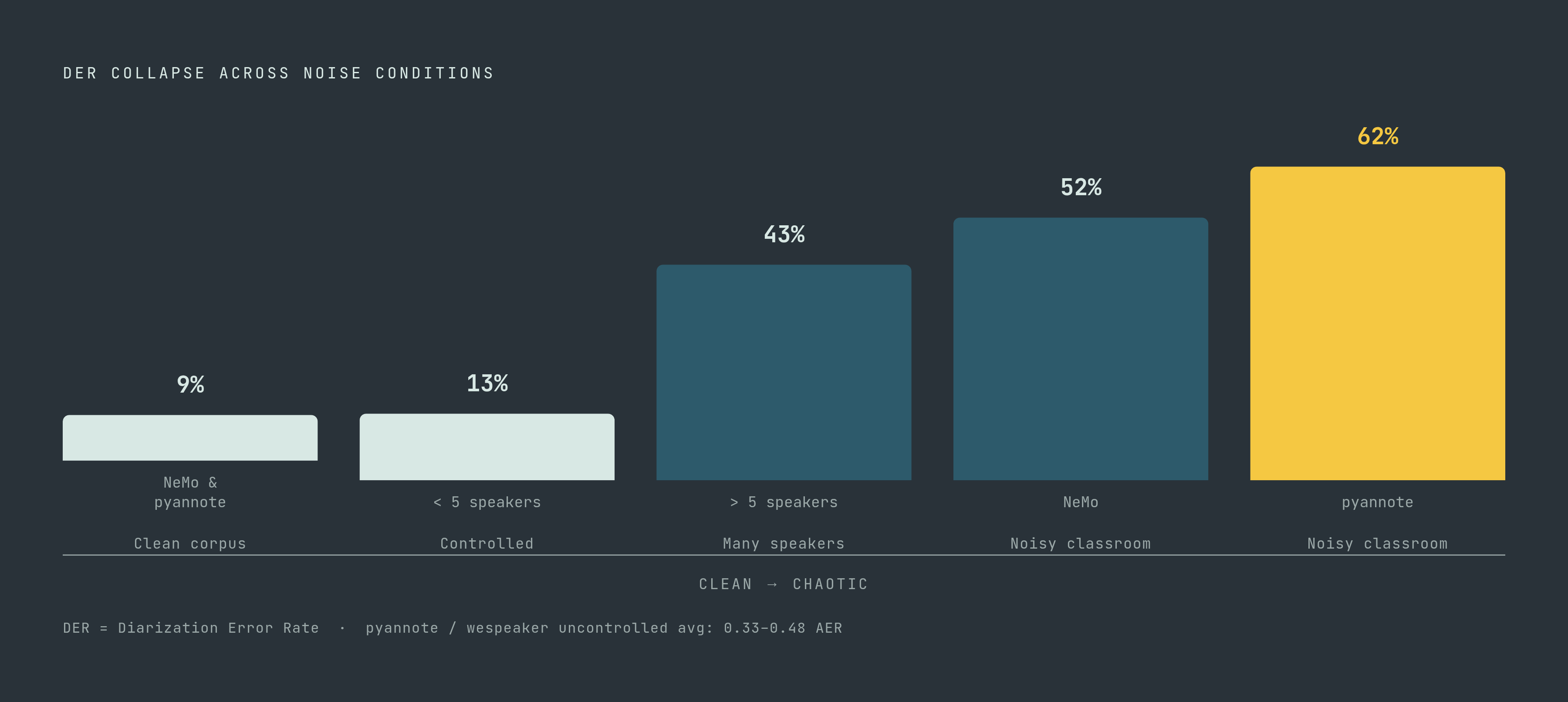
As a rough guide, DER under 10% counts as excellent, 10 to 15% is good, and anything above 20% is poor, but only when the collar and overlap rules match across whatever's being compared. On clean, cooperative, multi-speaker adult conversation, open-source models like NeMo and pyannote are around 9% DER. The distance between that figure and a noisy conference room is the entire subject of this piece.
A second metric, concatenated minimum-permutation word error rate (cpWER), ties speaker labels directly to the transcribed words instead of scoring segmentation on its own. DER can look clean while cpWER, the number closer to what a person actually reads in a transcript, tells a rougher story. Which metric a vendor chooses to publish often decides where it lands on a leaderboard, so read those claims knowing that.
How benchmark corpora create a false sense of solved problems
Most published DER numbers trace back to a small handful of datasets, and the most cited is the AMI Meeting Corpus. Its headset-mix test set runs 16 meetings, roughly 9 hours of audio total, sessions averaging about 21 minutes each, labeled with real care. CallHome appears often in these evaluations too, and so does DIHARD III, which was built deliberately to be hard, throwing child speech, restaurant noise, and courtroom acoustics at systems until the conditions start to resemble an actual meeting.
Vendor-published DER numbers almost always come from AMI, or from internal datasets built to resemble cooperative office meetings: people in fixed positions, taking turns politely, recorded under research-grade conditions. That is not the audio anyone captures in production. A hybrid meeting has people dialing in from cars, from kitchens, from a laptop mic three feet away while someone runs a dishwasher two rooms over. Microphone distance varies wildly, noise floors differ from participant to participant, and nobody waits their turn.
Diarization looks solved if the only thing read is a benchmark leaderboard. It is not solved on the audio a team actually records, and that gap is not a rounding error. Treating a benchmark DER as a deployment target ranks as the single most common mistake in evaluating these systems: a vendor's AMI score tells you almost nothing about how the same model behaves on a call where three people are talking over a dishwasher. What happens once a benchmark's polite assumptions, fixed seating, clean turn-taking, controlled acoustics, stop holding is where the real numbers live, and they are not subtle.
How noise collapses accuracy in layers
Start at the front of the pipeline, since that's where noise does the most damage. VAD fails two ways: missed speech, where the model doesn't detect that someone spoke, and false alarms, where background noise gets mislabeled as speech. Both inflate DER before the system has even tried to work out who's talking. Research out of Stanford and UMD, presented at EDM 2025, measured how bad this gets in practice: models like NeMo and pyannote, which score around 9% DER on clean multi-party adult conversation, jump to 52 to 62% DER when applied unmodified to noisy classroom recordings. Research indicates the jump is largely driven by errors at the VAD stage, where missed speech accumulates before any speaker-level logic runs. The same research found that denoising the audio before running VAD meaningfully cuts the missed-speech component, and training on a mix of denoised and noisy audio, rather than clean audio alone, adds further gains on top of that.
Short segments are the next failure point, and a stubborn one. Backchannels and quick interjections, a student or meeting participant who speaks for two seconds and stops, contribute a disproportionate share of total errors. The classroom research bears this out directly: shorter utterances are consistently the hardest category to attribute correctly. Separately, recent engineering work targeting very short segments, around 250 milliseconds, under noisy conditions reports a 43% improvement on that specific failure mode. A company doesn't ship a narrow patch for a 250-millisecond segment unless that segment was a known, unresolved gap rather than an edge case nobody had noticed yet.
Overlapping speech is the hardest problem in the stack, and it's where distant-microphone conference room recordings suffer most. Embedding and clustering models assume sequential turns, one person talking, then another. Overlap breaks that assumption directly, because the mixed audio doesn't cleanly belong to either speaker's acoustic profile. NVIDIA's own reported numbers show the cliff: 13.24% DER on recordings with fewer than five speakers, jumping to 42.56% above that threshold. Speaker count and overlap density interact, and once density crosses a certain point, clustering methods that worked fine start failing in a way that isn't gradual. No single architecture wins across the board. WavLM-based end-to-end segmentation handles dense overlap better, while traditional VBx clustering does fine in scenarios with very little overlap, under roughly 1%. Routing meetings through different pipelines based on measured overlap ratio beats betting on one architecture for every kind of audio, and any team still doing the latter is leaving accuracy on the table.
Then there's the ceiling test: what happens in genuinely chaotic, uncontrolled recording conditions. Highly uncontrolled multi-speaker conditions offer a useful stress test for chaotic audio. Under such conditions, pyannote.audio and wespeaker produced average error ratios of 0.33 and 0.48 respectively, meaning roughly a third to nearly half the audio got misattributed. That's closer to a coin flip than a working system, and it's a far better stand-in for a chaotic all-hands or working-lunch call than AMI ever was. Reverberant, far-field audio in large rooms has historically broken speaker tracking the same way, and recent vendor updates claim a 57% improvement on mid-length reverberant audio, though that figure comes from the vendor itself and deserves the same skepticism as any number a company reports about its own product.
Where the pipeline sits in 2026: what the best real-world results look like
The clearest evidence of what the best systems can do on genuine meeting audio, not a benchmark corpus, comes from the MISP 2025 Challenge. The winning system posted an 8.88% DER, a 9.48% character error rate, and an 11.56% concatenated cpCER. That's a serious result, and the engineering explains why: ASR-aware observation addition, fusing a noisy multichannel audio sum, Mossformer2-separated speech, and GSS-separated speech, with blending coefficients predicted by a Conformer-based bridging module trained on a cosine-similarity loss over precomputed character error rate values. Nobody gets that from a single API call. It's a heavily engineered ensemble, purpose-built, stacking multiple separation techniques and learning how to weight them dynamically. The distance between an 8.88% DER built that way and the 52 to 62% DER on unmodified classroom audio is the actual size of the work required to close the gap, and no vendor closes it by accident.
On the commercial side, AssemblyAI's own benchmark using real-world datasets compared cpWER across major API providers: Universal-3.5 Pro, released July 7, 2026, posted 30.17 cpWER, against ElevenLabs Scribe v2 at 35.26, Gladia at 36.87, and Deepgram Nova-3 EN at 37.92. Separately, the Pipecat open STT benchmark, which tests real voice-agent conversations rather than recorded meetings, found Universal-3.5 Pro Realtime posting a 6.99% word error rate against Deepgram Flux's 15.58%. That gap points to something structural rather than incidental: cleaner turn detection produces cleaner input for the diarizer downstream, so transcription quality and diarization quality aren't independent measurements sitting side by side. They're coupled, and improving one tends to lift the other.
Fireflies reports a 7.2% DER on vexascribe.com, though stacking that figure alongside the cpWER numbers above would be misleading, since the two protocols score fundamentally different things. On the infrastructure side, pyannoteAI maintains an open-source Community-1 model for teams that want to self-host, alongside a commercial Precision-2 model built for enterprise reliability. That split captures the real tradeoff: run it yourself and own the tuning work, or pay for an API and inherit whatever tradeoffs the vendor already made on your behalf. Either way, cpWER differences translate directly into what a reader experiences in a transcript, since cpWER scores speaker labels against real words rather than against segmentation cleanliness measured in the abstract.
The three-layer fix for noisy ASR and what each layer does
Fora Soft, drawing on production work across more than 250 real-time communication products, describes a consistent structure for fixing noisy ASR built from a noise-suppression front end, a noise-hardened acoustic model, and domain biasing stacked on top. If any one of the three is skipped, the other two end up compensating for it, which works for a while and then hits a wall.
The front end does the most work per unit of effort, and it's the first thing anyone should fix, not the last. Running a Krisp-class neural noise suppressor ahead of the acoustic model cuts noisy WER by 20 to 40% relative, before anything about the model itself changes. It handles stationary noise like HVAC hum and fan noise, non-stationary noise like typing and door slams, and even competing background speech. Named tools here include Krisp and DeepFilterNet, the latter of which is open source and drops naturally into a self-hosted stack. The classroom research cited earlier confirms the mechanism directly: denoising audio before VAD is what reduces the missed-speech component of DER, more than any other single change tested.
The acoustic model is the second layer, and it can't carry the load on its own. A model with a clean-room WER of 5 to 7% degrades to 30% or worse on a factory floor with no front-end suppression ahead of it, which is the whole argument for putting the noise suppressor first. Fora Soft's 2026 reference targets by environment give a sense of what a properly stacked system should aim for: 10 to 14% WER in an open-plan office, 12 to 16% in a call center, 14 to 20% in a vehicle or drive-thru setting, 16 to 24% in industrial or clinical environments. Named models here include Deepgram Nova-3, Whisper Large v3 Turbo, NVIDIA Parakeet, and Conformer-RNNT. The classroom diarization research makes the same point from a different angle: training on a mix of denoised and noisy audio, rather than clean audio alone, produces real gains once the model meets actual noisy conditions.
Domain biasing is the third layer, and it's where the model gets tuned to the vocabulary and speaker structure of a specific deployment. Modern APIs let teams supply a custom keyterm list at inference time, which matters for proper nouns, product names, and technical jargon that a general-purpose model will otherwise underweight or mangle. Deepgram's own documentation admits that noisy conditions add meaningful WER overhead even on Nova-3, and that's the right way to read any vendor's number: it's not your WER, and the only measurement that means anything is one run on your own audio. On the diarization side, a hybrid VAD approach, one that combines ASR word-level timestamps with frame-level VAD predictions, gets DER as low as 17% in teacher-student separation experiments and 45% in full all-speaker separation. That's the domain-biasing equivalent for diarization: tuning detection logic to the real structure of the audio instead of treating every speaker interaction as generic.
Stacking all three layers moves noisy WER from the 25 to 40% range down to roughly 8 to 12%. That drop takes real engineering, tuning, testing, retraining on the right mix of data, not a checkbox on a vendor's feature list, and most cloud-API marketing pages leave that work out.
Emerging architectures that rethink the pipeline rather than patching it
Even a fully stacked three-layer fix inherits the structural weakness built into the pipeline itself. VAD, segmentation, embedding, and transcription still run as sequential stages, so an error made early still propagates forward. The architecture, not just the audio, is the constraint, and no amount of layered patching removes it.
G-STAR, an end-to-end LLM-based speaker-attributed ASR framework from 2026, attacks that constraint head-on. It targets long-form, multi-speaker speech with overlapping regions, the exact condition where existing pipelines lose track of speaker identity across a full meeting. Its design couples a cache-conditioned speaker-tracking module with a Speech-LLM transcription backbone: the tracker supplies structured, temporally grounded speaker cues, and the LLM generates attributed text conditioned directly on those cues, rather than having speaker labels bolted on after the fact. Reported results show strong speaker-attributed transcription on both oracle-segmented tests and full-meeting global tests, holding identity consistency and accurate timestamps without giving up temporal precision. The real shift is that speaker identity and transcription get optimized jointly, as one objective, instead of handed off sequentially from module to module, which is the structural fix the layered failure pattern has been asking for all along.
A second line of work, from Worcester Polytechnic Institute in 2026, attacks a different weakness: almost every ASR and diarization system today runs open-loop, with no way for a user to flag an attribution error in the moment. Errors get caught later, if at all, usually through expensive manual annotation after the meeting ends. The proposed system runs streaming ASR and diarization together, uses an LLM to generate short summaries that surface likely speaker errors as they happen, and lets users offer lightweight verbal corrections during the session, at which point the system updates the transcript and adds a new speaker enrollment on the fly. Tested against the AMI headset test set, this approach cut DER by 31.99% relative to a streaming baseline built on Google ASR and ECAPA, and cut speaker substitution error specifically by 52.68%. Anyone building something similar should hold to a few hard constraints: don't make users read walls of text to catch an error, keep the correction lightweight with no detailed timestamp entry required, and make sure both ASR and diarization run in true streaming mode, since the decision has to happen immediately rather than wait for the session to end.