Streaming vs Batch Transcription Architecture Trade-Offs
Smart routing cuts streaming costs by a third without sacrificing accuracy when it matters most.
Streaming versus batch transcription is not a speed-versus-quality coin flip, and the fact that most teams treat it like one is why so many voice pipelines end up either too slow or too sloppy for what they're actually built to do. It is a four-variable equation: latency tolerance, accuracy floor, infrastructure overhead, and cost. Collapse those into "streaming is fast, batch is accurate, pick your poison" and the choice gets made backwards more often than it gets made right. This piece builds the actual framework, and it lands on a specific claim: most teams that default to streaming "for simplicity" are overpaying by a third or more, and the fix is routing, not picking a side.
How the two architectures actually work
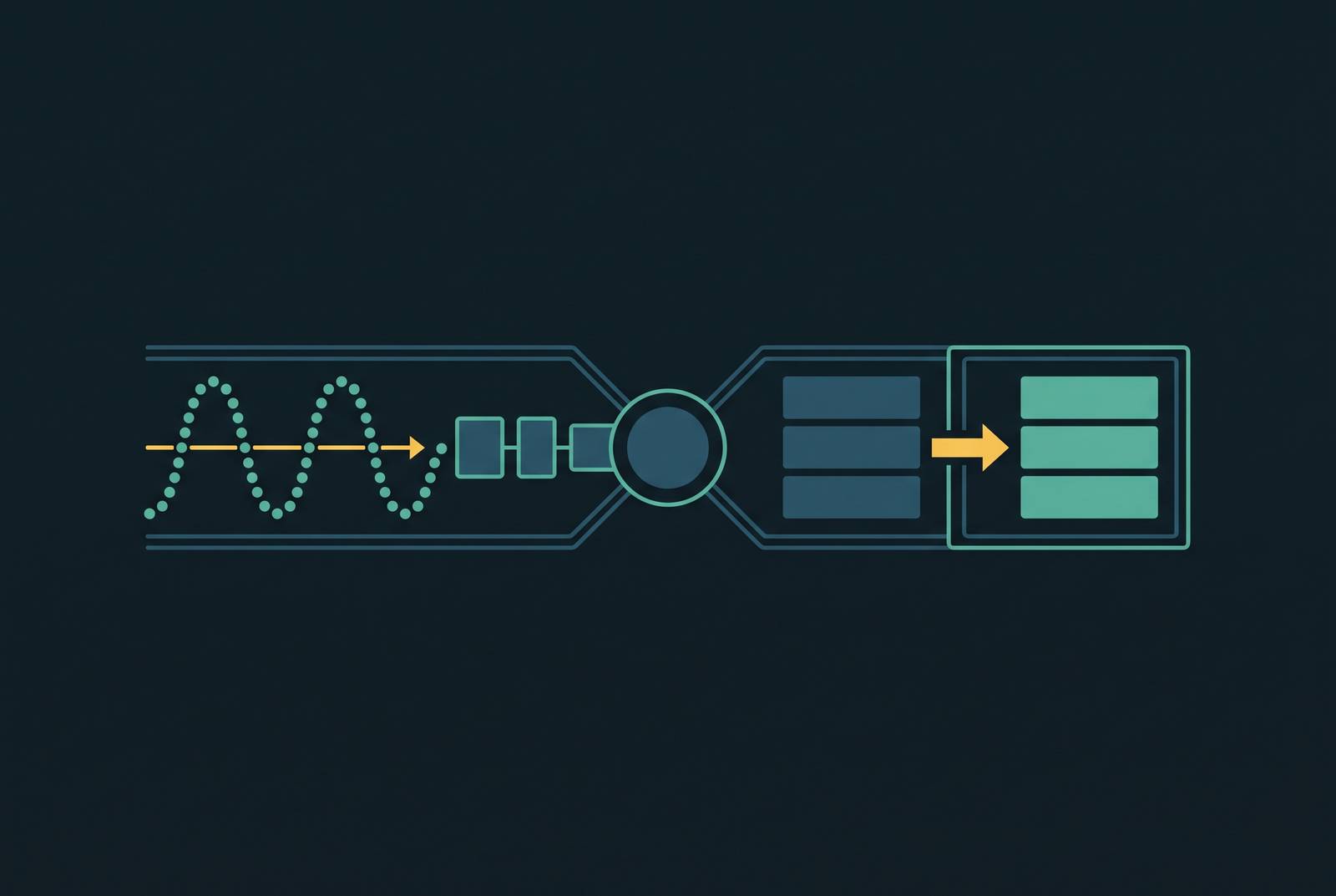
Batch transcription is the librarian's approach. Someone hands over a complete audio file, the system reads it start to finish, and out comes a transcript. According to deepgram.com, batch systems can process audio at roughly 120 times real-time speed, meaning even lengthy recordings come back in a fraction of the original runtime. No rush, no partial answers, just a finished product delivered whole.
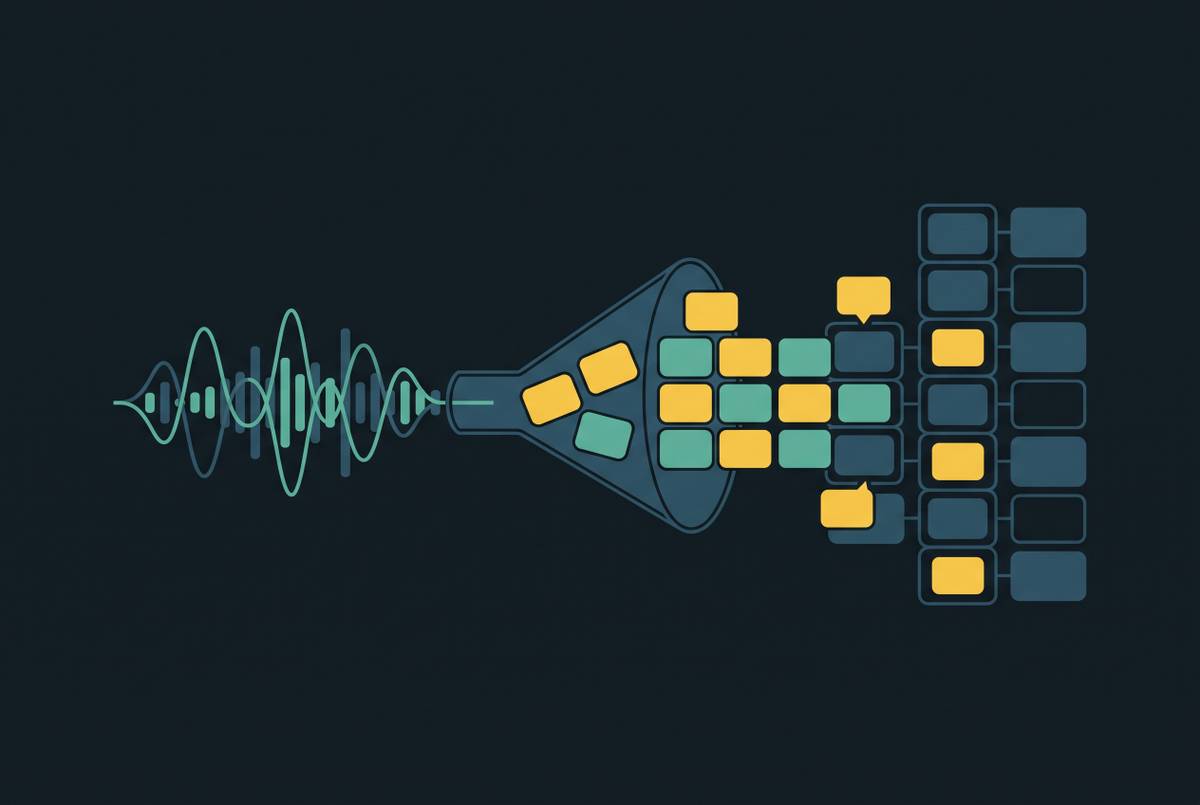
Streaming is a different animal. Audio gets chopped into chunks of 100 to 200 milliseconds and fired over a persistent WebSocket connection, and the system talks back while the person is still talking. It produces two kinds of output along the way: interim results, which show up within about 150 milliseconds and keep live captions feeling alive, and final results, which lock in once the model's confidence crosses a set threshold. Interim results are the rough draft scribbled in pencil. Final results are the version that gets inked.
Why does the WebSocket matter mechanically? Because it stays open for the entire session, which cuts out the repeated handshake overhead a REST-based system pays every time it opens a new request. At high frequency and low latency, that handshake tax adds up fast, so a persistent connection is less a nicety and more a structural requirement.
One wrinkle worth flagging early: streaming is not defined by whether the audio is "live." A podcast file can run through a streaming architecture just as easily as a phone call can. The distinction is about how the transcript gets delivered, incrementally versus all at once, not about where the audio came from. This section stays free of accuracy or cost numbers on purpose. Those get earned in the sections built for them.
The mechanical reason streaming is less accurate than batch
This is the part that trips people up: it is not a bug that better engineering eventually patches. It is math. A streaming model has to commit to each token using only the audio it has already received, what engineers call left-context. It cannot search its way through audio that has not arrived yet, because that audio does not exist yet from the model's point of view.
Batch models do not have that problem. They see the entire utterance before generating a single word, so they can look forward in the audio to resolve an ambiguous phoneme or untangle a garbled phrase. Guessing the end of a sentence as someone says it is a different task than reading the whole sentence and explaining what it meant afterward. One requires prophecy. The other just requires reading comprehension.
The standard fix has been to limit context in exchange for lower latency, which speeds things up but accepts some hit to word error rate (WER) as the cost of doing business. Adding buffering to a streaming pipeline narrows the gap, though it does not close it, and treating narrows as closes is where a lot of product decisions go wrong. It does not close it, and treating "narrows" as "closes" is where a lot of product decisions go wrong.
The frontier is moving, worth saying plainly. Vendors continue to promise streaming models that approach batch-level quality at low latency, and those claims deserve skepticism until benchmarks confirm them. Teams building today should treat the accuracy gap as an architectural constant, not a promise sitting in next quarter's changelog.
What the accuracy numbers actually show
A 2024 cross-provider study (Kuhn and Kersken et al., arXiv 2408.16287) put streaming WER at 10.9% against a batch WER of 9.37% on English datasets, a gap the authors found statistically significant under a Welch's t-test. A point and a half does not sound dramatic on paper, and that's exactly the trap: in specialized domains, when batch pairs full-context access with a domain-specific language model re-decode pass, it can beat streaming by 10 to 17 points of WER. That's not a rounding error. That's the difference between a transcript someone trusts and one someone has to check line by line.
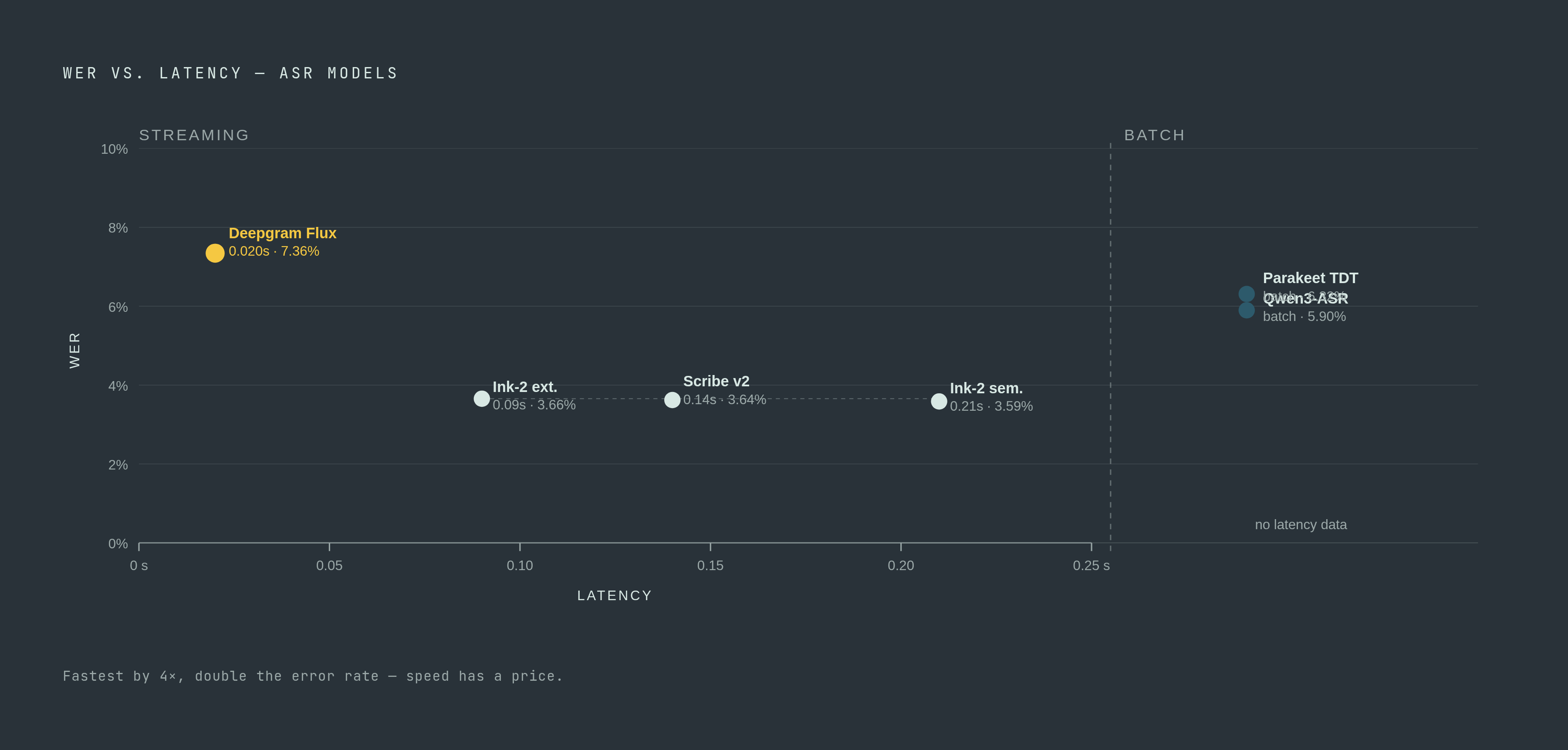
The most recent snapshot, the Artificial Analysis AA-WER Streaming benchmark from June 2026, shows how tight the frontier has gotten among the fastest streaming systems. Cartesia's Ink-2 model with semantic endpoints posts a WER of 3.59% at 0.21 seconds of latency. ElevenLabs Scribe v2 Realtime comes in at 3.64% WER and 0.14 seconds. Cartesia's Ink-2 with external endpoints hits 3.66% WER at just 0.09 seconds. Deepgram Flux clocks in at a blistering 0.020 seconds of latency but a WER of 7.36%, roughly double the error rate of its closest competitors. Speed has a price tag, and Flux is the receipt for anyone who thought otherwise.
On the batch side, Qwen3-ASR-1.7B posts a 5.90% WER, Parakeet TDT-0.6B-v3 comes in at 6.32%, and Canary-1B-v2 sits at 7.15%, all needing 2 to 7 gigabytes of memory and GPU inference to run. No single model leads on both axes at once, and nobody has found a way around that. Pick the trade-off, because it is not going anywhere.
Domain specialization sharpens the stakes further. Here's where the position gets firm: for medical dictation, legal depositions, or compliance recordings, batch is the correct default, not a cautious one. Its ability to chain a correction pass or load a long custom keyword list is often the whole difference between a transcript sitting at noticeably lower accuracy and one closing in on near-perfect accuracy. Streaming's biasing window, the buffer it has to work with custom vocabulary, is smaller, and a missed domain term in a live stream cannot be recovered after the fact. It just sits there in the transcript like a typo nobody is allowed to fix.
Why does any of this matter beyond the transcript itself? Because errors do not stay contained. In voice agent pipelines, a speech-to-text mistake propagates downstream, dragging down the reasoning quality of whatever large language model is reading the transcript, then degrading the speech generated in response. Garbage in does not just mean garbage out. It means garbage compounding at every layer of the stack.
The three latency numbers teams actually need to track
"Latency" gets thrown around like it is one number. It isn't, and treating it as one is how teams ship something that benchmarks beautifully and feels broken in production. There are at least three distinct metrics, each governing a different part of the pipeline.
Time to First Byte drives UI responsiveness, the thing users perceive as "instant" when a captioning system starts putting words on screen. Word Emission Latency governs how quickly those partial results appear while someone is mid-sentence. Time to Final Segment is the delay between when a speaker stops talking and when the system delivers a stabilized, final transcript. That third one is what an LLM pipeline is actually sitting around waiting for, and neither of the first two metrics captures it. A system can nail Time to First Byte and still leave a voice agent hanging awkwardly if Time to Final Segment lags behind.
Deepgram's architecture documentation puts the production target at roughly 300 milliseconds for this window, the number separating something that feels like a demo from something that survives contact with real users. A multi-system comparison from the WhisperKit paper (arXiv 2507.10860, 2025) found WhisperKit and Fireworks fastest for hypothesis text, at a mean latency around 0.45 seconds, with Deepgram trailing at 0.83 seconds. OpenAI does not support hypothesis text streams at all, so once everything gets normalized to confirmed text, latency across the tested systems converges around 1.7 seconds.
That convergence matters more than it sounds like it should. It shows how closely the tested systems tracked each other on confirmed-text latency, regardless of how fast their interim results looked.
One more catch, an important one: clean-audio benchmarks like LibriSpeech set a lower bound, not a production estimate. Real audio has overlapping speech, background noise, and microphone artifacts that force longer beam searches and delay endpointing (deciding a speaker is actually done talking). A team that benchmarks in a quiet room and deploys into a noisy call center will find its real-world numbers meaningfully worse than what the evaluation promised. That gap between lab and floor is where a lot of production launches go sideways.
How cost structures differ and where teams overpay
The streaming premium is not arbitrary padding on a pricing sheet. It's structural: keeping a socket open and compute running continuously costs more than spinning a batch job up and letting it wind down. Keeping a restaurant open 24 hours costs more than opening for dinner service, and always-on ASR infrastructure follows the same arithmetic.
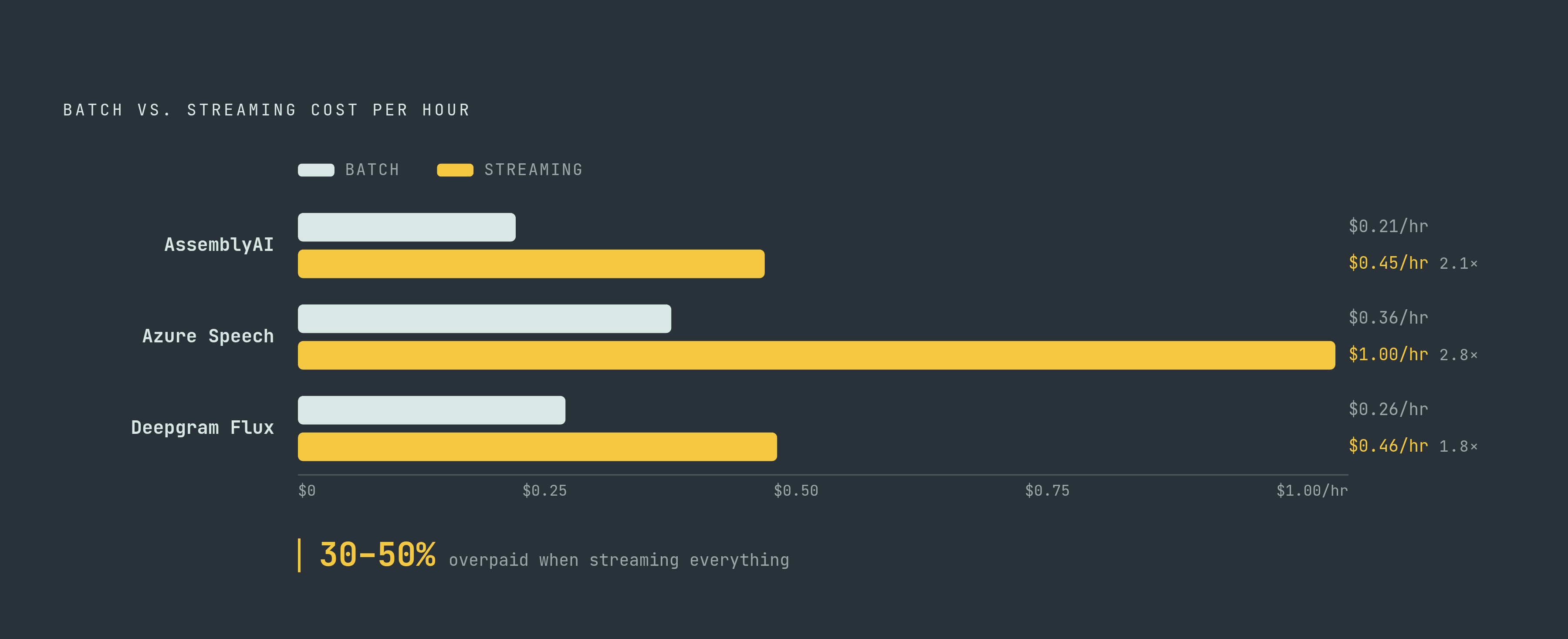
The numbers make the pattern obvious. AssemblyAI's Universal-3.5 Pro runs $0.21 per hour for batch versus $0.45 per hour for streaming, more than double. Azure Speech charges $0.36 per hour for batch and $1.00 per hour for real-time. Deepgram's Flux lists batch at $0.0043 per minute against $0.0077 per minute for streaming, which works out to streaming costing roughly 79% more. OpenAI's Realtime API runs anywhere from $0.38 to $1.15 per hour depending on whether audio output is also being generated, while its Batch API cuts costs in half for teams that can tolerate a 24-hour turnaround.
There's a billing trap hiding in the streaming model that catches teams off guard more often than it should. AssemblyAI bills for the full duration a WebSocket stays open, including idle time, and an unclosed session can sit open for up to three hours, billing the entire stretch. Run two simultaneous five-minute sessions and the bill reads ten minutes, not five. Add in dropped connections that get retried, and those retried seconds effectively get billed twice. It's less "pay for what you use" and more "pay for what you forgot to close."
Streaming everything "for simplicity" is the single most common overpayment pattern in this market, and it usually costs teams 30 to 50% more than necessary. Deepgram's own pricing analysis suggests routing non-interactive traffic to batch instead often cuts the bill roughly in half. Cost alone justifies the extra routing complexity even when latency requirements would technically allow streaming for everything. Convenience is expensive. Someone just has to be the one to say so before the invoice arrives.
Engineering complexity that only appears after deployment
Streaming brings an operational surface that never shows up in a benchmark spreadsheet. Someone has to manage persistent WebSocket sessions across mobile network handoffs, keep audio buffered and context intact through disconnects, and build idempotent replay logic. Skip that last part and dropped connections that get retried without idempotent replay logic can introduce errors or out-of-order segments in the transcript. Thousands of concurrent sessions also mean memory and CPU held for the entire duration of every call, while batch jobs draw from pooled, shared compute that does not care whether a job takes ten minutes or ten hours.
Endpointing deserves its own callout, because it is a genuinely hard problem dressed up as a simple one. How does a system know when a speaker is actually finished, versus just pausing to think? Raw silence timers are a blunt instrument: set the threshold too short and a voice agent cuts people off mid-thought, set it too long and the interaction feels sluggish. More advanced approaches read tonality, pacing, and speech patterns to make that call, and Deepgram's Flux model builds end-of-turn detection directly into the model itself rather than bolting on a separate voice activity detection layer. Small architectural choice, outsized effect on how natural a conversation feels.
Speaker diarization, figuring out who said what, tilts clearly toward batch, and this is one place where the streaming advantage is closer to marketing than mechanism. Some async diarization models, such as pyannoteAI's Precision-2, run in post-call workflows and are designed to deliver high attribution accuracy. Real-time streaming diarization typically ends up handled in post-processing anyway, which raises a fair question: what's the point of the streaming speed advantage if diarization gets punted to a later batch pass regardless? For this feature specifically, the latency benefit of streaming is mostly theoretical.
Replay and auditability round out the list. Streaming systems are genuinely harder to replay cleanly, since doing so needs offset rewinds, state restoration, or reprocessing large volumes of events in the right order. Batch fits naturally into certification workflows, quality checks, and publish gates, the kind of process enterprise compliance teams expect as a baseline. Batch's structural simplicity is almost boring: defined input, defined transformation, defined output. A failure just gets re-run. No out-of-order events, no duplicate handling, no watermark logic to reason about at 2 a.m.
If a team's existing infrastructure and on-call runbooks were built around batch patterns, adopting streaming often costs more in practice than the benchmark numbers implied. That's not a knock on streaming. It's a reminder that the sticker price on a benchmark chart and the total cost of running the thing in production are two different documents, and only one of them shows up on the invoice.
The decision framework: four questions that determine the right architecture
Four questions, asked in order, do most of the work here.
What is the latency tolerance? If the use case demands a response within seconds, think voice agents, live captioning for sports or breaking news, real-time call center monitoring, streaming isn't a preference, it's a requirement. If the use case tolerates minutes or hours, post-meeting transcripts, podcast processing, compliance archives, legal or medical documentation, batch is the sane default, and reaching for streaming there is solving a problem nobody has.
What is the accuracy floor, and does the domain need a specialized correction pass? General-purpose streaming at the frontier, Cartesia and ElevenLabs among them, now lands in the low single digits for WER, plenty for most conversational applications. But for medical, legal, or compliance work, batch wins outright: its ability to chain correction passes and load long custom keyword lists is what closes the gap between a transcript sitting at noticeably lower accuracy and one reaching near-perfect accuracy. Streaming's narrower biasing window can't replicate that, full stop.
What does the traffic actually look like? Continuous, always-on audio, live monitoring being the obvious case, makes streaming infrastructure cost unavoidable. Bursty or scheduled traffic, recorded uploads, nightly processing jobs, is where batch lines up compute spend with actual load, and streaming "for simplicity" tacks on that 30 to 50% overpayment discussed earlier for no real benefit.
Is the infrastructure actually ready? Does the team have operational muscle memory for WebSocket session management, endpointing logic, and replay handling? If not, the hidden engineering cost of streaming can outweigh whatever latency benefit it offers, especially for workloads that would have tolerated batch just fine.
Run those four questions and the output sorts itself: use cases answering "seconds" with mature infrastructure behind them go streaming. Use cases answering "minutes or longer" with accuracy or compliance requirements go batch. Everything in between is a candidate for hybrid routing, which happens to be exactly where the industry is heading.
Why hybrid routing is becoming the production default
The pattern showing up across healthcare, contact centers, and enterprise voice platforms follows the same logic: stream during the live interaction, then batch-process that same audio afterward for compliance, diarization, and quality review. One recording, two passes, each built for a different job. Deepgram describes exactly this setup in healthcare: streaming during a patient appointment to support real-time clinical decisions, followed by batch processing of the same recording to generate compliance-ready records. Contact centers run a similar playbook, with voice bots handling live calls through streaming while overnight batch jobs chew through the recordings for QA, agent coaching, and reporting.
That routing decision, which traffic goes to which lane, is a policy choice, not a default a team happens to fall into. Teams that make that call on purpose, rather than letting the path of least resistance decide for them, are the ones that dodge the 30 to 50% cost overpayment that comes from streaming everything out of sheer convenience.
A third lane is worth watching too: on-device processing. Model quantization, converting model weights down to 8-bit or 4-bit integers, shrinks model size by 50 to 75% while holding onto most of the original accuracy. That makes ASR viable directly on a device, no cloud infrastructure required, which matters for latency-sensitive or privacy-constrained use cases where sending audio to a server isn't an option at all.
The frontier keeps moving, and end-to-end streaming models like Voxtral Realtime suggest the accuracy gap will keep narrowing. But narrowing isn't closing, and even in a world where it does close, most production stacks still need to handle interactive traffic and archival traffic at the same time, for different reasons, under different constraints. That's the real argument for hybrid routing: not that streaming and batch are converging, but that the workloads sitting on top of them never converge at all.
Which brings the whole piece back to where it started, minus the coin flip. The question was never streaming versus batch. It's which workload belongs in which lane, and whether anyone bothered to write that routing logic down before the WebSocket bill showed up.