Transcription Confidence Scores and Error Handling in Production
Confidence scores don't predict accuracy unless you've proven yours against your actual audio.
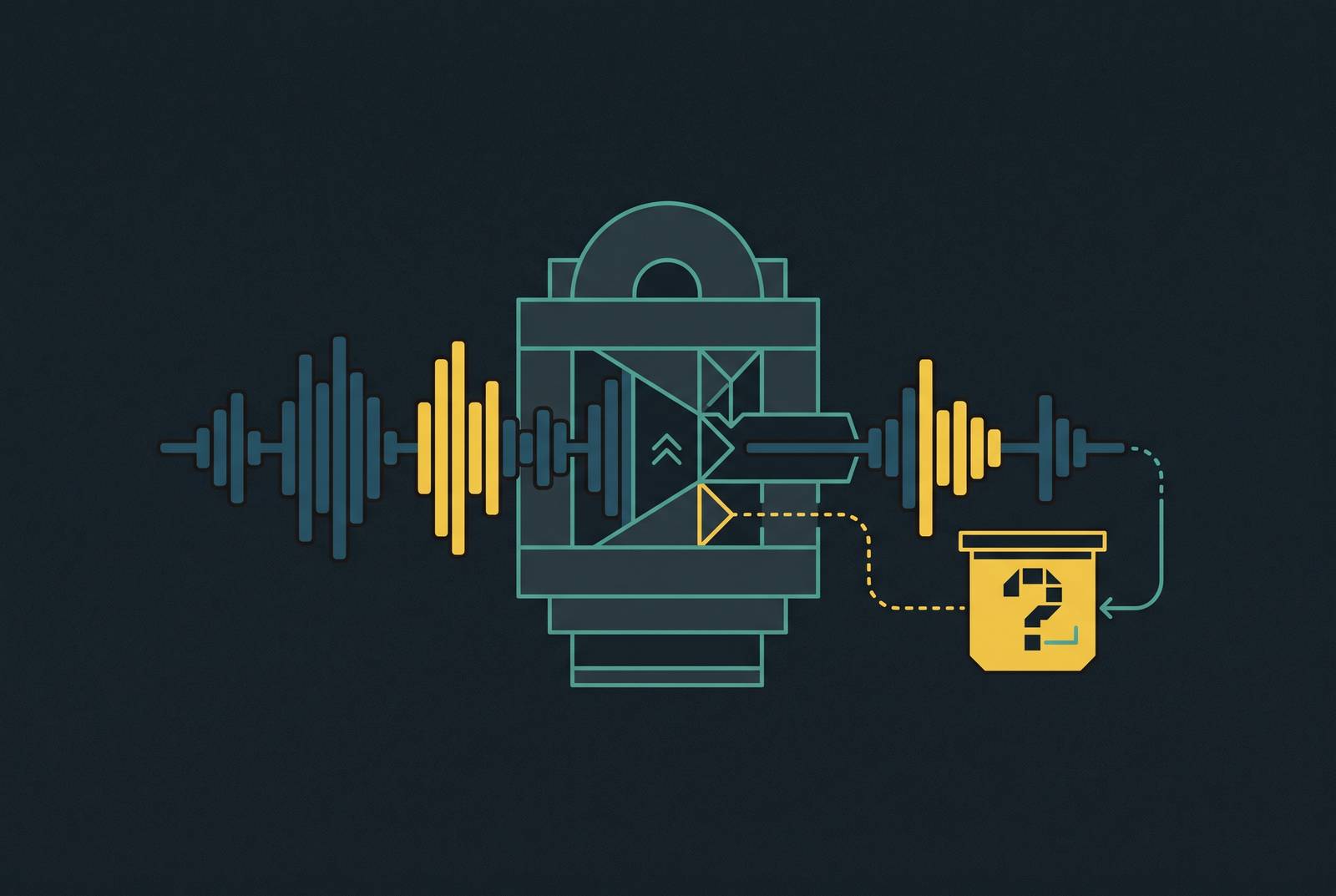
Confidence scores in production transcription systems tell you less than the number on screen implies. A score of 0.92 looks like a probability, and gets treated like one the moment an engineer wires up a threshold at some round number and calls it done. But that score is model output, not a statistically checked probability, unless someone has actually gone back and confirmed it behaves like one. Closing that gap takes a bit of structure around confidence scores, so a badly calibrated number doesn't quietly wreck your routing logic.
The production accuracy gap that makes threshold-setting non-trivial
Vendor benchmarks in 2026 report word accuracy of 95 to 98% on clean audio for the best speech-to-text models. That number is real, and it's also close to useless for setting a production threshold, because production audio is never clean. Studies tracking the drop from benchmark conditions to real deployment put the degradation somewhere between 2.8x and 5.7x.
Medical dictation makes the point cleanly. Controlled, single-speaker dictation lands around 8.7% word error rate (WER). Multi-speaker clinical conversations, recorded in the same domain with the same vendor, push past 50% WER. Same task on paper, a different task entirely in the exam room, and the only thing that moved is how many people were talking and how messy the room got.
Vendor-commissioned tests tend to flatter the vendor. That's not a scandal, it's just a reason to read them carefully. A 2024 TestDevLab report commissioned by Zoom found Zoom at 7.40% WER, Webex at 10.16%, and Microsoft Teams at 11.54%. A peer-reviewed study of psychiatric interviews using Zoom and Otter found 19.2% WER under real clinical conditions, which says something about how far a controlled comparison can drift from a clinical one, even using the same tools. Take vendor comparisons for what they are: a starting hypothesis, never a number you inherit and trust as-is.
None of this makes benchmarks worthless. It means a benchmark is a guess about how your system might behave, not a verdict. The only way to know where your threshold should sit is to measure calibration against your own audio, your own speakers, your own microphones and call quality. Skip that step, and the threshold you ship is a guess wearing a lab coat.
Why WER alone cannot tell you where to draw the threshold line
WER counts every word as equally important, and that's the whole problem with using it alone. Your business doesn't grade words that way: a dropped "um" costs nothing, a dropped drug name in a clinical note costs a patient, and the metric needs to know the difference even though it was never built to.
Take a simple case. The system transcribes "The meeting is at 3 PM" as "The meeting is at 5 PM." One word changed, so WER registers a 20% error rate, technically 80% accurate. But the calendar books the wrong slot, someone shows up two hours late, and the transcript was wrong on the only word that mattered. WER can't tell a harmless slip from a task-breaking one, and pretending it can is where a lot of routing logic goes wrong before it even ships.
Semantic WER fixes that by using a language model as judge. Instead of counting word-for-word mismatches, it asks whether the meaning changed enough to alter what a downstream system or reader understands, which makes it the metric that actually predicts whether a voice agent takes the right action. It scores outcomes, not spelling.
Multi-speaker audio needs its own yardstick, and this is where a lot of teams end up with the wrong number without realizing it. tcpWER scores transcription errors and speaker-attribution errors together, a harder and more honest test than measuring diarization error on its own. A system can nail every word and still assign them to the wrong speaker. Plain WER won't catch that. tcpWER will.
Missed Entity Rate belongs on the dashboard too, tracked next to WER rather than instead of it. A system can post a strong WER and still drop the one account number or medication name that actually mattered, and WER alone will call that a good day.
Multilingual pipelines complicate things further. Languages with complex morphology or no clear word boundaries strain WER's basic assumption that words are countable, discrete units. Research from NAACL 2025 (Thennal D K and colleagues) argues for character error rate (CER) as the primary metric in multilingual ASR evaluation, precisely because it sidesteps that assumption.
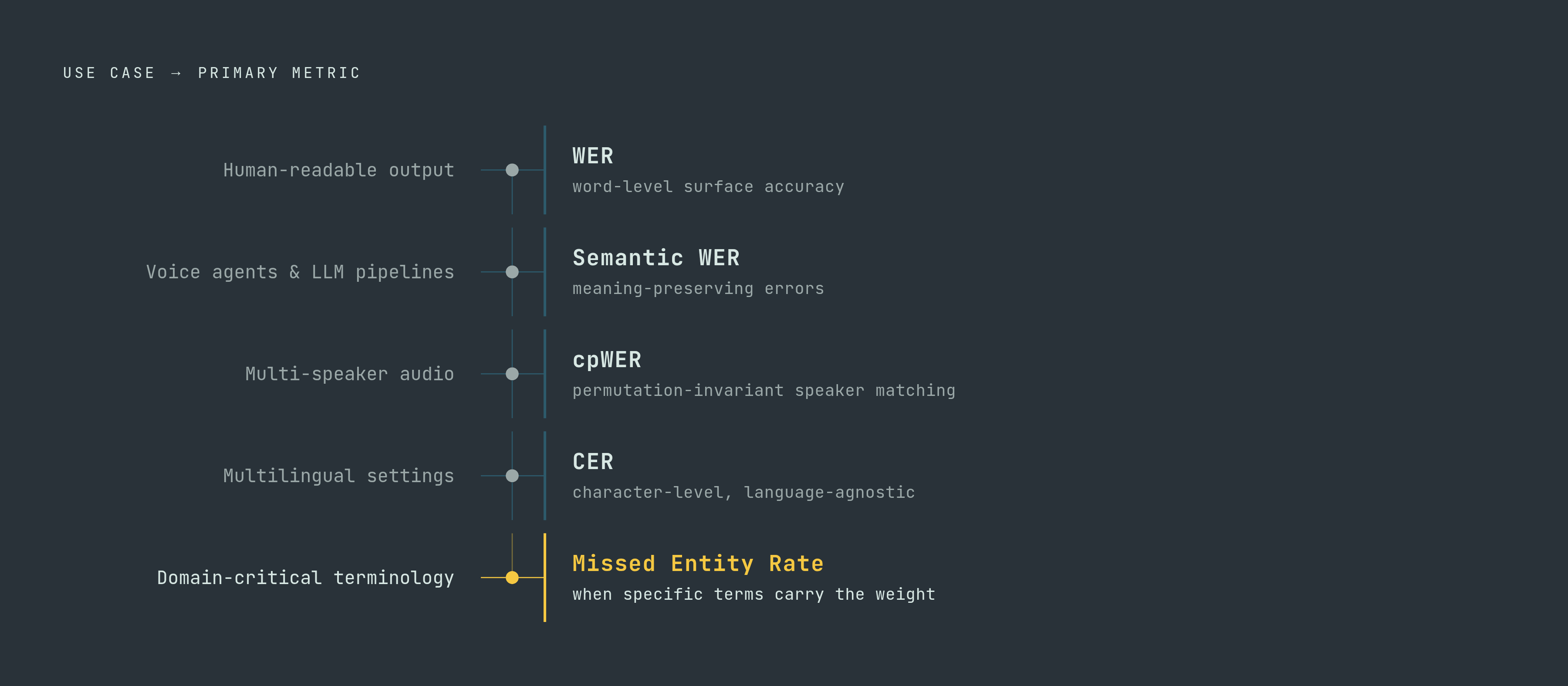
So the matrix looks like this: WER for anything a human reads directly, Semantic WER for voice agents and downstream LLM pipelines, cpWER for multi-speaker audio, CER for multilingual settings, Missed Entity Rate wherever specific terms carry the weight of the task. Pick the metric before you pick the threshold, not after. The metric defines "low confidence" in the first place, and getting this order backwards is the single most common mistake in the whole pipeline.
The six error patterns that low-confidence flags are actually catching
Production error analysis in speech-to-text pipelines reveals recurring patterns worth learning individually, because a confidence flag is just a symptom and each symptom points somewhere different. Treat every flag the same way, route it all to a human reviewer, and the wrong thing gets fixed roughly half the time. That's the mistake to name plainly: not every low-confidence flag is a transcription problem, and assuming it is wastes the one resource, reviewer attention, that this whole system exists to protect.
Homophones sit at the top of the list: "their," "there," "they're," "to," "too," "two." The model is guessing spelling from context, and confidence drops in short utterances, one-word answers, or sentences that trail off before they resolve.
Domain-specific terms are the second pattern, and the fix is usually simpler than a review workflow. Keyterm prompting, feeding the model product names, acronyms, and proper nouns ahead of time, measurably improves recognition. AssemblyAI's own example shows "afib/gerd" correcting to "AFib/GERD" once the terms were prompted ahead of the call. Low confidence on an unfamiliar term should send you to the vocabulary list, not straight to a human reviewer.
Multi-speaker audio is its own category of failure, and mistaking it for a transcription error wastes a reviewer's time. Streaming diarization systems can now handle up to ten speakers with live labeling, re-clustering corrections within roughly half a second of the stream ending. Low confidence on speaker-attributed segments usually means the diarization broke, not that the words were mistranscribed. Recording each speaker on a separate channel turns this from an open ML problem into something closer to solved.
Audio quality is the blunt instrument behind a lot of failures across every deployment type. When confidence sits low consistently on segments from one particular source, whether that's a device, a channel, or a call center location, the fix is the recording environment, not a lower threshold.
Accent and out-of-distribution speech round out most of the list. The Edinburgh International Accents of English Corpus, covering more than 40 English varieties, shows average WER of 19.7% against just 2.7% on US read speech. That's not a rounding error. That's a different model performance for a different population of speakers, and routing those speakers to human review without also revisiting model choice treats the bruise while ignoring the fall.
Downstream amplification is the sixth, and it's the one that catches people off guard. CHiME-8's summarization evaluation found only weak correlation between transcription quality and summary quality: systems above 50% tcpWER produced summaries roughly on par with systems near 11%. Summarization forgives, because it aggregates errors away. Compliance evidence, dispute reconstruction, and voice-agent command parsing forgive nothing, because they turn on the exact words spoken. Same underlying error, wildly different consequence, depending entirely on what sits downstream of it.
How calibration quality determines whether your thresholds are trustworthy
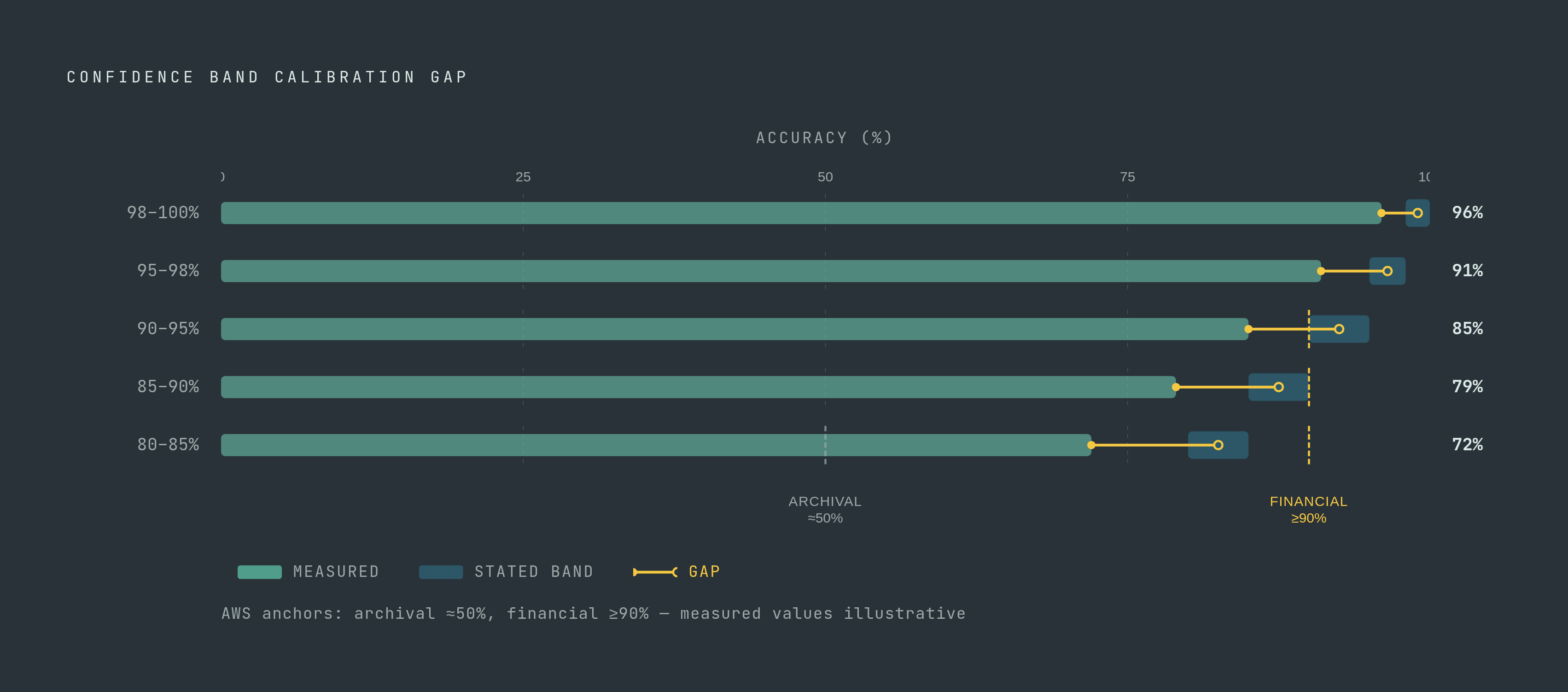
Calibration has a specific, testable meaning: at the 90% confidence band, the system should be right 90% of the time. Any gap between that number and reality is the gap between what a vendor's slide claims and what's actually driving your routing decisions.
Expected Calibration Error (ECE) and Brier Score are the standard tools for measuring this. ECE is the weighted average gap between stated confidence and actual accuracy, measured across confidence bins, so it tells you exactly where the miscalibration lives instead of just confirming it exists somewhere.
A July 2026 preprint on beam search confidence estimation (SR-CEM) cut word-level maximum calibration error substantially under a standard softmax baseline down to a much lower figure, and posted the lowest ECE on the benchmark dataset tested. SR-CEM won on calibration specifically, which is the property that matters once you set a threshold and walk away from it.
That distinction carries the whole section. A score can rank correct and incorrect outputs well (discrimination) while being badly scaled (calibration), and the reverse holds too. The confidence format your vendor ships may have been tuned for one property and not the other, so before setting any threshold, ask which property the score was actually optimized for. Most vendors won't volunteer the answer. Ask directly, and if the answer is vague, treat that vagueness as data.
None of the threshold math in the next section means anything if the underlying scores rank correctly but scale wrong. Calibration and discrimination are different questions, and a system can pass one while failing the other outright.
Setting thresholds that reflect measured risk rather than vendor defaults
AWS suggests a starting range of roughly 50% confidence for archival text and 90% or higher for financial decisions. Treat that as a hypothesis to test against your own data, not a policy to adopt just because AWS wrote it down. Adopting a vendor's suggested threshold wholesale is the second big mistake here, right behind skipping calibration checks altogether: a number that worked on someone else's audio, speakers, and microphones doesn't describe yours.
The actual method is more manual and a lot more reliable: bucket predictions by confidence band (80 to 85%, 85 to 90%, 90 to 95%, 95 to 98%, 98 to 100%) and measure the real error rate inside each bucket against your own audio before locking in a cutoff anywhere.
What the threshold should be depends entirely on what sits on the other side of the error. Legal evidence review routes almost anything below a high threshold to human review, because missing an error costs far more than reviewing something that turns out fine. Meeting transcription for note-taking can run a much lower threshold, since Semantic WER, not word-level WER, actually governs whether the notes are usable. Voice agent command parsing needs careful handling, because different error types carry different consequences for downstream actions. Financial and compliance extraction sits at the strict end, 90% or above, with Missed Entity Rate tracked right alongside the confidence distribution.
Thresholds aren't the only lever. Reducing errors before they reach the threshold works just as well, sometimes better. AssemblyAI's Universal-3.5 Pro Realtime model cut WER by 10.2% across 20,000 voice-agent files just by passing agent context ahead of the transcription call. Fewer errors upstream means a cleaner signal when confidence scores do dip, and keyterm injection does the same job for known vocabulary, improving recognition of terms the model might otherwise flag before threshold logic ever has to make a call.
One global threshold for an entire pipeline is asking for trouble, and this is worth naming outright: teams pick a single number because it's simpler to build, then wonder why the review queue is either flooded or useless. Different field types, different speaker setups, different downstream consumers carry different risk. A routing table with several thresholds beats a single number every time. If your system only has one threshold today, fix that first, before touching the number itself.
Routing low-confidence output without overwhelming reviewers
The whole point of a human-in-the-loop system is that the machine clears the large, confident majority on its own, and people handle the smaller uncertain remainder. That only works if the remainder stays small and coherent enough to actually get read. Set the threshold wrong and the "small remainder" turns into a queue nobody can keep up with, and at that point the automation isn't saving anyone any work at all.
Real outcomes hinge on getting this right. A Nordic insurer reached 70% automatic extraction on unstructured medical reports and invoices. A biotech firm eliminated roughly 1,750 hours of manual accounts-payable work in a year. Neither number comes from a threshold pulled off a vendor's default settings. Both depend on thresholds calibrated against measured error rates.
The failure mode on the other side of that coin costs just as much, maybe more. A threshold set too cautiously floods reviewers with flagged segments that turn out fine, and that erodes trust fast: reviewers burned by too many false alarms start rubber-stamping the queue instead of reading it, which defeats the entire point of having a queue in the first place. An overcautious threshold and an absent one end up producing roughly the same outcome, unreviewed errors, just by different paths. Neither is the safe choice, whatever the engineer who set it might have told the compliance team.
Design the routing around what's actually uncertain, not around the whole transcript by default. Flag individual low-confidence words in the interface when only isolated spans are shaky, and reserve full-transcript review for cases where aggregate confidence drops below threshold or a high-stakes span (a named entity, a numeric value, a speaker attribution) gets flagged. Different error types deserve different queues, too: a vocabulary miss needs a subject-matter expert, an audio-quality failure needs a re-recording request, not a reviewer squinting at static trying to guess at syllables. Track what reviewers actually correct, then feed that back into recalibrating the thresholds, because reviewer corrections are the closest thing to ground truth the system will ever get.
There's a regulatory clock running under all of this now, too. The EU AI Act's December 2027 deadline makes human oversight a legal requirement for high-risk AI systems under Annex III. Human-in-the-loop routing isn't purely an accuracy strategy anymore. For standalone high-risk systems, it's partly a compliance artifact, whether or not anyone on the engineering team thinks of it that way.
Ensemble confidence scoring, pulling from multiple signals rather than one heuristic, tends to produce more reliable routing decisions than any single score, for the same reason a second opinion beats a single doctor's read: a score built from several angles is harder for one bad audio condition to fool.
Production monitoring to detect drift before thresholds become stale
A threshold set correctly on day one doesn't stay correct forever. Confidence distributions shift as audio quality changes, as the speaker population changes, or as the vendor pushes a model update nobody on the team asked for. Any of those can quietly invalidate a threshold that took weeks to calibrate.
The monitoring habit worth building is fairly unglamorous: sample a fixed share of production transcripts every week, correct them by hand, and score the model against those corrected references. That's how drift gets caught instead of guessed at months later from a customer complaint. Layer confidence scores on top of that sample and route the low-confidence spans to review, the same as production traffic.
Watch the shape of the confidence distribution itself, not just the trailing WER number. A shift in the share of outputs landing in the 80 to 85% band tends to show up before WER visibly degrades. By the time WER moves, the distribution already told you something was changing, which makes distribution-watching the earlier warning of the two.
Model swaps deserve special caution here. MLCommons added Whisper-Large-V3 to its MLPerf Inference v5.1 benchmark suite in September 2025, and Whisper cut the WER of the prior benchmark model, an RNN-T system, by more than 72%. That's a genuinely large jump, and adopting a change of that scale without re-checking calibration can undo months of careful threshold work overnight. The only way to catch it before it becomes a routing problem is monitoring that's already running when the swap happens, not monitoring planned for afterward.
Validation feedback loops, tracking accuracy at each confidence band and recalibrating thresholds against what actually happened, separate a production-grade confidence system from something that got configured once and forgotten. The Open ASR Leaderboard (Srivastav and colleagues, 2025, hosted on Hugging Face) offers a standardized way to compare open-source and proprietary systems across multiple datasets, useful groundwork before evaluating any candidate replacement model.
Monitoring also tends to surface audio-quality problems that threshold tuning can't fix on its own. Consistent low confidence tied to one channel, one device type, or one call center location usually points to an environment problem, and fixing that reduces review load more than any amount of threshold fiddling ever will. Watching confidence distributions and adjusting routing logic over time is what separates a transcription pipeline that stays ahead of degraded output from one perpetually cleaning up after it.