Speaker Diarization vs Speaker Identification in Meeting Pipelines
Choosing the wrong technology early cascades errors through every downstream feature.
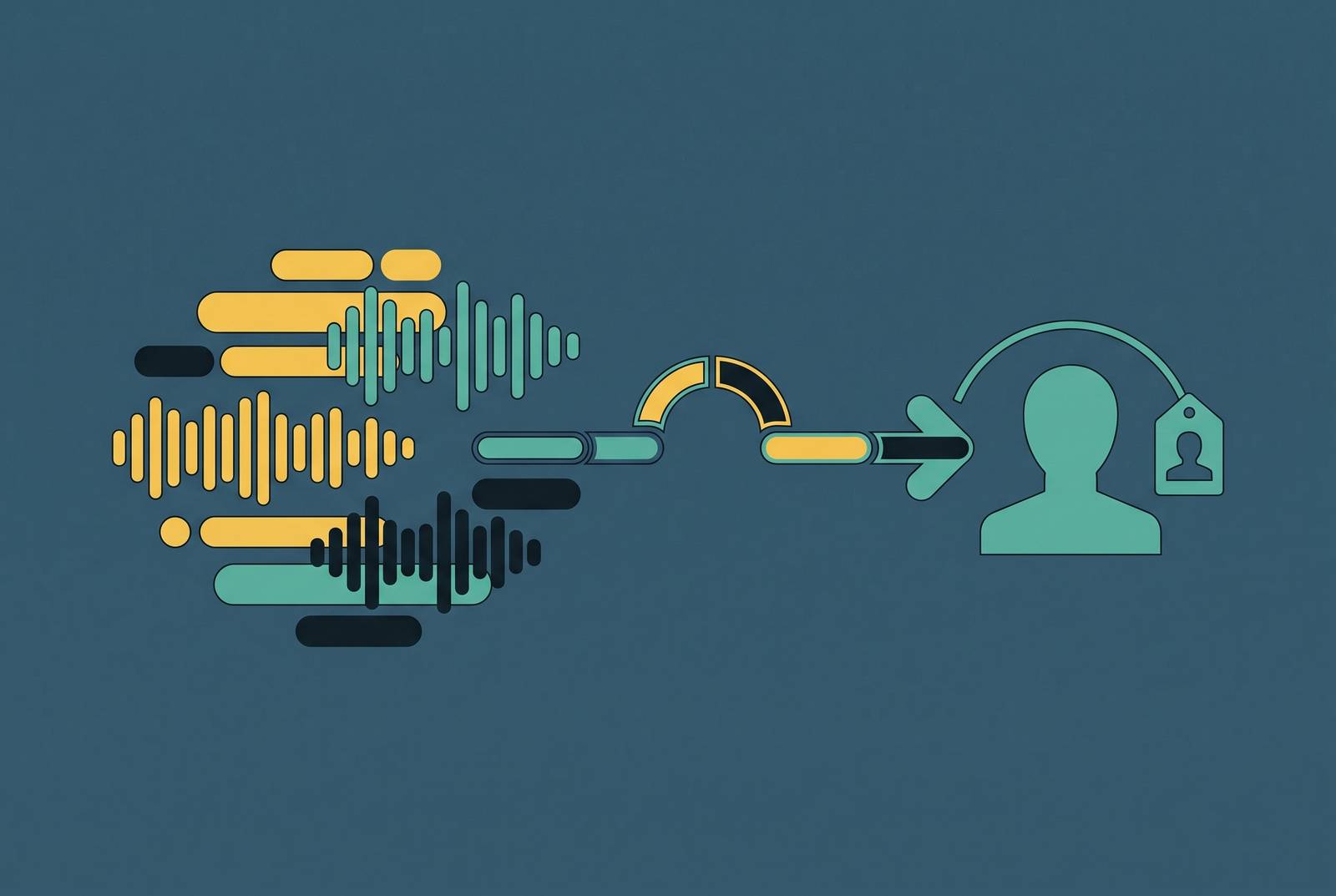
Speaker diarization and speaker identification get treated as interchangeable terms in product specs all the time, and that's a mistake with real consequences. Diarization answers "who spoke when." Identification answers "who is this person." Confuse the two, or pick the wrong one for a build, and every feature downstream of that decision, from talk-time analytics to compliance logs, inherits the error.
Four terms get thrown around in engineering conversations as if they were synonyms: diarization, recognition, identification, verification. They're not. Each does a distinct job, and the confusion isn't just semantic sloppiness: it costs teams real rebuild time when the wrong technology gets specified early and the mistake becomes visible three sprints later.
Diarization partitions an audio stream into speaker-labeled segments. It doesn't care who those speakers are in the real world. No enrollment, no voiceprint, no name attached, just "Speaker 1" and "Speaker 2," and those labels are anonymous and local to that one file. Identification does something different: it takes an incoming voice and checks it against a roster of voices registered in advance, then returns a name. It cannot work on someone it has never met. AssemblyAI's August 2026 framing lays out the ladder cleanly: diarization separates anonymous voices, identification picks a known person out of a group, and verification confirms a single claimed identity, the kind of check a service might run before granting account access.
The gap that trips people up most is persistence across files. Picovoice's October 2025 writeup makes clear that "Speaker 1" in one recording has no relationship to "Speaker 1" in another recording, even if it's the same human being talking in both. Diarization has no memory between files. Identification fixes that, because Jane Doe is Jane Doe every time her voiceprint matches, across any number of recordings. That distinction alone should decide a lot of architecture calls before a single line of code gets written.
What each technology produces and what it requires as input
Diarization's output looks like a timestamped map: "Speaker 1 [00:00-00:03], Speaker 2 [00:04-00:07]," and so on down the recording. It needs nothing in advance. Feed it a multi-speaker audio file and it starts segmenting immediately.
Identification's output is a set of confidence scores against a known roster: "Jane: 0.77, John: 0.13, Sarah: 0.10." Picovoice's October 2025 documentation states the higher number wins, but the system only works if Jane, John, and Sarah were enrolled beforehand. That's not a shortcoming to be optimized away with a better model. It's a hard operational boundary. Diarization runs on any audio the moment it arrives. Identification cannot name a person who was never registered, full stop, no matter how good the underlying model is.
That enrollment requirement carries weight beyond convenience. Storing voiceprints is a data governance decision, not just an engineering one, and it is squarely inside GDPR territory and whatever sector-specific rules apply to the business. A voiceprint is biometric data. Treating its storage as a minor implementation detail is how compliance reviews turn into fire drills.
None of this means the two technologies compete for the same job. Plenty of voice analytics systems run both in sequence, as Picovoice's October 2025 breakdown describes: diarization segments the audio first, then identification maps each segment to a named person. Layering them is additive. Each one solves a problem the other one can't touch.
The pipeline architecture decision: batch versus streaming, and when each applies
Batch, or async, diarization waits until the whole recording is in hand before it starts working. Because it can scan the entire file, forward and backward, it's the most accurate option available, and AssemblyAI's August 2026 guidance points to it as the right call for post-call analytics, meeting summaries, and media transcription work where nothing needs to happen in real time.
Streaming diarization can't afford that patience. It assigns labels the moment speech arrives and can't look ahead, so it commits to a speaker label based only on what it's heard so far. The first few conversational turns are the shakiest, since the model hasn't built up enough audio to be confident yet. Still, streaming is the only option when speaker identity has to shape what happens next, mid-conversation. A voice agent that needs to tell the customer apart from a human agent joining the call in real time has no other path forward. Batch simply arrives too late to be useful there.
On a standard two-party agent call, diarization might not be needed at all. Channel separation, one microphone or line per speaker, sidesteps the whole problem. Diarization earns its place when channels collapse into one another: warm transfers, conference bridges, speakerphone calls, mono recordings where every voice lands on the same track, as the Cekura research referenced in this space shows. That's the moment the technology stops being optional.
The field is pushing further into complex environments too. The MISP 2025 Challenge, a multimodal speech processing benchmark for meeting scenarios, extended the audio-visual diarization work first introduced in MISP 2022, a signal that the next frontier is meetings with multiple overlapping speakers and camera feeds, not just clean two-party calls.
Identification adds its own wrinkle to streaming. Real-time voiceprint lookup means latency budgets and enrollment pipelines have to be designed in from the start, not bolted on after the diarization architecture is locked. Skipping that step is how a team ends up re-architecting the whole thing six weeks before launch.
Why headline accuracy numbers mislead and what to measure instead
pyannote's own benchmark table shows Diarization Error Rate ranging from 8.9% to 46.8% across twelve datasets, same pipeline, same code, nothing changed except which audio went in. That's a five-fold spread. A vendor's single headline DER figure, quoted without context, tells a buyer almost nothing about how the system will behave on their actual calls.
Part of the problem is that DER measures diarization in isolation, disconnected from the words actually being transcribed. cpWER, concatenated minimum-permutation word error rate, ties the speaker label to the transcript itself, and AssemblyAI's August 2026 material makes the case that this is the metric that actually reflects what a user experiences. A file can post a decent DER and still produce a transcript that reads like garbage if the speaker boundaries land in the wrong place relative to the words.
Overlapping speech makes the problem sharper still. On the DIHARD III core development set, overlapping speech accounted for a modest but non-trivial share of total speaking time, and that's a corpus built mostly from recorded conversation, calmer traffic than the interrupt-heavy back-and-forth a phone agent deals with all day. Real call center audio is going to stress diarization harder than most academic benchmarks let on.
The corrective is open, standardized benchmarking rather than vendor-reported single numbers. Argmax presented SDBench at Interspeech 2025 in Rotterdam (August 17-21), an open-source benchmark suite spanning 13 datasets across languages and use cases with standardized test splits and evaluation configs. It's since been renamed OpenBench and extended to cover real-time transcription and keyword recognition too. That kind of infrastructure matters because it lets a team compare systems on the same footing instead of trusting whatever number a vendor chose to publish.
Identification needs its own version of this discipline: threshold calibration. A confidence score of 0.87 signals a strong match; 0.15 signals it's probably not the person at all, per Picovoice's guidance. Where a team sets that cutoff matters as much as how good the underlying model is. Setting it too loose causes false matches to occur; setting it too tight causes real matches to be rejected.
How diarization error cascades into every downstream meeting pipeline feature
Every speaker-scoped metric in a meeting pipeline inherits whatever error diarization introduces. The Cekura research cited earlier shows that talk ratio, interruption counts, sentiment scored per speaker, compliance attribution, all of it fails together the moment the underlying speaker labels are wrong. There's no feature built on top of diarization that gets to skip this exposure.
Conversation intelligence tools make the dependency obvious. Per-speaker sentiment, agent-versus-customer breakdowns, summaries that attribute specific statements to specific speakers, all of it sits on top of clean diarization as a foundation, and AssemblyAI's August 2026 material is blunt about the consequence: one corrupted speaker label poisons every layer built on top of it. Fix the label upstream or accept that everything downstream inherits the mistake.
In legal and regulatory contexts, misattribution is a liability issue rather than a product quality issue. Depositions, hearings, regulatory documentation, anywhere speaker attribution carries legal weight, misattributing a statement has consequences that reach well past a bad user experience.
Healthcare shows the sharpest version of this risk. A 2025 commentary in npj Digital Medicine names speaker attribution error as a specific patient safety concern in AI scribe systems: current tools can attribute a patient's own words to the clinician, or the reverse, which is a different category of failure than a clunky transcript. That's not an inconvenience. That's a documentation error in a medical record.
Identification errors fail differently, and arguably worse. An anonymous diarization mistake produces a neutral placeholder, "Speaker 2," that a reader can treat with appropriate skepticism. A false identification match produces a confident, specific, wrong name attached to a statement. The error looks authoritative even though it isn't, which makes it more dangerous, not less.
There's at least one concrete data point on what fixing this looks like in practice. AssemblyAI's August 2026 reporting shows Metaview, a meeting-intelligence platform, saw roughly a 47% drop in low-confidence tokens after switching to a more accurate async diarization model. That's a useful proxy for how much cleaner speaker-attributed data gets across an entire pipeline once the diarization layer improves, not just a marginal metric bump.
Where to use diarization alone and where identification becomes necessary
Diarization alone is enough when the goal is a readable, speaker-split transcript, and anonymous labels do the job just fine. Meeting notetakers, conversation-intelligence dashboards, podcast transcription, contact-center analytics, all of these can run entirely on "Speaker A" and "Speaker B" without anyone needing to know those speakers' actual names, as Picovoice notes in its guidance.
Context-based label resolution offers a middle ground worth mentioning too. Instead of full voiceprint identification, a system can infer "the doctor" and "the patient" from conversational context, who's asking the questions, who's describing symptoms, without ever building an enrollment database. It's not persistent identity tracking, but it gets a product meaningful labels without the overhead identification demands.
Identification becomes necessary once the product requires persistent named attribution across sessions. A team meeting tool that needs to map voices to specific named colleagues every time, a smart assistant that greets each family member individually, a compliance archive that has to tie every statement to a real legal name across years of recordings, none of these can be satisfied by diarization alone, no matter how accurate it gets.
Verification sits in its own lane entirely: a one-to-one check, confirming a caller really is the account holder they claim to be on a support line. That's a security decision with its own regulatory obligations, distinct from analytics use cases even though it shares underlying voice-matching technology with identification.
There's also a correction layer that doesn't require switching technologies at all. A 2025 paper in Speech Communication by Efstathiadis, Yadav, and Abbas looked at LLM-based correction of diarization output as a generalizable fix, cleaning up speaker labels after the fact without the cost of moving to full identification.
The decision heuristic is straightforward, even if teams don't always treat it that way: if there's no case for building and maintaining an enrollment database, diarization is the answer. If persistent named attribution is a real product requirement, identification's operational cost, enrollment flows, voiceprint storage, threshold tuning, is necessary. It's the price of the feature.
How the leading diarization APIs and open-source pipelines compare in 2026
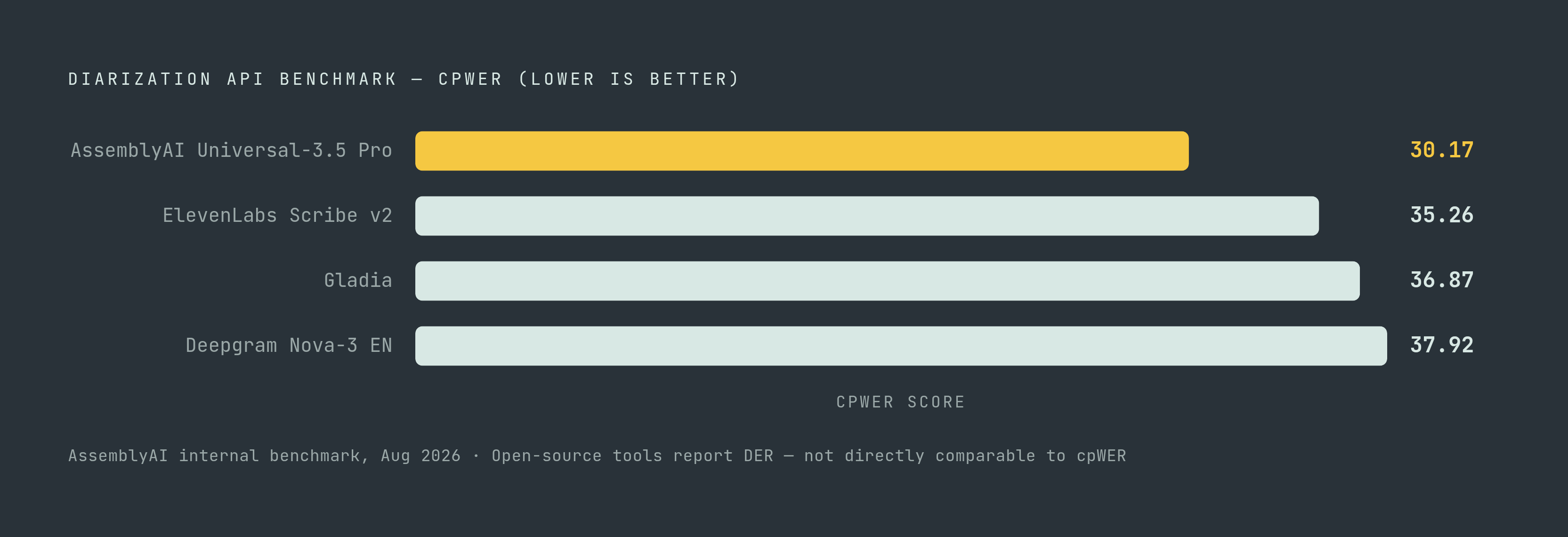
One framing note before any numbers: cpWER is the metric that matters for production decisions, and DER figures from open-source tools don't sit on the same scale as cpWER figures from commercial APIs. Comparing them directly is comparing different units.
Among commercial APIs, AssemblyAI's internal benchmark runs from August 2026 show that lower cpWER is better. AssemblyAI's own Universal-3.5 Pro, released July 7, 2026, posted 30.17 cpWER, running async and real-time streaming under one API key, supporting up to 20 expected speakers async or 10 via a streaming hint, with native code-switching across 18 languages. Metaview's roughly 47% drop in low-confidence tokens after migrating to this model is the concrete result cited above. Pricing is listed at $0.15 per hour. ElevenLabs Scribe v2 came in at 35.26 cpWER, async and ASR-first, a natural fit for teams already built around the ElevenLabs ecosystem. Gladia posted 36.87 cpWER with streaming support, positioned well for teams already using Whisper who need diarization layered on top. Deepgram Nova-3 EN measured 37.92 cpWER, offering both async and streaming, aimed at high-throughput pipelines where speed is the priority. Speechmatics runs both async and real-time but reports DER rather than cpWER, and it's positioned more toward enterprise deployments that need on-premise options.
On real voice-agent conversations specifically, using the Pipecat open STT benchmark cited by AssemblyAI in August 2026, Universal-3.5 Pro Realtime posted a 6.99% word error rate against Deepgram Flux's 15.58%, a gap that matters most for teams building streaming, live-conversation products rather than post-call analytics.
Open source tells a different story, reported in DER rather than cpWER. pyAnnote is batch-focused, with that 8.9%-46.8% DER spread across 12 datasets depending heavily on audio conditions, a strong fit for research work and custom self-hosted builds where a team has the resources to tune it. NVIDIA NeMo offers streaming through its Sortformer architecture, described as production and deployment ready, geared toward advanced research and multi-speaker ASR work. DiariZen, documented in an April 2026 arXiv paper (2604.21507), is described as the leading open-source state-of-the-art pipeline at the time of writing: a hybrid design built on a structurally pruned WavLM-Large encoder, a Conformer backend using powerset classification, and VBx clustering, which achieved 14.49% DER on DIHARD III according to Interspeech 2025 research, with tutorial documentation available on GitHub. Kaldi and SpeechBrain round out the open-source batch options, both DER-reported, both suited to academic research and prototyping rather than production deployment out of the box.
None of these benchmarks capture the operational weight identification adds on top: enrollment database management, voiceprint storage infrastructure, and confidence threshold calibration. Those factors have to be evaluated on their own terms, separate from whatever accuracy figure a model posts.
How meeting pipeline builders should sequence these decisions in practice
Start with this: does the product need speaker-split text, or does it need named-speaker text? That single answer determines whether diarization alone is sufficient or whether identification has to be layered on top.
From there, the question of which mode to use follows naturally. Does speaker identity need to shape what happens during the conversation, which means streaming, or is post-call analysis good enough, which means batch is available and generally more accurate? Streaming narrows the field of API options considerably and introduces latency constraints that batch never has to deal with.
Then comes the question of enrollment, and it's often the one teams skip until it's too late: can the organization realistically build and maintain a voiceprint database for its user population? If the honest answer is no, identification is off the table, regardless of how strong its accuracy numbers look on paper.
Only after those three questions does accuracy belong in the conversation, and it should be answered on the team's own audio, not on a vendor's headline figure. That five-fold DER spread across datasets exists precisely because call type, two-party, multi-party, speakerphone, mono, determines which system actually performs well. The published leaderboard position means far less than a test run against the specific audio a product will actually encounter.
The ceiling for meeting intelligence work is a layered architecture: diarization segments the audio first, identification maps those segments to real names where needed, and LLM-based post-processing cleans up whatever errors remain. Each layer is optional, and each one should be justified independently against the cost it adds and the accuracy it buys.
The most reliable way to sequence all of this is to work backward from the features that actually have to function: compliance attribution, per-speaker sentiment, agent performance analytics. Figure out the speaker-labeling accuracy those specific features demand, then choose the technology that clears that bar. Not the one sitting highest on somebody else's benchmark leaderboard.
Sources
- 8 Best Speaker Diarization Solutions & APIs in 2026
- Speaker Diarization vs. Recognition vs. Identification
- Speaker Diarization vs Speaker Identification
- DiariZen Explained: A Tutorial for the Open Source State-of-the-Art Speaker Diarization Pipeline
- Overlap-Adaptive Hybrid Speaker Diarization and ASR-Aware Observation Addition for MISP 2025 Challenge