On-Premise Transcription Deployment for Regulated Industries
Data residency and regulatory exposure make cloud transcription risky for regulated firms.
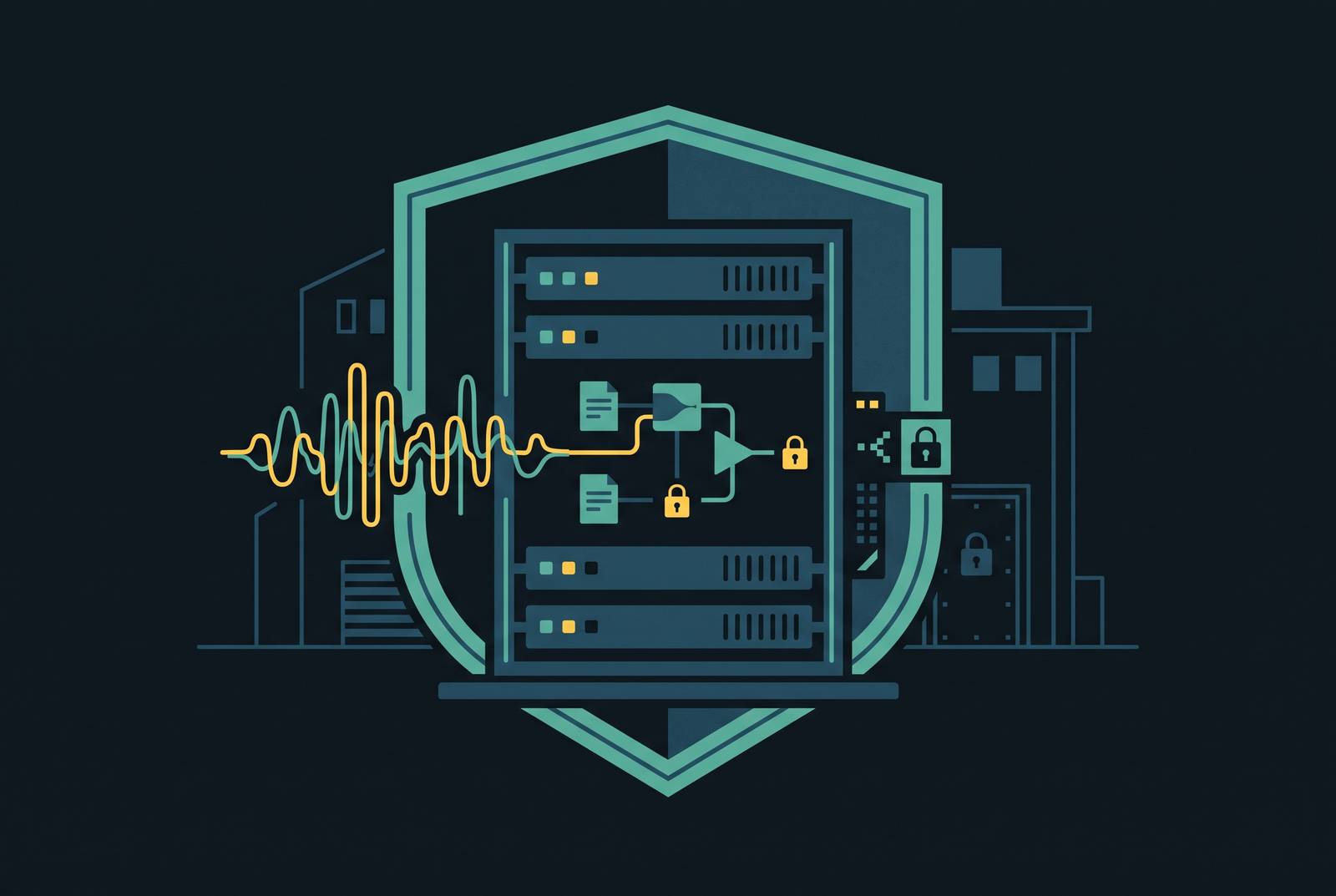
Transcription used to be a convenience: someone recorded a meeting, a vendor typed it up, nobody thought twice about where the audio went afterward. That era is over. Every recorded clinical encounter, client call, or deposition now generates a data artifact that a regulator, an opposing counsel, or a foreign court can demand to see, and where that artifact physically sits has become the whole ballgame. For most regulated workloads, cloud transcription is the wrong default. On-premise isn't the cautious choice here. It's the correct one, and the rest of this piece is the argument for why.
Cloud transcription vendors build for speed and scale: process as many hours as possible, as fast as possible, across as many customers as possible. Regulated organizations need something closer to the opposite: containment, chain of custody, an audit trail that survives cross-examination without anyone in the room having to explain a gap. Those aren't two versions of the same goal. They're different goals, and no amount of vendor certification paperwork changes that math.
How the US CLOUD Act and GDPR create a structural conflict that cloud deployment cannot resolve
Start with two laws that were never built to talk to each other. The US CLOUD Act, passed in 2018, lets American law enforcement compel US-based tech companies to hand over data no matter where in the world that data physically sits. GDPR Article 48 says roughly the opposite: European data can't go to a non-EU authority just because that authority issued an order, unless an international agreement backs it up.
Put those next to each other and a vendor ends up stuck in the middle. A US cloud provider storing audio files in a Frankfurt data center is bound by American law to comply with a CLOUD Act subpoena, and bound by European law to refuse it. There's no third option where everybody walks away happy. In 2025, Microsoft told regulators it could not guarantee full data sovereignty for its EU customers, the largest cloud provider on the planet conceding, in public, that the architecture has a hole no regional data-center map can patch over.
Companies have noticed, and they're voting with procurement budgets. IDC projects global spending on sovereign cloud services will hit $258 billion by 2027, up from roughly $80 billion in 2022. Two new EU rules raise the stakes further: DORA, effective January 17, 2025, and NIS2, with a transposition deadline of October 17, 2024. Both require financial firms and essential-service providers to manage risk from third-party ICT vendors, and a cloud transcription API is exactly the kind of vendor these rules were written to scrutinize.
Meta's €1.2 billion penalty in May 2023, the largest ever issued, came specifically from EU-US data transfer violations. GDPR fines can run up to 4% of a company's worldwide annual revenue, which turns a data residency question into a board-level conversation rather than something IT quietly handles on its own.
On-premise deployment sidesteps the whole mess structurally, not contractually. Audio that never leaves the organization's own infrastructure can't be subpoenaed from a cloud vendor, because there's no cloud vendor holding it. No custody, no compulsion.
What healthcare organizations actually risk when PHI touches an external transcription pipeline
Send a patient audio file to an external transcription API and several things happen at once, most of them unwelcome. It requires a Business Associate Agreement. It creates a new audit trail sitting on somebody else's servers. It opens a breach vector the covered entity doesn't fully control, no matter how polished the vendor's security page looks.
Most compliance teams underestimate one thing here: a single AI transcription run doesn't produce just a transcript. One pipeline can spin off an audio file, a transcript, a summary, a draft clinical note, and system logs, each carrying its own privacy exposure, its own access rules, its own retention clock. HIPAA requires six years of documentation retention, and under HHS guidance, cloud speech-to-text vendors handling patient audio count as business associates. The BAA obligations attach the moment audio leaves the building, whether or not anyone remembered to check that box.
State law stacks on top of that. California's CCPA, New York's SHIELD Act, and similar statutes elsewhere create obligations tied to where the patient lives, not where the vendor's servers happen to sit. GDPR adds another wrinkle for any healthcare organization with European patients, since it restricts moving health data outside approved jurisdictions, something cloud routing can't reliably guarantee once traffic starts getting load-balanced across regions.
Then there's "shadow AI," which sounds like a spy novel plot and is really just an employee opening an unapproved transcription app on their phone during a patient visit. What starts as a garden-variety lapse can turn into a full regulatory investigation, and some states are already moving toward AI-specific consent requirements for provider-patient interactions. Voice AI is spreading through hospital systems faster than anyone is building the guardrails for it, a bit like handing out car keys before the roads are finished.
On-premise resolves the structural problem cleanly, not partially. Audio processed entirely inside the organization's own infrastructure never becomes a third-party BAA obligation, never generates an external audit trail, and never crosses a perimeter the covered entity doesn't already control.
How financial services recordkeeping rules turn transcription architecture into an enforcement question
The SEC and CFTC have made their position clear through sheer repetition. Since 2021, the two agencies combined have brought more than 100 enforcement actions and collected over $3 billion in penalties tied to recordkeeping failures. Stifel and Invesco each paid $35 million for failing to preserve off-channel communications, the kind of gap that opens up when employees text clients from personal phones and nobody's capturing any of it.
SEC Rule 17a-4 requires either WORM storage (write once, read many) or an electronic system with a defensible audit trail, so the architecture of the transcription system itself decides whether the resulting record holds up in an exam. When an AI tool processes a voice call and produces a transcript or summary, that output becomes a written record under Rule 204-2, generally required to be kept for five years from the end of the fiscal year the last entry was made.
KYC and AML rules add another layer, requiring documented records of client interactions during onboarding. Regulators are increasingly willing to accept transcripts as evidence, but only when the transcript is accurate, unaltered, and stored properly, and all three get harder to guarantee once a third party holds the processing infrastructure and the audio never sat on a system the firm itself controls. MiFID II layers parallel obligations onto European financial firms covering call recording, retention, and audit trails, which collides directly with the CLOUD Act exposure covered above. Same jurisdictional knot, different regulatory hat.
Banks aren't adopting on-premise transcription because it's fun to build. They're adopting it because the alternative is an examiner asking why a call went unrecorded, and "the vendor's servers were down" has never once satisfied an SEC examiner. On-premise architecture makes WORM-compliant storage, an immutable audit trail, and chain-of-custody documentation far easier to build, since the pipeline runs on infrastructure the firm owns and governs under its own retention schedule, not a vendor's.
Why attorney-client privilege is especially fragile under cloud transcription and what bar guidance now says about it
Privilege depends on confidentiality, and confidentiality depends on nobody outside the relationship having access to the conversation. Send audio of a privileged conversation to a cloud transcription tool, and a third party now has that access, which is exactly the condition that can waive privilege in litigation. That's the whole doctrine, in one sentence.
AI transcription makes this worse than it first looks, because it doesn't summarize the way a paralegal taking notes would. It captures virtually everything, verbatim: offhand remarks, corrections, statements someone retracted thirty seconds after making them. Curated meeting minutes leave things out on purpose. An automated transcript doesn't know what to leave out, and every word of it can become discoverable material in litigation or a government investigation.
Bar associations have started responding directly. The New York City Bar Association's Formal Opinion 2025-6 addresses how vendor practices — cloud storage and AI model training specifically — pose risks to privilege that can arise without anyone in the room ever intending it. Bar association guidance has moved in the same direction, with recommendations that attorneys carefully restrict AI tool use in privileged contexts and favor local or secure firm infrastructure over third-party cloud services.
The example that pushed this into mainstream attention involves Otter.ai. Machine-learning engineer and researcher Alex Bilzerian reported receiving a complete transcript from Otter.ai that reportedly captured private conversation after a Zoom call had officially ended. The post spread widely online and handed bar associations a concrete, viral illustration of exactly the failure mode they'd been warning about in the abstract. AI-based recording platforms can jeopardize privilege whenever conversations are stored, shared, or used to train a vendor's model, even when the recording itself was lawful and everyone in the room consented to it. Recording, transcription, summarization, and cloud storage are four separate links in one chain, and privilege depends on every single link holding.
On-premise deployment removes the third-party-access problem at the root, rather than managing around it with contract language. Process the audio inside firm infrastructure, with no outside vendor ever holding the data, and the confidential relationship privilege depends on stays intact.
The three operational conditions that make on-premise the rational architecture choice, not just a compliance checkbox
Compliance is one reason to go on-premise. Treating it as the only reason actually undersells the argument, because the strongest case for on-premise infrastructure often has nothing to do with regulators at all. Deepgram's production deployment guidance points to three forces driving the decision, and only one of them is regulatory.
The first is exposure: when data legally has to stay inside an organization's perimeter, cloud architecture simply isn't viable, no matter how many security certifications sit on the vendor's homepage. The second is latency. Real-time clinical documentation and live trading floor transcription often need response times under 100 milliseconds, and a cloud round-trip, however fast the vendor's network claims to be, doesn't always hit that bar consistently.
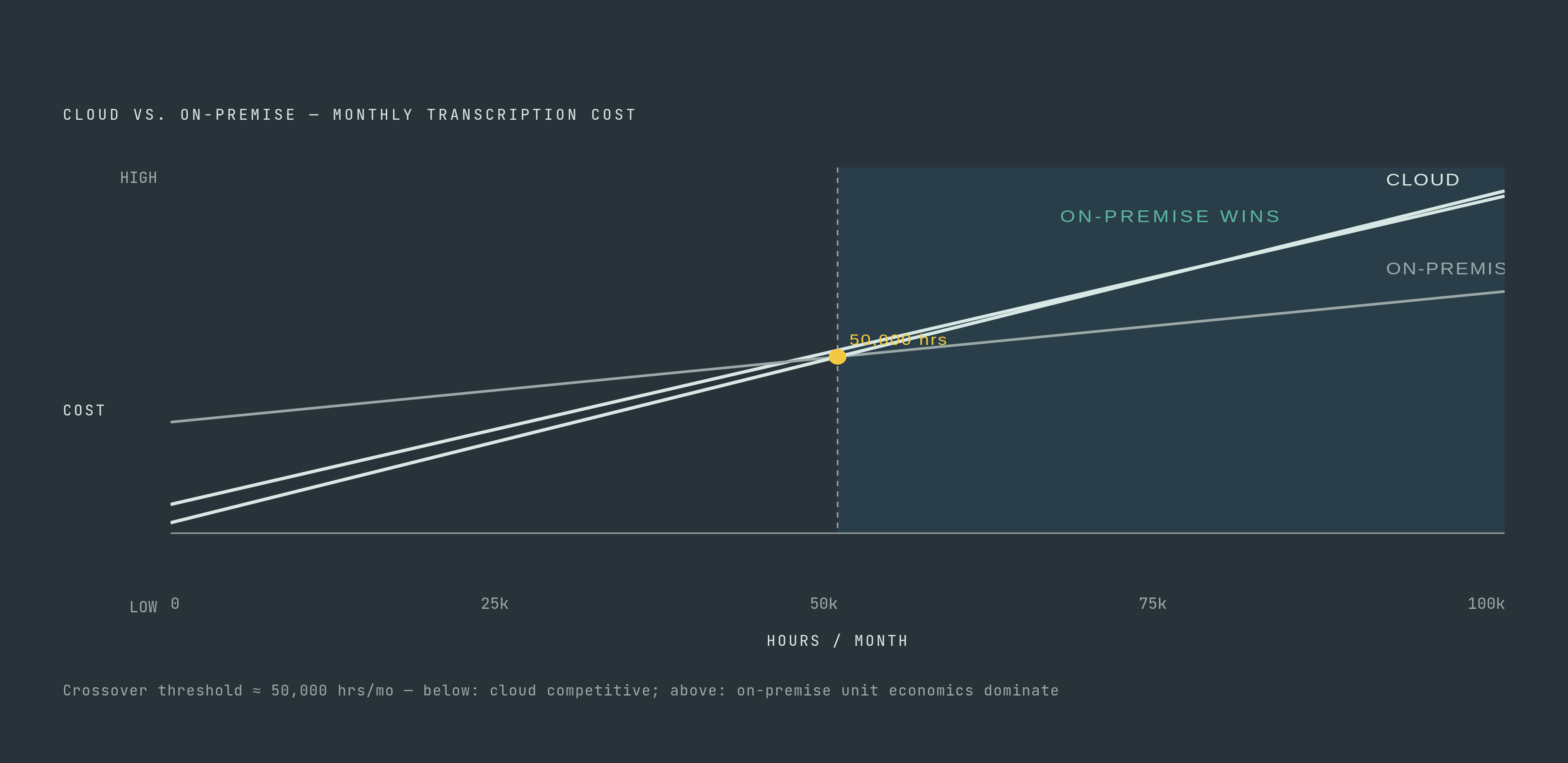
The third is volume economics, and this is the one people get backwards most often: past roughly 50,000 hours of transcription a month, on-premise infrastructure's unit economics tend to beat or match cloud per-hour pricing. Past that threshold, staying on cloud isn't the safe choice. It's the expensive one, and treating it as safe is the actual mistake most procurement teams make.
Worth flagging on the regulatory side too: under GDPR, voice recordings count as special-category biometric data once processed through methods that allow unique identification. That reclassifies every audio file, not just the transcript that comes out the other end, into a more sensitive category with tighter handling rules attached.
On-premise deployment also hands organizations direct control over model versioning, which sounds like a minor engineering detail until a vendor pushes a silent update and accuracy drifts without warning. Freezing a model version for audit purposes, testing new vocabulary without exposing live production audio, avoiding a mystery accuracy dip nobody asked for: these are practical, everyday reasons that have nothing to do with a compliance officer's checklist and everything to do with an engineer not wanting a 2 a.m. page.
At the far end of this logic sit air-gapped deployments for defense, intelligence, and certain government workloads, where no audio is permitted to leave the customer's environment under any circumstance. Containerized on-premise systems are built for exactly this job. Cloud APIs, by design, are not, and pretending otherwise is how a procurement officer ends up explaining a data spill to Congress. Defense procurement has been moving this direction deliberately, following the EU's 2022 Strategic Compass and related sovereignty initiatives, treating on-premise not as a legacy holdover but as an active requirement written directly into contracts.
The technology options available for on-premise deployment and what distinguishes them in regulated contexts
On-premise transcription tools split into three rough camps: purpose-built enterprise platforms offering on-premise deployment, containerized or self-hosted versions of cloud-native engines, and open-weight models organizations run on their own hardware. Each carries tradeoffs worth naming specifically, and the wrong pick here isn't a small mistake. Get the deployment model wrong and a hospital system ends up rebuilding its entire pipeline eighteen months in, mid-audit.
Speechmatics offers SaaS, private cloud, and full on-premise deployment, positioned squarely at regulated healthcare and enterprise use. Its Medical Model, launched in December 2025, added German, Danish, and Norwegian to bring the total to seven languages, trained on a large volume of medical-specific data layered on top of an even larger existing model corpus. The new medical language models cut Word Error Rate substantially compared to earlier Speechmatics versions, and the English Medical Model hit a Keyword Error Rate substantially lower than its nearest competitor, with real-time accuracy under one second. Independent, third-party AA-WER benchmarking measured Speechmatics Enhanced at a low WER, not a number Speechmatics generated about itself. The containerized version is specifically cited as suitable for sovereign or air-gapped environments, including defense and intelligence use cases, exactly the crowd this piece has been talking about since the CLOUD Act section.
Deepgram offers flexible deployment including on-premise, with its Nova-3 streaming model measured at a low WER on the third-party AA-WER Streaming benchmark. Deepgram runs a unified speech-to-text and text-to-speech platform, cutting down the integration work for organizations building a full audio pipeline in-house rather than stitching together separate vendors for each half.
AssemblyAI's Universal-3 Pro model scored a low WER on Artificial Analysis's AA-AgentTalk subset, part of the AA-WER v2.0 benchmark, landing third among the models measured there, not first. Whether AssemblyAI offers a dedicated on-premise deployment path isn't confirmed in available sources, so that shouldn't be assumed either way.
Azure Cognitive Services supports on-premise deployment through Azure containers, an option specifically cited in industry guides as a route for regulated industries. Azure covers 129 neural voices across 54 locales and more than 50 languages, and its pricing gap between real-time and batch processing is stark: a notably higher rate per audio hour for real-time versus a much lower rate for batch, a several-fold difference that matters enormously once volume planning enters the room. Azure offers a HIPAA BAA, though GDPR compliance depends entirely on how the deployment is configured, not something the default routing guarantees on its own.
Google Cloud Speech-to-Text covers over 50 languages and plugs cleanly into the broader Google Cloud ecosystem, with a real-time-versus-batch cost gap of roughly 5.3x. A standalone on-premise container option comparable to Azure's isn't confirmed in available sources, so that comparison shouldn't be forced where the evidence doesn't hold it up.
AWS Transcribe has a narrower streaming-to-batch cost gap, around 1.67x, which matters for organizations running mixed real-time and batch workflows. It carries a 15-second minimum per request too, a detail that quietly inflates costs for short interactive voice response calls, the kind financial services contact centers run constantly and at high volume.
None of this is really about finding the single best score on a benchmark chart, and treating it that way is the mistake most procurement teams make. It's about matching WER performance, deployment flexibility, and pricing structure to the specific regulatory and volume conditions covered throughout this piece. The right answer for a hospital system processing clinical dictation looks nothing like the right answer for a trading desk logging voice orders in real time. Any vendor selling one tool as the answer to both hasn't read this far.