Data Residency Requirements for Meeting Transcript Storage
Compliance depends on transfer mechanisms, not just where servers sit.
A meeting transcript is the end product of a chain of events, and that chain is what makes residency compliance for transcripts a different and harder problem than residency compliance for an ordinary file. An ordinary file gets created in one place and stored, often by one person, on one system. A transcript starts as an audio stream captured during a live call, gets sent to a transcription engine (frequently a remote AI service running on infrastructure the meeting host never sees), comes back as formatted text, lands in primary storage, gets copied into backup systems, and may later be pulled up by a support technician troubleshooting an account issue. Each of those stages moves data across a system boundary, and in many organizations, across a national border. Voice data captured in a recording is personal data under the GDPR. Every one of those stages, not just the final storage location, has to satisfy lawful basis, purpose limitation, data minimization, storage limitation, and security obligations. Treating residency as a question about "where the file lives" misses most of where the actual risk sits.
Residency, localization, and sovereignty: three different obligations
Residency, localization, and sovereignty get used interchangeably in procurement conversations, and that habit is itself a source of non-compliance, because each term describes a different kind of obligation. Physical location on a server at a given moment is what data residency tells you. Data localization is a legal mandate: a rule that says data must stay inside a specific territory and, in some regimes, cannot be accessed from outside it. Data sovereignty is the broadest of the three: it covers not just where data sits but whose laws govern it and who has the power to compel access to it, regardless of where the servers happen to be.
The GDPR gets called a data residency law constantly, and that label is wrong in a way that matters. It does not forbid you from storing EU personal data outside the EU; it restricts the act of transferring personal data to a country outside the EU without a valid legal mechanism behind that transfer, an adequacy decision, Standard Contractual Clauses, or Binding Corporate Rules. Compliance depends on which legal mechanism covers the transfer, not which city the server sits in.
HIPAA works on a different axis. It sets no geographic requirement for where electronic protected health information must be stored. Compliance under HIPAA turns on the provider's encryption, access controls, security practices, and willingness to sign a business associate agreement, independent of server location. A healthcare organization storing meeting transcripts that touch patient information is answering a security question, but a European enterprise storing that same kind of transcript is answering a transfer-mechanism question, and the two obligations do not map onto each other even though both involve sensitive voice data.
The gap with the largest consequences appears in sovereignty. Many teams choose the European region of a US-headquartered cloud provider and assume that this satisfies sovereignty as well as residency, but it does not. The US CLOUD Act lets US law enforcement compel an American company to hand over data it holds, even when that data sits on servers in Frankfurt or Zurich. A transcript can be stored entirely within EU borders and still fail a sovereignty test, if the company operating the infrastructure answers to a US court order. Regulators and enterprise buyers increasingly test for exactly this distinction, not just for where the bytes sit.
The regulatory patchwork organizations must navigate simultaneously
No single law covers a transcript's full journey, and the rules that do apply often come from different governments with different priorities. Under the EU framework, if you transfer EU personal data to a country outside the EU, you need an adequacy decision or a safeguard such as Standard Contractual Clauses or Binding Corporate Rules, backed by a Transfer Impact Assessment wherever adequacy is missing. The European Commission had targeted new SCCs for adoption by the second quarter of 2025, intended to cover transfers to third-country importers already directly subject to the GDPR, but as of mid-2026 those clauses had still not been formally adopted.
Many US-headquartered providers rely on the EU-US Data Privacy Framework to move transcript data lawfully, and it survived its first legal test in September 2025 when the EU General Court dismissed the Latombe case. Organizations using the DPF for transcript transfers do better to keep Standard Contractual Clauses in place as a fallback instead of treating the DPF as a permanent settlement.
The United States, by contrast, has no federal law that governs where data must physically sit. State privacy laws focus on what companies can do with consumer data, not on data's physical location, and sector rules like HIPAA impose security obligations rather than location mandates, as already described above. An organization running transcript infrastructure across both regions is dealing with two rulebooks built on different premises, applied to the same recording at different stages of its life. That instability has a practical consequence for infrastructure planning: organizations need the ability to stand up new regions within six to twelve months of a regulatory shift, because a configuration that satisfied residency requirements in 2023 can fail to satisfy them in 2026 for the same data category.
How the transcript processing chain creates multiple exposure points
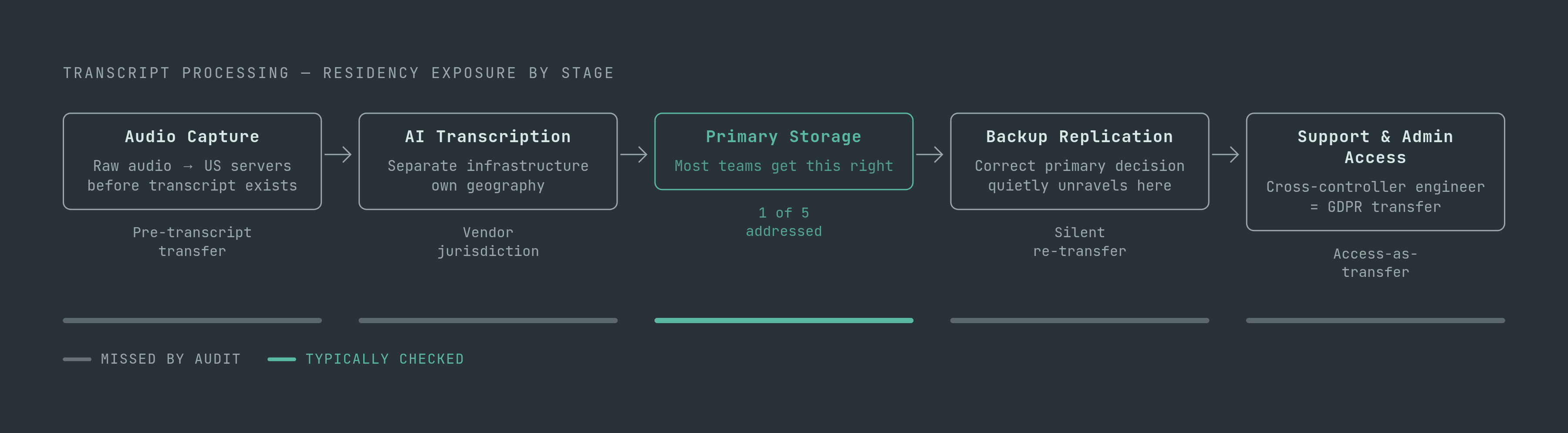
Each stage in a transcript's lifecycle, audio capture, AI transcription, primary storage, backup replication, and support access, can independently trigger a residency or transfer violation, no matter how carefully the other stages were configured. Fixing one stage does not fix the others, and an audit that checks only the final storage location will miss every one of them.
Audio capture is where exposure starts, often before anyone thinks about residency. Many AI notetakers join a call as a bot and route the raw audio to US servers by default. For a European user, that means a transfer out of the EU has already happened before a transcript exists, regardless of where the finished text eventually gets stored.
Transcription is a separate infrastructure layer with its own geography, and it does not inherit whatever residency guarantees apply to storage. A tool that processes audio only on US servers adds a compliance burden that a correctly configured storage bucket cannot undo. Where the AI model actually runs, meaning where prompts, retrieved context, and generated output transit, is a distinct question from where the final transcript sits once it is saved, and the two can point to entirely different jurisdictions. This is the most frequently missed gap in transcript compliance audits: residency controls applied at the storage layer do not automatically extend to the processing layer sitting upstream of it.
Primary storage is the stage most teams get right, largely because it is the most visible one. A tool built on EU-only storage removes the international transfer question for that stage entirely, and a US-based tool can also be made compliant through Standard Contractual Clauses, but only if that choice is made on purpose and documented, not assumed.
Backup replication is where a correctly configured primary storage decision quietly unravels. Backups have to meet the same residency standard as the primary copy, and a common failure pattern is an organization that locks down primary storage correctly while letting backup systems replicate across borders without applying the same controls.
Support and admin access is the stage least likely to appear in a compliance review. Under GDPR, a support engineer from a different controller or processor accessing logs or recordings from outside the EU or EEA counts as a data transfer, regardless of where the underlying data is stored. Access by an employee of the same controller or processor working remotely does not trigger that Chapter V transfer requirement. The organizational relationship between the person accessing the data and the company storing it determines the legal analysis, not just their physical location. Metadata, diagnostic logs, and admin tooling can all touch jurisdictions well outside the chosen residency region even when the transcript itself never moves.
Real deployments show how this plays out even among providers with mature residency programs. Microsoft finished rolling out its EU Data Boundary in February 2025, letting European business customers keep core service data inside the EU and EFTA, but metadata, backups, diagnostics, and admin access can still touch other jurisdictions even under that boundary. The same month, Microsoft turned on Teams transcription by default, which sharply increased the volume of transcript data organizations now have to govern under exactly this kind of partial boundary. Zoom lets eligible paid accounts route meeting data through EU data centers, though standard paid accounts still keep account and diagnostic data in the US, and only Education and Enterprise customers on Zoom's dedicated EU Infrastructure keep those categories in the EU as well, a reminder that "EU hosting" often covers some data categories and others' default settings keep data outside the EU, frequently behind a paid tier or admin setting. Cisco has stored European Webex customer data in Frankfurt and Amsterdam since October 2022. None of these examples are failures. They are evidence that even well-resourced residency programs leave gaps at stages other than storage.
AI processing layers need a separate residency analysis from storage
AI features built on top of a transcript, summarization, action-item extraction, search, are not a cosmetic layer sitting on top of a storage decision already made. They are a distinct infrastructure question, and legal teams are generally behind the pace at which these features have shipped. Where a transcript sits and where an LLM processes that transcript's content are two separate questions, and each one needs its own residency analysis rather than inheriting the answer from the other.
Governments are moving fast on this point. Where a country's data trains or runs through a model, officials increasingly want the data, the compute, and the resulting model to stay under that country's jurisdiction, a position generally described as Sovereign AI. Residency is no longer just a hosting detail that procurement checks off on a vendor form. It has become the condition that determines which AI products a regulated organization can lawfully deploy.
The EU AI Act does not help close this gap, because it sets no data-residency or localization requirement of its own. An organization cannot point to AI Act compliance and call it a substitute for GDPR transfer discipline. The two frameworks apply independently, and satisfying one says nothing about the other.
The EU Data Act has been enforceable since 12 September 2025, and it widens the scope further by extending sovereignty principles to industrial and non-personal data too. That extension matters for transcript-adjacent metadata: participant counts, call duration, and routing information are not personal data in the traditional sense, but an organization running AI analytics on top of transcript data may find that metadata pulled into the same sovereignty analysis as the transcript text itself.
This creates a direct structural conflict for any US-headquartered AI provider that serves European customers. Meeting a data-residency requirement might mean running LLM inference in Frankfurt. Meeting a sovereignty requirement means that Frankfurt-held data has to stay outside the reach of US law enforcement. For an enterprise built on a US-headquartered cloud provider, those two goals cannot both be fully true at once, which is the same tension the next section examines directly.
The sovereignty gap that EU data center selection alone cannot close
Choosing an EU data center satisfies a residency condition but does not determine whose laws govern the data or who can compel access to it, and that gap is what regulators and sophisticated enterprise buyers are now testing for. The US CLOUD Act lets US law enforcement compel an American company to produce data it controls, even when that data sits on servers in Frankfurt or Zurich. Any transcript held by a US-incorporated conferencing or transcription provider carries this exposure, regardless of which regional data center the customer selected.
The common practitioner position, that selecting an EU region guarantees insulation from foreign legal reach, does not hold up legally. A US-incorporated provider running an EU data center cannot simultaneously give a customer full GDPR protection and full insulation from CLOUD Act reach. Those two regimes pull in different directions at once, and a single infrastructure choice cannot satisfy both.
Some point to the EU-US Data Privacy Framework as the bridge that resolves this tension. That claim is contested. Concerns remain about conflicts between US surveillance authority, including FISA Section 702, and GDPR's requirements, and Nordic regulators have already told organizations to plan exit strategies given the DPF's long-term uncertainty.
The practical effect of this shift is that the evaluation standard European regulators and buyers apply has moved. The question used to be where data is stored. The question now is where it is processed, who can reach it, and which legal system a foreign court or regulator would invoke to demand access. Storage residency alone no longer satisfies that standard.
France shows what the far end of this response looks like. Under a national cloud sovereignty doctrine and its implementing law, sensitive French government data must run on a qualified sovereign cloud infrastructure, one built specifically to sit outside the reach of extra-EU legal regimes. No commercial SaaS platform from a foreign vendor could offer that guarantee, so France moved toward a sovereign, state-developed video platform built on qualified French sovereign cloud infrastructure, and this model eliminates CLOUD Act exposure at the architectural level.