AssemblyAI vs Rev AI for Async Meeting Transcription
AssemblyAI wins on automation; Rev AI wins on accuracy guarantees.
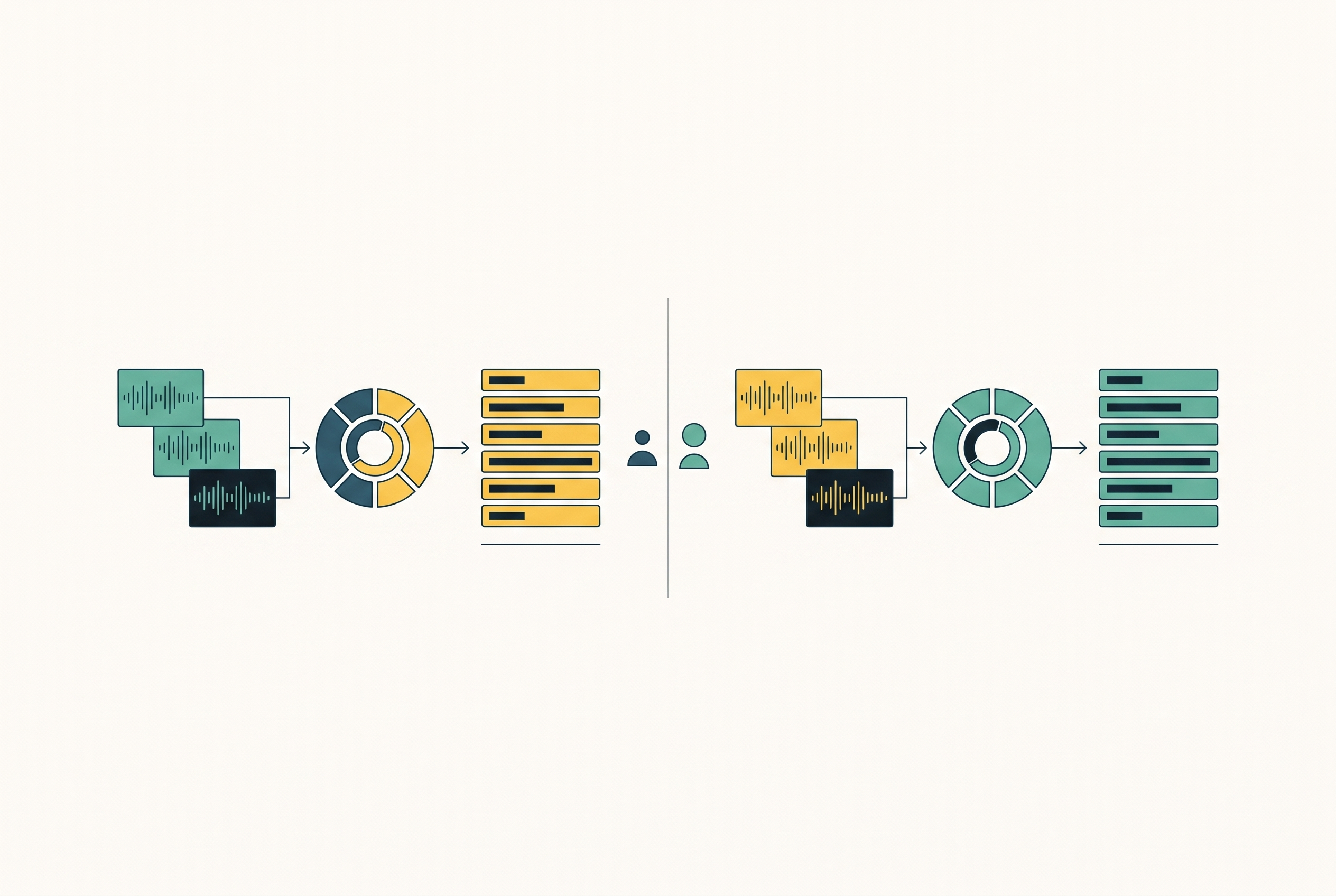
AssemblyAI and Rev AI make different architectural bets for async meeting transcription. AssemblyAI focuses on AI-first transcription with meeting intelligence built in, while Rev AI offers professional human verification on top of its AI tier. AssemblyAI is the stronger fit for automated meeting workflows at volume. Rev AI is the stronger fit when a defensible accuracy guarantee outweighs processing cost and turnaround time.
Why async meeting transcription forces a real architectural choice
Speakers interrupt each other, microphones pick up different levels of noise, and teams use specialist vocabulary without explaining it. A system must handle those conditions while preserving who said what. Errors therefore reach beyond the transcript itself. A misunderstood technical term or misplaced speaker label can weaken the meeting record that downstream tools use.
AssemblyAI puts AI transcription, speech understanding, and LLM integration in one stack, while Rev AI provides access to professional transcriptionists when automated output is insufficient. Those approaches impose different costs and workflow requirements. Given those two bets, which one serves async meeting transcription better for your situation?
What each platform actually is, and what it is built for
AssemblyAI is an API-first Voice AI platform built for developers. Its relevant offerings span speech-to-text, the Speech Understanding API, and LLM Gateway, which supports models including GPT, Claude, Gemini, and Qwen over transcribed audio. These are parts of a broader product offering. Universal-3.5 Pro launched on July 7, 2026, with the replacement of Universal-2 as the async default effective September 2, 2026, and the retirement of Universal-3 Pro. AssemblyAI supports 99+ languages for async transcription and 32 for real-time streaming, whose flagship model is Universal-3.6 Pro Realtime.
Rev AI uses Reverb for automated transcription and offers professional human transcription for content that needs review. Its orientation is primarily batch and async work. Sources say it supports 58+ languages, though that alone does not show how well it will handle a given meeting. Rev acquired SmartDepo in March 2025, integrating AI-assisted legal testimony and deposition analysis into VoiceHub and signaling a strategic focus on legal transcription.
How accuracy actually works for each platform, and what meeting audio does to it
Accuracy is the hinge dimension because every later interpretation depends on the transcript. AssemblyAI ranks Universal-3.5 Pro first on English benchmarks among non-open-source models and says it leads in multilingual and code-switching accuracy. Those are vendor-published benchmark claims, with accuracy on individual recordings still subject to variation. Meeting audio remains a demanding test. Overlapping turns, voices that sound alike, and domain vocabulary can reveal weaknesses that tests on clean speech miss.
AssemblyAI addresses vocabulary through contextual prompting, which accepts plain-English context before transcription, including speaker names, domain terms, and mixed-language passages. Rev AI’s Reverb models do not offer equivalent prompting controls. Better recognition of a proper noun can prevent that error from entering later summaries. AssemblyAI also describes Universal-3.5 Pro as delivering its most accurate diarization to date. That combination is particularly relevant when both the words and their attribution are difficult.
Rev reports Reverb accuracy for clean, clear English, but those figures are not independently benchmarked against the same standardized datasets as AssemblyAI’s. They are not directly comparable. Rev’s diarization works well when voices are distinct and speakers take turns, but it has a harder time when people talk over each other. Its human tier makes a different claim, offering a reported 99%+ accuracy guarantee through professional review of AI output. Does that settle the comparison? Only when the workflow can absorb human review’s cost and turnaround time.
Speaker diarization and speech understanding as the features that determine meeting usefulness
A correct sequence of words is not yet a useful meeting record. Speaker diarization establishes attribution, while summaries and action-item extraction turn the conversation into something people can use. These tasks depend on the transcript’s integrity. Contextual prompting therefore has downstream value beyond recognition, because correctly transcribed domain terms give later processing better input.
AssemblyAI’s Speech Understanding API offers sentiment analysis, entity detection, topic detection, and summarization as part of the transcription platform, with no separate service tier for them. Diarization and PII redaction are separate add-ons within that platform. Integrated does not mean every feature is included. LLM Gateway extends the workflow through natural-language requests such as “list all action items” or “what decisions were made?” Developers can query transcribed audio without building a separate retrieval pipeline.
Rev AI has more limited speech-understanding add-ons and lacks the same built-in intelligence layer. That distinction creates little friction when the required output is simply text. It becomes more consequential when a product needs speaker-attributed records, summaries, and LLM queries together. AssemblyAI has a structural advantage for that workload because transcription and understanding can be requested through an integrated API workflow. The benefit is less separate service integration, with evaluation of the resulting meeting record still required.
Pricing structures and what they mean at actual meeting transcription volumes
The base transcription rate does not describe a workflow that also requires diarization, redaction, summaries, or human review. AssemblyAI lists Universal-3.5 Pro at $0.21/hr, unchanged from Universal-3 Pro’s prior rate, with Universal-3 available as a lower-cost standard async tier. Billing is per second, with no minimums or contracts. That structure makes transcription usage predictable, although the configured feature set determines the final bill.
Rev AI has a lower-cost Reverb transcription tier and a human tier that costs much more. Its add-ons for language identification, sentiment analysis, and summarization can also raise the cost per minute. Current rates require direct confirmation with Rev. At meaningful meeting volumes, AI-only tiers differ moderately in cost, while human-verified transcription carries a much larger premium over automated transcription. The latter premium is justified when compliance-critical content requires verification.
For an actual workload, the relevant comparison is the cost of the required output across the full recording volume, including the share sent for review. Teams looking at AssemblyAI should check the current prices for add-ons, while those looking at Rev should check both AI and human rates. Integration expense also belongs in that assessment. AssemblyAI’s startup program includes dedicated support and forward-deployed engineers for hard integration problems, which can affect the cost of building a meeting-intelligence pipeline.
Compliance, security, and human fallback — where Rev AI's model has a genuine edge
For legal, medical, or archival recordings that require a defensible accuracy floor, Rev’s human tier provides something an AI-only service cannot replicate. Turnaround is measured in hours. That delay can fit an async review workflow even when it would exclude a live application.
Rev’s stated compliance posture includes SOC 2 Type II, HIPAA, and CJIS, but HIPAA coverage depends on the product and account arrangement. It is not automatic across all plans. On the consumer subscription, HIPAA coverage is restricted to Unlimited, formerly Enterprise, with the required HIPAA-specific subscription and signed BAA. Rev AI API accounts can be HIPAA-enabled through a signed BAA and updated MSA. Teams must confirm the setup for their specific product and account directly with Rev before uploading protected health information.
AssemblyAI also has security and compliance features, so teams should check directly with both providers for current certifications and whether a BAA is available before they commit. A compliance label does not resolve the entire selection. Most meeting transcription is neither legally binding nor tied to protected health information, and human review gets expensive when there are many recordings. Its hours-long turnaround also excludes near-real-time use cases. Rev’s advantage is therefore strongest where verified accuracy and the applicable compliance arrangement are necessary together.
Real-time and streaming capabilities, and why they matter even for async-first teams
An async-first purchase can shape a later live product. A team may move from batch meeting transcription to a live meeting assistant and eventually to a voice agent. That path makes streaming capability a relevant selection criterion even before streaming is needed, because batch processing and live conversation impose different latency requirements. AssemblyAI’s broader real-time offering gives that expansion path more room.
AssemblyAI reports a 307ms median time to final transcript for Universal-3.6 Pro Realtime, measured through the Pipecat benchmark. The model offers configurable min_latency, balanced, and max_accuracy modes, plus context carryover that interprets each turn using prior turns. Its base rate is significantly higher than the async tier. The Voice Agent API builds on that model at a flat hourly rate, while the Sync API offers a different path for short, self-contained clips, returning a finished transcript from one HTTP POST in approximately 134ms.
Those latency figures describe distinct workloads. Rev AI is built mainly for batch work, with little focus on voice agents. That orientation is compatible with a finished-recording workflow, especially one involving human review. It is less aligned with a product roadmap that depends on live assistance or conversational agents.
Developer experience, integration complexity, and what shipping actually looks like
Streaming breadth is useful only if the integration fits the team. AssemblyAI provides SDKs, a streaming WebSocket, documentation, and product-led onboarding without contracts. Its pay-as-you-go offering scales to millions of hours with unlimited concurrency. Support can extend beyond a ticket queue. Through its startup program, forward-deployed engineers help teams that qualify work through hard integration problems.
Rev AI provides REST API access, SDKs, and webhooks. Those are practical tools for batch transcription. Zapier integration is available for Rev.com only, so the distinction from Rev AI is relevant when planning an integration. Human review introduces a different workflow from an automated API round-trip because the application submits audio and handles a delayed callback. The review work itself is not purely programmatic, even when submission and result handling use APIs.
For simple batch transcription, the objection that a REST API is enough is valid. The distinction grows when a team must also deliver summaries, action items, and speaker-attributed records. AssemblyAI’s integrated stack reduces the separate services involved in that work, while Rev’s human route adds a review stage when verification is necessary. Shipping complexity therefore follows the required output.
Which platform fits which async meeting transcription scenario
AssemblyAI is the stronger fit for a product whose output is meeting intelligence. This includes workflows that need speaker attribution, summaries, action items, and queries over technical or multilingual conversations. High recording volume strengthens that fit when human verification is unnecessary. A roadmap toward live meeting assistance or voice agents strengthens it further, because the next capability sits on the same platform. Contextual prompting and integrated understanding make this an architectural fit, subject to performance on the team’s recordings.
Rev AI is the stronger fit when the recording requires professional verification and the workflow can wait hours for it. Legal, medical, and compliance review are the clearest cases, as long as the account has the compliance arrangements it needs. Reverb’s automated tier also works well on clean English recordings where voices are distinct and speakers take turns. A simple batch requirement may need little more. The human option becomes decisive when its accuracy guarantee is mandatory and its cost is acceptable.
Teams can use AssemblyAI for large amounts of routine async transcription and Rev’s human tier for the recordings that need guaranteed accuracy. Before committing, test representative recordings on both platforms, including the team’s noise, accents, speaker count, and vocabulary, using AssemblyAI’s free tier and playground where useful, and base the final choice on that performance.