Punctuation and Formatting Restoration in Raw Meeting Transcripts
How to turn raw ASR transcripts into readable, usable text.

Restoring punctuation and formatting in raw meeting transcripts is a spoken-to-written conversion problem. Reliable results require four interacting layers, namely punctuation, capitalization, inverse text normalization, and disfluency handling. Modern NLP makes those layers increasingly tractable, but production quality still depends on domain-matched training data, models suited to latency constraints, and editorial review.
Why ASR output lacks punctuation and what that costs downstream
A question without its question mark can read as a statement. In raw automatic speech recognition output, that ambiguity begins with the conversion from sound to words. Speech expresses meaning through prosody, pauses, and intonation, but those signals do not survive as text markers in a standard ASR pipeline. Traditional systems produce lower-cased words without punctuation or explicit sentence boundaries.
Meeting speech makes reconstruction harder than restoring marks to otherwise polished prose. Speakers hesitate, restart, and backtrack within an utterance. Those features are common in conversation but rare in the written corpora often used to train restoration models. A model must therefore infer written structure from language that was never composed as writing.
Pulipaka et al.’s 2025 work on Cadence identifies difficulties with spontaneous speech that hinder translation, text-to-speech, and summarization, where sentence boundaries help preserve quality. Suen et al.’s Interspeech 2025 research also identifies costs to named entity recognition, dependency parsing, and part-of-speech tagging. These systems need more than a correct word sequence. They also need useful signals about how those words belong together.
The four-layer process that turns raw ASR output into readable text
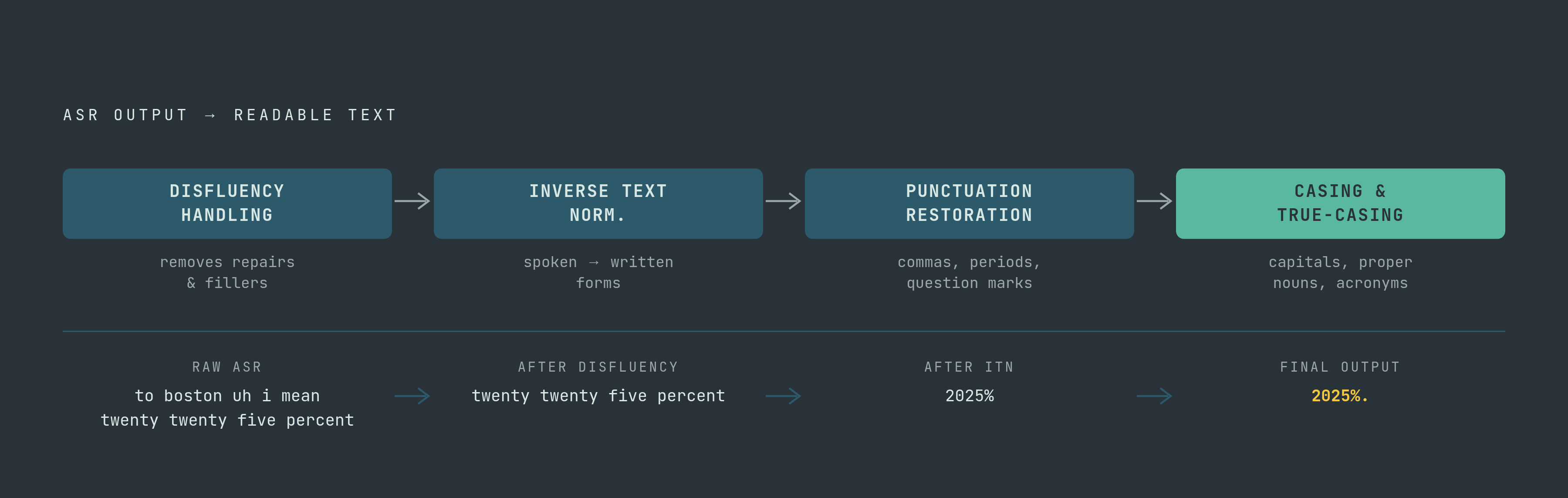
Punctuation restoration inserts marks at syntactically appropriate positions, including commas, periods, question marks, and language-specific symbols such as the Devanagari danda, or purna virama. Capitalization, also called true-casing, restores sentence-initial capitals, proper nouns, and acronyms. The two tasks interact through sentence boundaries. A decision to end one sentence also establishes where the next sentence’s initial capital belongs, while proper nouns require a different kind of judgment.
Inverse text normalization, or ITN, converts spoken-form tokens into their written equivalents. The examples “twenty twenty five”, “mister”, and “percent” become “2025”, “Mr.”, and “%”. Disfluency handling addresses a different source of clutter. In “I want a flight ticket to Boston, uh, I mean to Denver on Friday,” the segment “to Boston, uh, I mean” is a repair. Suppressing it makes the speaker’s intent easier to interpret.
These are distinct problems, but they need not require four isolated models. Joint spoken-to-written conversion research frames the task as a two-stage process whose first stage tags text for all four dimensions together. That consolidates work previously handled through a cascade. More broadly, conversion from meeting speech to written language involves “understanding then rewriting”, with choices about verbatim versus cleaned style. Speaker renaming, paragraph breaks, and timestamp granularity remain additional production concerns rather than automatic consequences of correct grammar.
How the dominant text-classifier approach works and where it falls short
The most common way to restore punctuation uses token-level sequence classification. A pretrained encoder transformer receives an unpunctuated token sequence and assigns each token boundary a punctuation label or a null label. It labels boundaries rather than rewriting the passage. This framing gives the system a constrained task, with a defined set of possible marks at each position.
Cadence extends that approach by adapting the pretrained generative model Gemma-3-1B into a bidirectional transformer through a Masked Next Token Prediction objective. It then fine-tunes the adapted model for token-level classification. A model first built to generate text can restore punctuation without open-ended text generation.
A text model predicts punctuation that fits written conventions, which can differ from marks that reflect a particular speaker’s pause, interruption, or trailing thought. Training on a news corpus makes that gap harder to handle because formal prose is so different from the way people speak in meetings. Scale alone does not remove the mismatch. Cadence’s analysis identifies domain shift and rare punctuation marks as persistent difficulties even for strong multilingual models.
Those limitations do not make restoration optional for downstream processing. Cadence reports that adding punctuation to ASR output improves translation quality, with average gains in both BLEU and chrF++ across the tested language pairs. Better sentence structure helps a subsequent system process the transcript, even when restoration itself remains imperfect.
Why training data source matters as much as model architecture
The data used to train a restoration model shapes which forms of language it learns to organize. Formal corpora such as news and Wikipedia are plentiful but differ in register from meetings. Conversational corpora, including meeting transcripts and podcast archives, are better matched but scarce and noisier. Synthetically de-punctuated text offers control over the training examples. Removing punctuation from written prose, however, does not give it the false starts and informal structure of natural speech.
Suen et al.’s Cantonese study makes this distinction concrete. Models trained on LLM-annotated, naturally spoken YouTube transcripts outperformed models trained solely on formal written text, despite the smaller spoken dataset. The transcripts included Cantonese–English code-mixing, disfluencies, and informal speech patterns missing from the formal material. Those features were part of the target domain. Their presence made the smaller dataset more useful for restoring conversational language.
The study found that initial learning from Wikipedia followed by adaptation on YouTube transcripts worked better than either dataset alone. General learning and domain adaptation each had a different role. For low-resource languages, this distinction is especially consequential because scarce data compounds differences between spoken and written conventions.
Adding punctuation labels by hand still takes a lot of time and money, which makes LLM-generated labels an appealing way to use real conversations. Repl4NLP workshop research found that punctuation restoration as an auxiliary training objective improves structure understanding in named entity recognition, chunking, and open information extraction.
What LLMs bring to punctuation restoration and the new failure modes they introduce
LLMs can supply labels for real speech or restore punctuation directly. In the annotation role, naturally spoken audio is transcribed first, and an LLM adds punctuation labels. The bottleneck shifts from collection toward labeling. The Cantonese study compared six LLMs, selected the strongest annotator, and distilled its punctuation expertise into a smaller encoder transformer model that performed on par with the strongest LLM evaluated.
Direct restoration offers a different route. A prompted LLM can add punctuation without task-specific fine-tuning, which is useful for low-resource settings or rapid deployment. Seq2seq approaches, including T5-based models, occupy an intermediate position between fixed-label classification and full LLM prompting. They can predict more than one punctuation mark in sequence while remaining more controllable than open-ended generation. That flexibility expands the output space, but it also makes output behavior a separate engineering concern.
The first failure mode is alteration of the original words during prompted restoration. An explicit instruction such as “WITHOUT CHANGING ANY WORDS” can reduce the behavior, although reducing it is not the same as establishing that every output preserves the input.
The second failure mode is formatting drift. Generative systems can produce repeated punctuation marks or omit sentence-final symbols, creating a distinct category of output error. Fixed-label classifiers do not generate free-form punctuation sequences in this way. Their constrained output avoids this particular form of generative drift, though the label may still be incorrect. Even when the result reads smoothly, its formatting still needs to be checked.
Shejole et al.’s LoResMT 2026 study found that all evaluated LLMs showed lower punctuation robustness in English–Marathi translation than task-specific restore-then-translate and direct fine-tuning strategies. General-purpose prompting was not an equivalent substitute in that setting. For downstream-sensitive pipelines, the relevant test is not just whether a restored transcript reads naturally, but whether its structure supports the next task.
The streaming constraint: why real-time transcription and high-accuracy restoration pull in opposite directions
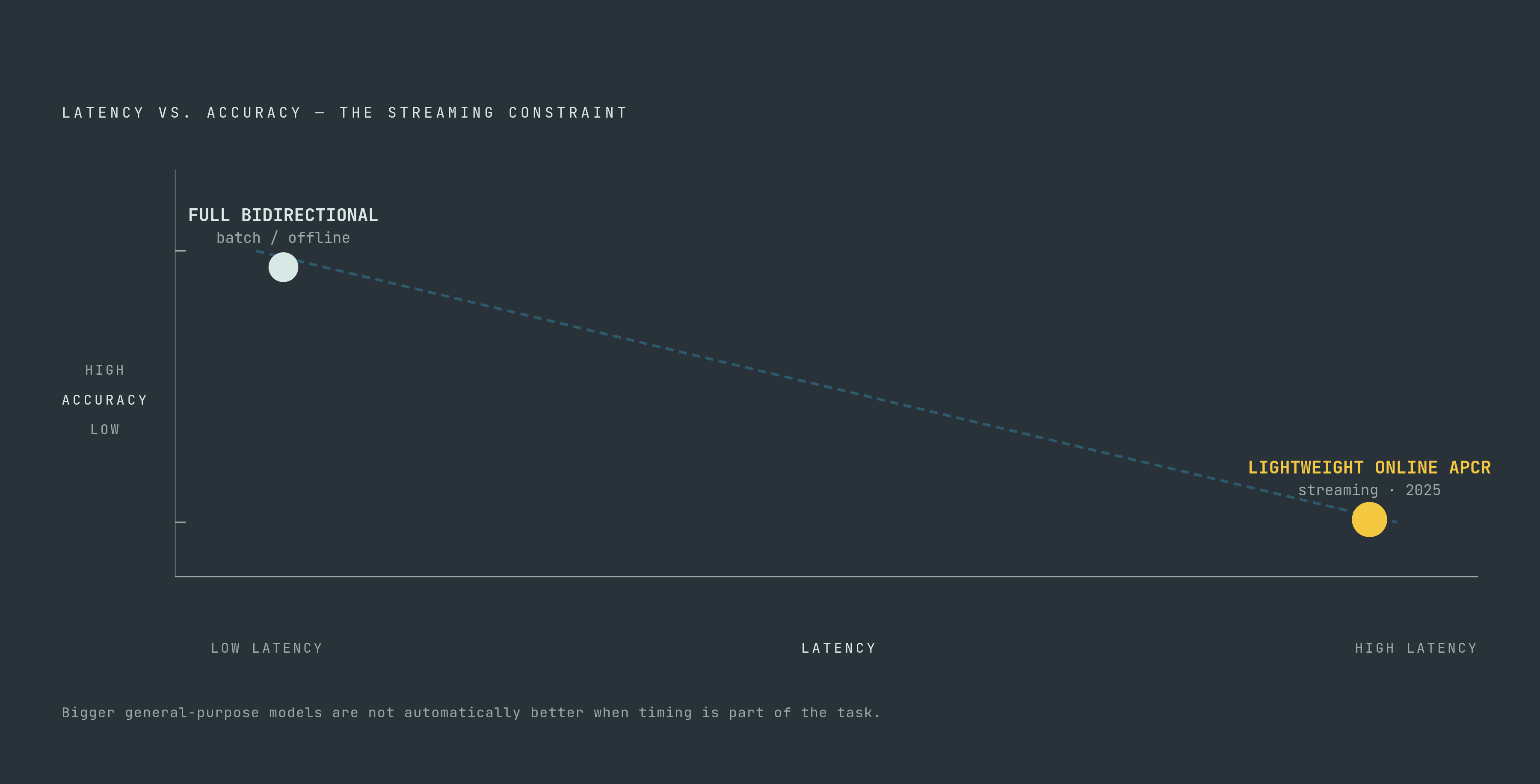
Restoration is more accurate when it can use the words on both sides of a token boundary. Bidirectional models read the available sequence in both directions before they assign labels, while a live ASR system must make decisions as speech comes in. Future words are not yet available to it. Full bidirectional context and sub-second decisions therefore pull in opposite directions, regardless of how well the model has learned meeting language.
Offline processing avoids that immediate constraint because the post-meeting transcript is already available. Live captioning has to work with speech as it arrives. Lightweight Online APCR, a 2025 approach designed for streaming automatic punctuation and capitalization restoration, demonstrates the value of optimizing for that setting. It outperformed GPT services and other transformer models on punctuation restoration under its low-latency constraints. Larger general-purpose models are not automatically better when timing is part of the task.
For teams evaluating live meeting tools, the practical lesson is to assess streaming latency and punctuation quality separately. The fastest real-time engine is not necessarily the one whose raw output is easiest to restore. Nor does a strong offline result establish suitability for live use. Model comparisons need to reflect the context actually available when a punctuation decision must be made.
Diarization creates a parallel problem at the display layer. Technical speaker-change boundaries can be much finer than conversational turns, leaving segments that are unsuitable as readable paragraphs. Production approaches merge adjacent compatible turns through deliberate gap and duration policies while omitting empty transcription results. Renaming speakers, refining paragraph breaks, choosing a cleaned or verbatim style, and setting timestamp granularity remain unresolved parts of the broader workflow.
What a well-engineered transcript restoration pipeline looks like in practice
Where possible, ITN and disfluency removal should precede punctuation restoration because spoken-form tokens and fillers can degrade classifier accuracy. Display-level diarization processing should also merge fine-grained speaker segments into readable paragraph blocks before restoration runs. The aim is coherent utterance-length input. Capitalization then remains part of the wider formatting process.
Model selection should follow the deployment constraint. For high accuracy, batch processing after a meeting can use a full bidirectional model trained on domain-matched material. Live captioning needs a lightweight online model built for the task, with some accuracy given up to stay within latency limits. Low-resource languages and new domains can use LLM annotation of real speech to build smaller adapted models, following the Cantonese approach. Training-data selection belongs in this design decision.
If prompted LLM restoration is included, explicit no-alteration instructions and formatting validation are necessary guardrails. Checks should look for repeated punctuation and missing sentence-final symbols. Fluency is not a sufficient acceptance test. The pipeline also needs to tell allowed formatting changes apart from word-level rewriting, especially when the transcript will be used for translation, summarization, or meeting minutes.
The AutoMin 2025 shared task on automatic meeting summarization into minutes and question answering illustrates that the end-to-end design question remains open. Participation was limited compared with prior years, raising questions about whether general-purpose LLMs are absorbing this work or task-specific pipelines retain a durable advantage. Either way, editorial review is still needed. Automated restoration relies on the grammar and domain statistics it has learned, without direct access to what a speaker intends. For meeting minutes and downstream-sensitive uses, human review is still the final check for errors that current systems leave behind.
Sources
- Mark My Words: A Robust Multilingual Model for Punctuation in Text and Speech Transcripts - ACL Anthology
Supplied the Cadence model details, including the Gemma-3-1B adaptation, domain-shift limits, and translation gains in BLEU and chrF++.
- A Robust Multilingual Model for Punctuation in Text and ...
Source for the Cadence paper's discussion of spontaneous-speech difficulties and downstream effects.
- Punctuation restoration for speech transcripts using large language model
Covers prompted LLM and seq2seq restoration for speech transcripts, including word alteration and formatting drift.
- Cantonese Punctuation Restoration using LLM Annotated Data
Provided the Cantonese study on LLM-annotated YouTube transcripts, Wikipedia pretraining, and distillation into a smaller model.
- Assessing and Improving Punctuation Robustness in English-Marathi Machine Translation
Supplied the finding that LLMs showed lower punctuation robustness than restore-then-translate strategies in English–Marathi translation.
- indic-punct: An automatic punctuation restoration and inverse text normalization framework for Indic languages
Informed the treatment of Indic-language punctuation such as the danda and of inverse text normalization alongside restoration.
- Punctuation Restoration for Speech Transcripts using seq2seq Transformers
Covers seq2seq transformer approaches such as T5 to punctuation restoration in speech transcripts.