Recall AI vs Symbl AI for Meeting Bot Infrastructure
Recall pipes raw meeting data; Symbl interprets it, but now answers to Invoca's priorities.
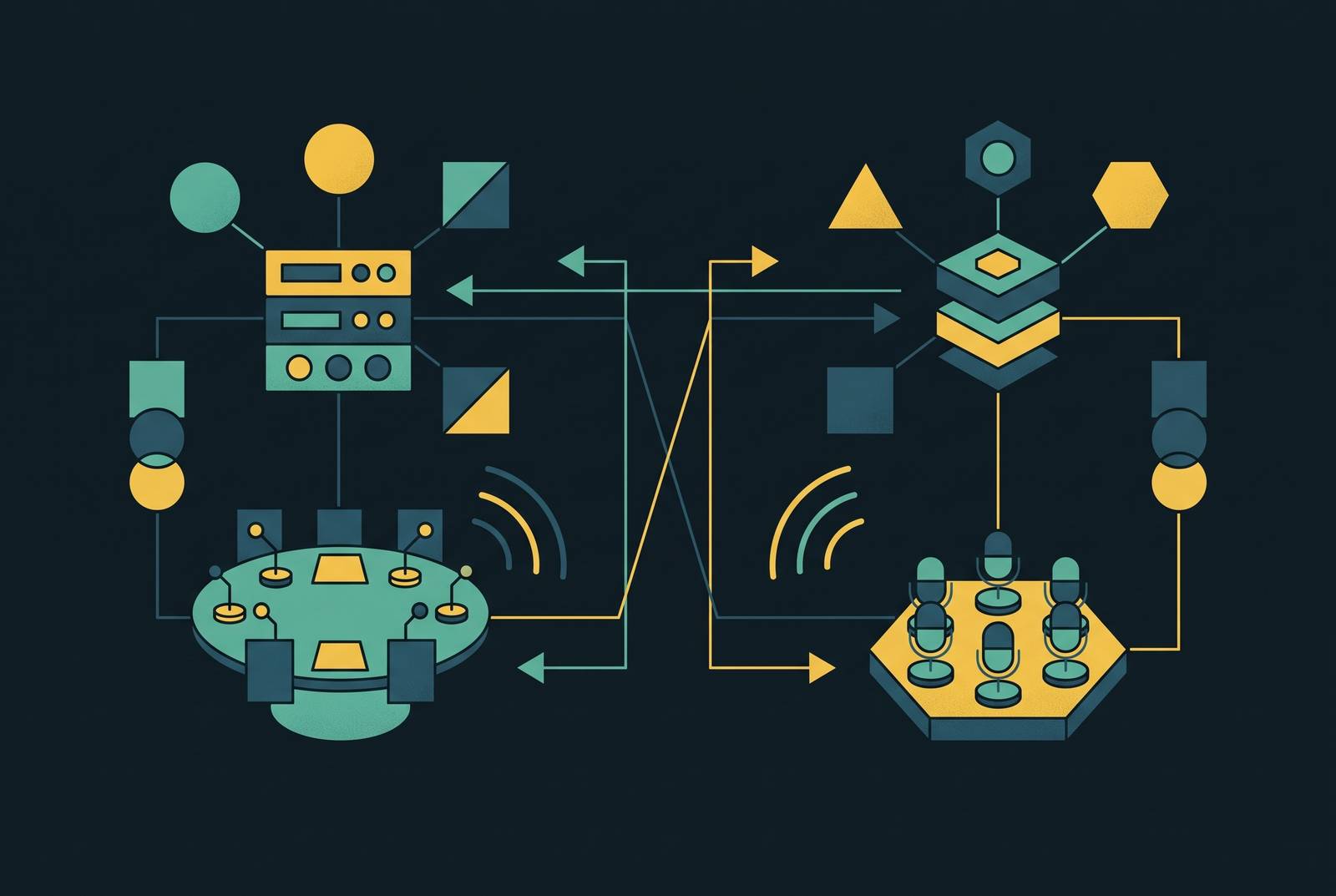
Two companies solved the "get a bot into a video call" problem, and they solved it in nearly opposite ways. Recall.ai built a pipe: hand it a meeting URL, and it hands back audio, video, and transcripts, leaving what you do with that data entirely up to you. Symbl.ai built an interpreter: feed it a conversation, and it hands back sentiment, topics, and summaries already worked out. That split used to be a clean architecture choice, one shop for raw pipes and another for finished answers. As of May 2025 it's also a question of which company you're actually buying from, since Symbl.ai was acquired by Invoca, with its roadmap now tied to Invoca's broader platform priorities. Any team currently evaluating Symbl should treat that fact as the first item on the list, not a footnote.
The architectural fork: infrastructure layer versus intelligence platform
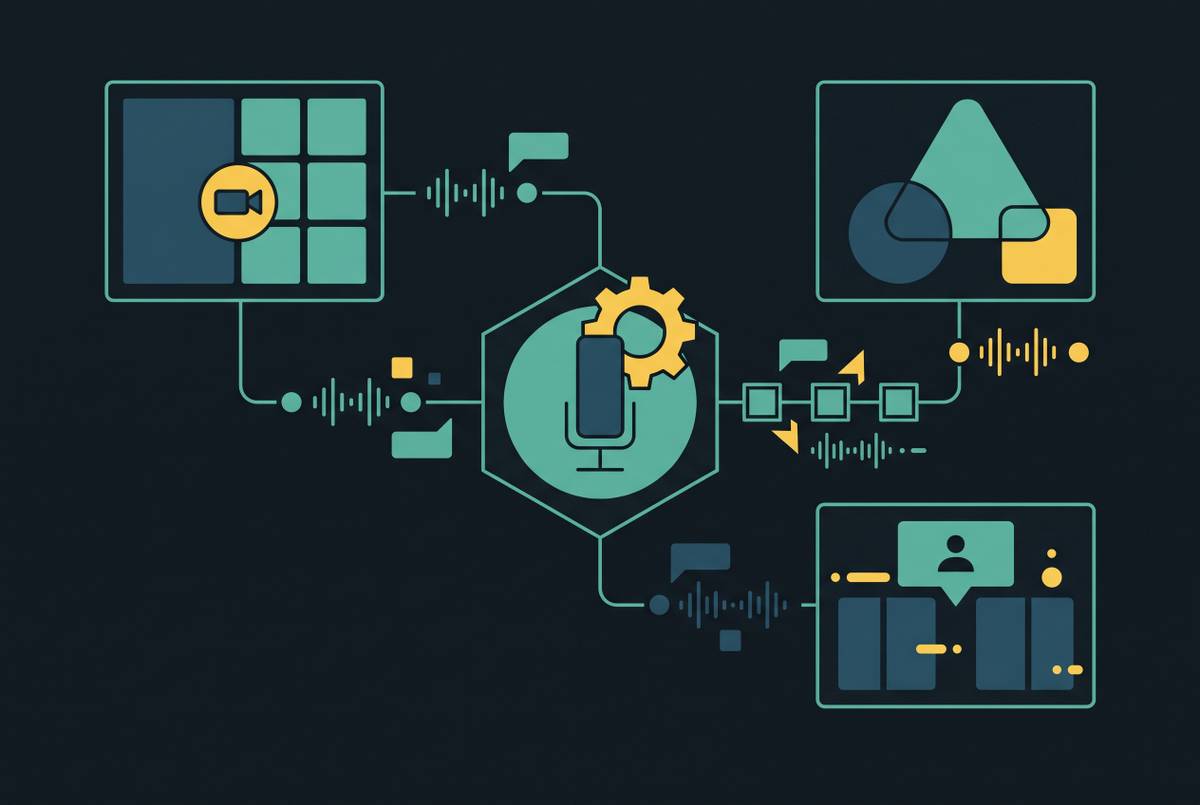
Recall.ai calls itself "Meeting Bots as a Service," and the description undersells how narrow that scope is on purpose. The company likens itself to AWS for meeting data: shared infrastructure every builder needs, not a packaged answer to a business problem. Send one HTTP call with a meeting URL, and Recall spins up a cloud VM, joins the call, and starts streaming data back. It works across platforms, including those with no native API of their own. What comes back is raw: audio and video per participant at roughly 200ms latency, speaker-identified transcripts pushed over webhook, and metadata like join times and screenshare events.
Symbl.ai starts further downstream. It processes voice, video, and text, live or after the fact, and hands back sentiment, entities, intents, and the questions asked during the call, not just the words spoken. At the center sits Nebula, a proprietary language model built on the Llama-2 family and trained specifically on conversational data, with a context window up to 16,000 tokens meant to hold the shape of a full conversation rather than isolated snippets. Around Nebula sits a wider set of products: task-specific models for entities and sentiment, applied tools for call scoring and real-time assistance during live conversations, and a Multi-Agent Platform where multiple AI agents coordinate on a communication problem within a business context.
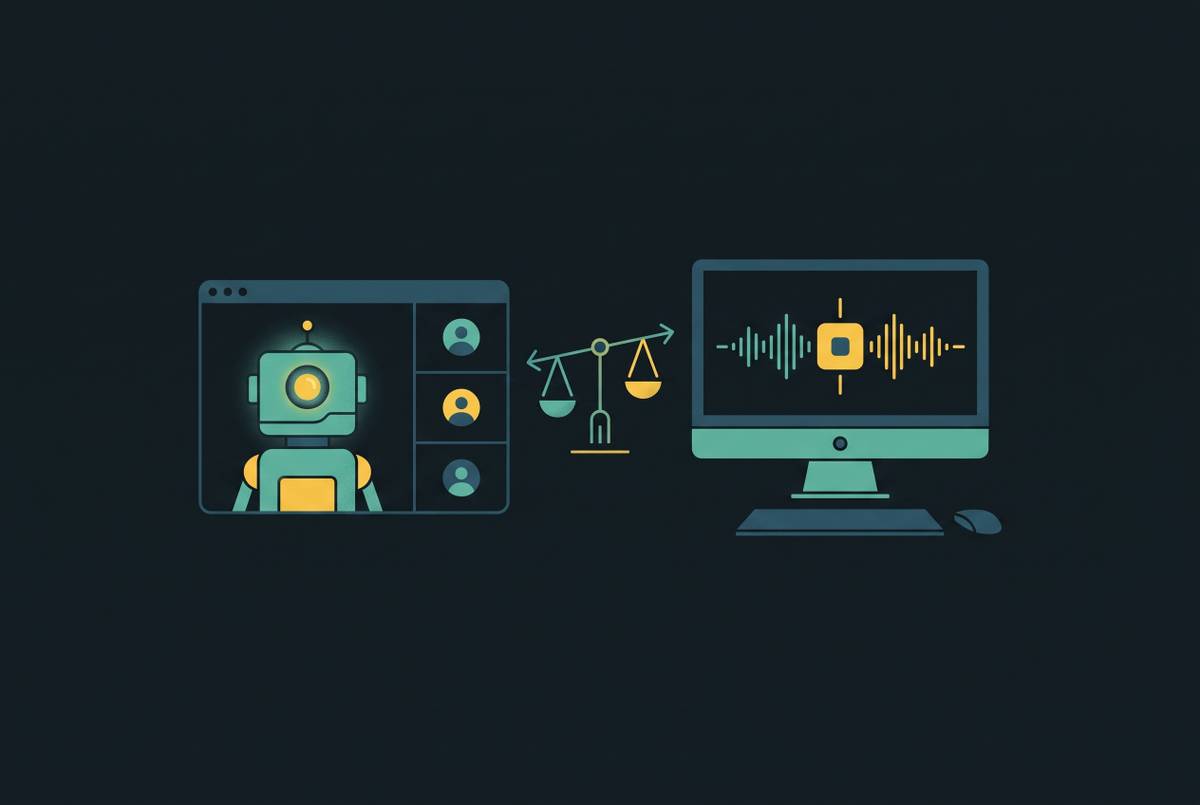
These are not two flavors of the same product, and treating them as interchangeable is where most build decisions go wrong. Recall.ai hands a team the data pipe and nothing else. Symbl.ai, now folded into Invoca, hands a team the interpretation sitting on top of a pipe someone else still has to build or buy. Picking the wrong one doesn't just cost money. It costs a rebuild six months in, once the team realizes the platform they picked was answering a different question than the one they asked.
What building on Recall.ai actually involves
Building meeting-bot infrastructure from scratch usually eats up 3 to 5 engineers and six months or more. Recall.ai's whole pitch is compressing that timeline from months down to days. Coverage spans Zoom, Google Meet, Microsoft Teams, Webex, Slack Huddles, GoToMeeting, RingCentral, Whereby, and Discord, more than 12 platforms total, and adding a new one usually just needs a meeting link.
What Recall handles behind the scenes: scheduling and running thousands of concurrent VMs, delivering audio and video in real time, telling speakers apart, firing metadata events, and making the final recording available shortly after a call ends. What a team still has to build is everything after that: summarization, sentiment scoring, writing results into a CRM, any agent logic sitting on top. Recall is the pipe, and it stays in that lane on purpose.
That lane is widening a little, though. The Output Media API, launched November 14, 2024, lets a bot inject audio or video into a live meeting and answer back with a synthesized, context-aware voice, moving Recall from a bot that only listens toward one that can actually take part. The Desktop Recording SDK, launched a week later on November 21, 2024, gives teams real-time meeting data without a bot joining as a visible participant at all, which matters to anyone worried about a bot's presence tripping a compliance review. A Slack Huddle API followed on March 6, 2025, and a startup program for teams building on meeting-recording infrastructure launched in mid-2026.
Companies already running on this layer include HubSpot, ClickUp, Rippling, BrightHire, Revenue.io, Sybill, and Instacart, which uses it for internal meeting transcription at real scale.
What building on Symbl.ai (now Invoca) actually involves
Symbl's pitch has always been that the interpretation ships built in. Sentiment, topic extraction, question detection, intent classification, call scoring, real-time assist during a live conversation: none of it gets wired up from scratch, it comes with the platform. Nebula sits underneath most of it, trained on conversation-specific data rather than general web text, with an embeddings model for teams that need additional tuning. That's a genuinely different bet than bolting a general-purpose model onto raw transcripts, and it shows up directly in build time: a team can ship a working sentiment feature against Symbl's pre-built models faster than training one from a blank slate on its own labeled data.
The Multi-Agent Platform pushes this further into orchestration. For complex customer-experience workflows, several agents can be linked together and deployed across a business context, which matters for a team building something closer to a CX product than a recording tool. Because the intelligence layer already exists, teams shipping common CX workflows avoid the overhead of building sentiment and intent detection from raw transcripts by hand.
How Symbl got here is the catch, and it's the part that should worry anyone building on top of it. Invoca announced a definitive agreement to acquire Symbl.ai on May 28, 2025. Surbhi Rathore, Symbl's co-founder, is now VP of AI products and strategy at Invoca; co-founder Toshish Jawale now heads engineering there. Invoca's own framing is that it wants Symbl's AI folded into its revenue execution platform, letting brands orchestrate a buyer's journey with agentic AI. For a builder, the practical upshot is that Symbl's roadmap now answers to Invoca's platform priorities, not to standalone API customers. That alone counts against Symbl for anyone who needs a developer-first product with a predictable release cadence, no matter how good Nebula is on its own terms. Standalone access and pricing after the acquisition are unconfirmed, worth checking directly with Invoca before building around them.
One gap worth naming: Symbl processes conversations, but relies on other systems for the actual capture. A team building on Symbl still has to solve the "get a bot into the call" problem some other way, usually by pairing it with a separate bot-infrastructure layer, which is its own integration project layered on top of an already uncertain roadmap.
The cost and scale trade-offs each architecture creates
Recall.ai's cost structure looks less like typical software margins and more like a hosting business. Each active bot needs real compute, something like 4 vCPU cores per concurrent meeting, and unlike most SaaS products, Recall has to provision server capacity for every meeting happening live, not just serve cached responses out of a database. That's why its gross margins sit closer to 50 to 60% instead of the 80 to 90% range software companies usually post. Recall has described one of its own fixes for this in public: dropping WebSockets for internal data transfer cut per-bot CPU usage in half and brought AWS networking costs, which had climbed toward $1 million a year, back under control.
Current 2026 pricing reflects that math. Pay-as-you-go runs $0.50 an hour for the Meeting Bot API and the Desktop Recording SDK, down from $0.70 previously. Built-in transcription adds $0.15 an hour, and storage costs $0.05 an hour after the first 7 free days. The old $1,000 monthly platform fee is gone. The first 5 hours are free, Launch and Enterprise tiers use custom volume pricing, and Calendar Integration API access comes at no extra cost on every plan.
There's real price pressure in this layer already. MeetingBaaS, a competitor, prices recording from $0.35 per bot-hour against Recall's $0.50 per bot-hour, though a typical record-and-transcribe session on MeetingBaaS runs $0.44 to $0.63 an hour before any monthly subscription, with recording included in that rate.
Symbl.ai's pricing after the acquisition is unconfirmed, so check with Invoca directly. Before the deal, Symbl offered tiered plans including trial access for new users. The bigger shift is structural: Recall's business scales by pushing more meeting-minutes through the system and shaving cost per minute. Symbl, now inside Invoca, is tied to enterprise platform contracts rather than pure usage metering, and that's a fundamentally different kind of commercial relationship to sign up for, one closer to buying a CX suite than subscribing to an API.
Which build scenarios favor Recall.ai, which favor Symbl/Invoca, and where neither is the full answer
Recall.ai is the right call for most teams that need reliable, platform-agnostic recording across a wide spread of conferencing tools and want to own the intelligence layer themselves. It's the clear fit once coverage has to stretch past Zoom, Meet, and Teams into additional platforms where there's no native API to lean on. It also fits teams that want commercial certainty: Recall is an independent company, sitting on $51 million in total funding after a $38 million Series B in September 2025 that valued it at $250 million, reporting $31 million in ARR as of January 2026 with 226.4% year-over-year growth and more than 1,000 companies on the API. Usage-based pricing, no platform fee, 5 free hours to start: the entry cost is low by design. And for teams building toward agentic features, the Output Media API means a bot can now speak and respond mid-call instead of sitting silently and recording.
Symbl.ai, now under Invoca, still makes sense for teams that want conversation intelligence, sentiment, intent, topic, summarization, handed to them instead of built from scratch, but that fit has gotten narrower since the acquisition, not wider. It's especially strong where the use case already sits close to CX, revenue execution, or call analytics, the exact ground the Invoca acquisition is meant to strengthen. Outside that ground, the case weakens fast: a team wanting a lean, standalone conversation-intelligence API without enterprise strings is no longer Symbl's target customer, whatever the marketing says.
Neither one answers every case by itself, and anyone pitching either as a single-vendor decision is skipping a step. Teams that need serious data capture and built-in intelligence at once usually end up pairing a bot-infrastructure API with a separate intelligence layer bolted on top, rather than treating the two as an either-or choice. That pairing is the honest architecture for most production use cases, not a compromise. And because Symbl's roadmap now belongs to Invoca, any builder hoping for a stable, developer-first conversation-intelligence API without enterprise lock-in should confirm the current product direction before committing engineering time to it, not after.
Vendor stability belongs on this checklist too, not as an afterthought tacked onto the end. Recall.ai is independent, well-funded, and has held a clear, narrow infrastructure mandate without wavering. Symbl.ai is now a product line inside a larger company with its own priorities, and product lines get deprioritized in ways that independent companies with a single mandate don't. Those are two different risk profiles, and a team building a multi-year dependency on either one should weigh that difference directly instead of assuming it washes out.
How AI-powered buyers will find and evaluate these platforms, and what that means for teams building on them
Discovery has changed, and it's changed fast enough that a two-year-old go-to-market playbook is already stale. Per 6sense's 2025 Buyer Experience Report, 94% of B2B buyers now use generative AI tools somewhere in their purchase process, so a developer weighing meeting-bot infrastructure is more likely to ask ChatGPT or Perplexity than to run a search and click through ten blue links.
Recall.ai comes out ahead here for reasons that compound on each other. Strong SEO, solid documentation, and an active, well-covered Series B round mean it shows up often when an AI tool gets asked to name meeting-bot infrastructure options. Being the first name a developer hears from an AI-generated answer isn't a small edge, since plenty of buyers never look past that first recommendation.
Symbl.ai faces a naming problem it didn't create through any fault in its own product. The acquisition means a search for "Symbl.ai" risks surfacing stale answers describing it as an independent vendor, while Invoca's broader revenue-execution positioning doesn't map cleanly onto a developer's narrow question about a conversation-intelligence API. That's a discovery gap, not a product gap, but it costs Symbl real consideration from exactly the developers who'd have picked it two years ago.
The cost of getting left out of these answers is climbing too. Ahrefs' analysis of 300,000 keywords found that where Google's AI Overviews appear, click-through rates for the top-ranking page drop from 7.3% to 1.6%. The AI's answer is turning into the last thing a buyer checks before deciding, not the first stop on a longer research trail.
For agencies managing clients in this exact space, whether those clients build on Recall.ai, sit inside Invoca's platform, or compete with both, tracking how AI tools describe and recommend a client's product is becoming infrastructure-level work for marketing teams, the same way a stable bot API is infrastructure-level work for engineering teams. Thrad's per-client analytics and weekly reporting exist for exactly this problem: giving account teams a clear, dated record of where a client is getting cited in AI-generated answers, and where a competitor is quietly taking that spot instead.
Sources
- Recall.ai revenue, valuation & funding
- The Meeting Bot API for every platform - Recall.ai
- meetstream.ai
- Top Generative Engine Optimization (GEO) Agencies in 2026: 10+ AI Search Specialists Compared | Mint Studios
- Invoca Acquires Symbl.ai, Empowering Brands to Orchestrate the Buyer Journey With Agentic AI | Invoca Press Release
- recall.ai
- speakai.co