Word Error Rate Benchmarking Methods for Meeting Transcription APIs
Meeting audio breaks single-score WER, so match your benchmark to production.
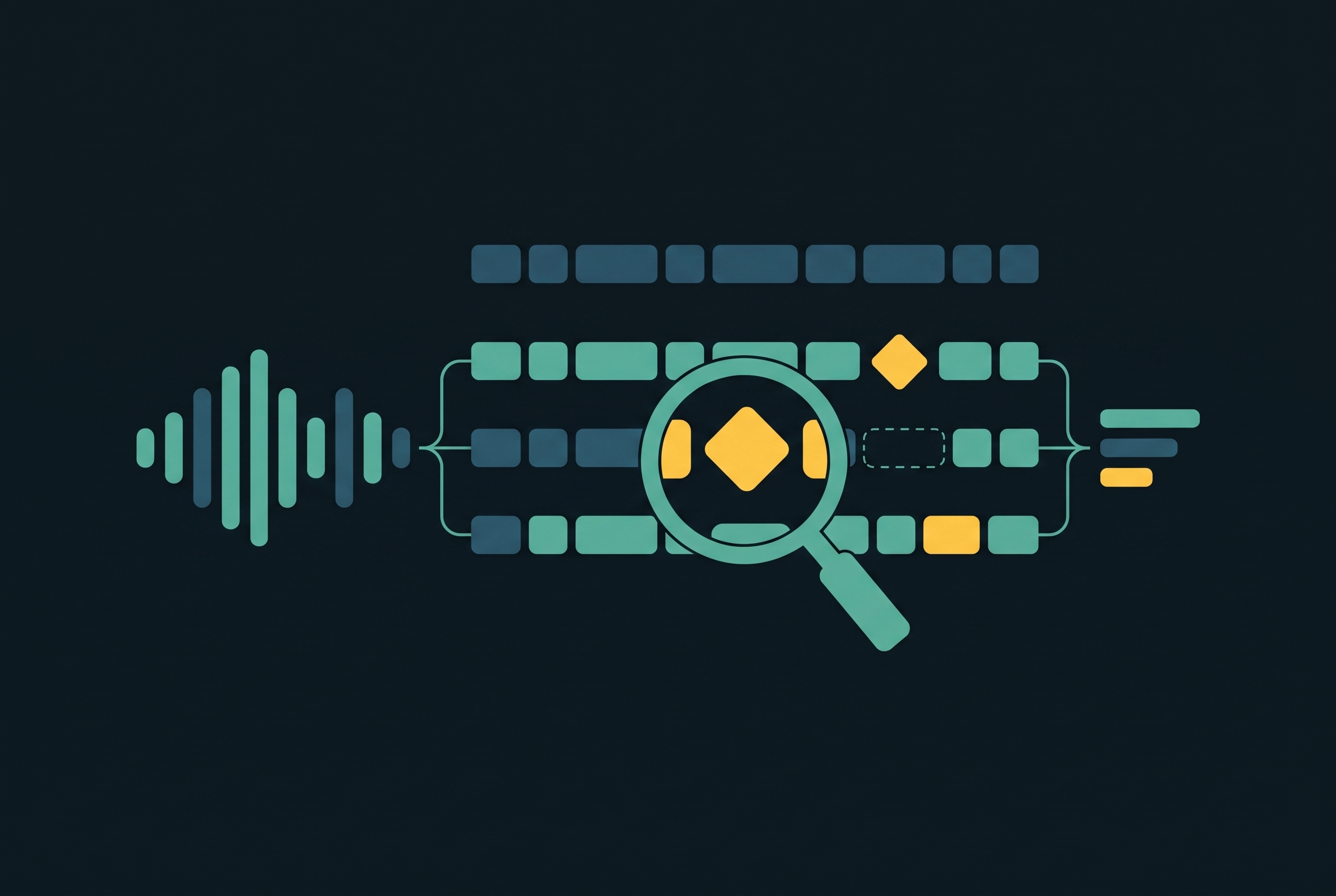
Benchmarking meeting transcription APIs requires more than comparing headline Word Error Rate (WER). Meeting audio exposes errors in speaker attribution, reference transcripts, and domain-critical terms that a single score obscures. A benchmark predicts production performance only when its audio, normalization rules, and metrics match the meetings and downstream tasks the system will handle.
Why meeting audio breaks the assumptions WER was built on
WER is presented as a single, clean number, while meeting audio contains overlapping turns, crosstalk, and unfinished thoughts. Standard WER was designed for single-speaker, single-utterance recognition, with assumptions better suited to read speech than group conversation. Its formula is (substitutions + deletions + insertions) ÷ total reference words. That calculation collapses different errors into one count. It does not distinguish a missing word from a failure to represent simultaneous speakers.
Meetings also contain speech that human transcribers routinely skip, including fillers, backchannels, and disfluencies. Differences in microphones, screen-share bleed, and background noise also make these recordings unlike controlled read speech. Domain vocabulary and mid-sentence code-switching add another source of variation. These are structural features of meetings. A meeting transcript must represent both the words and the conversation in which they occurred.
The Hugging Face Open ASR Leaderboard shows a substantial performance gap between LibriSpeech clean audiobooks and AMI meeting recordings. Median WER is far lower on the clean audiobook recordings. In the same snapshot, no system reached a low WER threshold on AMI that the vast majority cleared on clean audiobooks. The gap spans the field of systems.
How WER's equal-word-weight assumption produces systematically misleading scores in meeting contexts
WER assigns equal weight to each word error, although meeting errors have unequal consequences. Missing a filler and missing a drug name contribute to the same undifferentiated count of textual disagreement. When reference transcripts omit speech or use different formatting conventions, that disagreement can even penalize a correct transcription.
AssemblyAI's workshop on March 31, 2026 demonstrated this problem with Universal-3 Pro. Most words counted as errors were transcribed correctly but missing from flawed ground truth, including speech that human transcribers had missed. A captured “okay” or “uh-huh” becomes an insertion when the reference omits it. Because human references systematically omit quiet affirmations, overlapping speech, and disfluencies, the bias is predictable.
Entity blindness produces a different distortion. WER does not distinguish a meaning-preserving wording variant from a plausible but incorrect domain term. AssemblyAI's engineers illustrate the semantic risk with “My Cadillac isn't doing great” becoming “My cataracts aren't doing great”. The subject changes despite the similar wording.
Normalization adds a third source of distortion because “Dr.” and “doctor”, or “healthcare” and “health care”, can disagree without conveying different information. Unless a normalizer maps those forms to the same text, the score counts differences in formatting as recognition errors. Reference quality compounds all three problems. AssemblyAI's evaluation team notes that Artificial Analysis created proprietary datasets with manually corrected ground truths because errors in public references penalized more accurate models. The benchmark can misjudge both what was said and how well it was transcribed.
The metrics that capture what WER misses in multi-speaker audio
Multi-speaker evaluation needs metrics that complement WER. Concatenated minimum-permutation WER, or cpWER, scores transcription and speaker attribution together, so words assigned to the wrong speaker count as errors. AssemblyAI's accuracy guide uses cpWER across DiPCo, CALLHOME, NOTSOFAR, and AMI. Full-session comparisons expose this combined challenge. NVIDIA Nemotron 3.5 Transcribe achieved mean cpWER of 15.80 across AMI, CALLHOME, Mixer 6, and NOTSOFAR-1 full sessions, compared with the next-best published result of 16.83 from DiCoW v3.3 + DiariZen.
Von Neumann et al. distinguish speaker-attributed approaches such as cpWER and tcpWER from speaker-agnostic ORC-WER and MIMO-WER, which ignore speaker confusion errors. Their proposed diarization-invariant cpWER, or DI-cpWER, also ignores attribution errors. Its difference from cpWER isolates the contribution of speaker confusion. Metric choice thus defines which failures count. MeetEval standardizes computation of cpWER, ORC-WER, and MIMO-WER, while NOTSOFAR-1 uses tcpWER for primary ranking and tcORC-WER as an auxiliary metric.
Diarization error rate, or DER, counts missed speech, false alarms, and speaker confusion as a share of total speech duration. Strong segmentation does not guarantee usable transcription. The accuracy guide notes that DER and cpWER can rank the same systems differently, making their joint use useful for separating diarization problems from word-level failures.
Missed entity rate and entity error rate focus instead on names, numbers, IDs, and domain terms. Those measures are especially consequential for contact center, medical, and legal applications. Semantic WER uses a reasoning model as judge to check whether the meaning stays the same even when the words do not match exactly. AssemblyAI recommends it for voice agents and LLM pipelines, and Pipecat's open-source STT benchmark uses Claude Sonnet as a judge to reduce scoring bias. A human-readable transcript, a legal record, and an input to automation therefore require different combinations of these measures.
Why dataset choice determines whether a benchmark predicts production performance
The leaderboard's spread across dataset types shows why “meeting benchmark” is not a single category. LibriSpeech clean has far lower median WER than AMI, while SPGISpeech financial meetings also produce far lower WER than AMI. Domain mix changes the apparent difficulty substantially. A result can be internally consistent yet predict little about another kind of meeting.
LibriSpeech has read audiobooks recorded outside a studio in fairly controlled conditions, and its clean subset was filtered to keep the higher-quality recordings. GigaSpeech draws from audiobooks, podcasts, and YouTube, offering conversational material without real meeting crosstalk. Heavy optimization for clean-speech benchmarks also creates a saturation risk, and the leaderboard shows that clean-speech and meeting-audio performance are not improving at the same rate across the system population.
The AMI Meeting Corpus has real English meetings with close-talking and far-field recordings and detailed annotations made by hand. However, the leaderboard uses AMI-IHM cut into short single-speaker segments. Segmentation removes the multi-speaker challenge before scoring begins.
NOTSOFAR-1 tests distant ASR with English meetings recorded in several rooms, each with four to eight participants. Earnings-22 instead exposes accented speech in earnings calls. These datasets probe different weaknesses. The same distinction applies to production audio from legal depositions, clinical intakes, engineering standups, and sales calls.
What text normalization choices do to WER comparability across vendors
Two WER scores computed on the same audio with different normalization rules are not the same measurement. Normalization transforms both the reference and the hypothesis before edit-distance counting. Common operations include lowercasing, number-to-word conversion, symbol stripping, punctuation removal, and filler-word removal. Those choices change what counts as an error. Most vendor-reported figures do not disclose enough detail to establish equivalence.
The leaderboard removes punctuation and casing, normalizes numbers, standardizes spelling, and removes fillers before computing WER. Its scores therefore cannot be compared directly with scores that keep fillers, even when they use the same audio.
The Whisper Normalizer is the most commonly used open-source normalization package, but it does not resolve every equivalent form. AssemblyAI's engineers document gaps including “healthcare” versus “health care”, “all right” versus “alright”, and “setup” versus “set up”. Formatting-rich output is particularly exposed to naive normalization. Models with strong language model decoders, including LLM backbones, can have part of their accuracy advantage obscured by these artifacts.
For a reproducible comparison, the practical rule is to normalize both reference and hypothesis identically with the same normalizer and document it. The accuracy guide recommends the Whisper Normalizer and the open-source jiwer library for WER calculation. A package name alone is not enough. The applied rules must also be explicit so that another evaluation can reproduce the measurement.
How to construct a dataset and run a benchmark that reflects your production meetings
To turn these distinctions into a production benchmark, begin with recordings that match the intended deployment. Match microphones, acoustic environments, speaker demographics, and domain vocabulary. Include the difficult conditions the system will encounter, such as accented speech, code-switching, crosstalk, and low-bandwidth audio. Clean headset recordings cannot stand in for noisy laptop microphones. For multi-speaker evaluation, include full sessions with 4–8 participants and genuine simultaneous speech.
Aim for a substantial word count per test condition, roughly an hour of audio or more, to support meaningful confidence in WER results. Spread that coverage across more files to capture variance. Then have people check the reference transcripts before scoring any system. Decide whether annotation is verbatim or clean before work begins, and stick to that choice so that a mix of styles does not favor some types of models.
For human-readable transcripts, use normalized WER as the primary measure and add missed entity rate for domain-critical terms. For multi-speaker recordings, make cpWER primary and track DER separately. For LLM or automation pipelines, assess Semantic WER and downstream task quality, such as summary accuracy, together with WER. Legal, medical, and compliance evaluations should give missed entity rate substantial weight because ordinary word accuracy does not isolate their most consequential errors.
Compute aggregate WER from total errors divided by total reference words across the full dataset. Do not average per-sample WERs, since that gives short utterances excessive influence. Use jiwer or NIST SCTK for proper Levenshtein distance calculation. Use MeetEval for the multi-speaker measures it supports. Document every normalization rule, the library version, and the annotation style so the result can be reproduced.
Finally, run separate benchmarks for real-time and pre-recorded operation. AssemblyAI's published benchmarks show a measurable WER gap between pre-recorded audio and real voice-agent calls. Streaming evaluation should also capture latency through inverse Real-Time Factor, or RTFx, together with WER. Accuracy alone does not characterize a real-time system. Keeping the modalities separate prevents a pre-recorded result from standing in for the conditions of a live application.
Why vendor-reported benchmarks should not be trusted as production predictors
A vendor's published WER describes its performance under its evaluation conditions. Results on clean English audio do not show how accurate a system will be on call-center recordings with compression artifacts and background noise. Missing methodological details make the inference weaker still. Without the dataset, segmentation policy, normalizer, and reference style, a headline score cannot be compared reliably with another vendor's number or an internal benchmark.
The leaderboard's 2026-09-19 snapshot standardizes normalization and reports WER and RTFx across open and proprietary systems for pre-recorded audio. Artificial Analysis addresses reference errors through manually corrected proprietary datasets. AssemblyAI's benchmarks page, accessed October 8, 2026, provides cpWER averages across DiPCo, CALLHOME, NOTSOFAR, and AMI with named sources and dates.
The final decision also depends on what consumes the transcript. If the output feeds a meeting summarizer, the decisive question is whether the summary accurately represents the meeting. In that setting, LLM-as-a-judge evaluation of summary quality is more valid than relying on a transcript-level metric alone. Low WER cannot settle that downstream question. The evaluation must reach the task the system is supposed to perform.
The practical conclusion is to run the benchmark on production-matched audio, use metrics suited to the downstream task, and disclose normalization. AssemblyAI's guidance says teams should test on their own audio across the conditions their systems will face. Treat vendor WER as a starting point for investigation. This methodology is the minimum basis for a vendor choice that holds in production.
Sources
- Word Error Rate Definitions and Algorithms for Long-Form Multi-talker Speech Recognition
Supplied the distinctions among cpWER, tcpWER, ORC-WER, MIMO-WER and the proposed DI-cpWER, and how each treats speaker confusion.