Transcript Chunking Strategies for LLM Context Windows in Meeting Pipelines
Speaker turns, not tokens, are the atomic unit for chunking meeting transcripts reliably.
Meeting transcripts are not simply long documents. They belong to a structurally distinct category of text, and chunking pipelines built for prose, contracts, or technical manuals break when applied to them. This piece maps the specific failure modes transcripts produce and the chunking strategies built to address each one, and it closes with a decision framework for pipeline design.
Why meeting transcripts break generic chunking pipelines
Cutting a transcript at the wrong token boundary produces a line of text with no speaker attached to it. That single failure, attribution loss, is the clearest sign that a generic chunker is treating a conversation as if it were an essay. A multimodal chunking survey names speaker turns as a structural unit, one that chunkers need to respect rather than split, just as image chunkers need to respect object boundaries.
A second failure runs alongside the first: semantic severance. Generic chunkers were never built to handle the three structural properties that meeting transcripts carry. Salience concentrates unpredictably across speaker turns. Utterances depend on earlier turns, sometimes many turns back. And what counts as important shifts depending on who's reading: an engineer scanning for a technical decision and an executive scanning for a budget commitment will flag entirely different moments in the same call.
Low information density makes all of this worse. A chunk can look substantial by token count but still carry almost no extractable fact. So when the useful information is spread thin and scattered through a long document, where the model's attention lands starts to matter enormously.
The "lost in the middle" effect and the accuracy trap in low-density transcripts
A transcript can fit inside a model's context window, but a well-documented positional bias still decides how reliably the model uses what's in there. Newer frontier models have cut down on this effect substantially, but it hasn't disappeared, and meeting transcripts take the hit harder than most document types because their important moments rarely cluster near the start or the end. A decision made forty minutes into a sixty-minute call sits exactly where the model pays the least attention.
The mechanism is attention. Models process every token, but attention concentrates on the beginning and end of a long prompt, so middle tokens get handled less reliably. Production analysis from Redis shows models can deprioritize information in the middle of long prompts well before they approach the hard limit, a pattern often called "context rot." Pinecone's chunking documentation describes the same effect from the retrieval side: relevant information buried inside long documents gets missed even when it's included in generation.
Adding more context does not fix the problem; it feeds it. For meeting question-answering, where a user might ask about any point in a long call, this is the default condition the pipeline has to be designed around, because the problem is fundamentally about position.
Architectural separation between transcription and extraction as the foundational fix
Before you choose any chunking strategy, you need the pipeline's basic shape to be right. Most meeting pipeline failures trace back to architecture, not to the chunking algorithm layered on top of it. If one LLM call has to serve as both the transcription layer and the extraction layer, it collapses two jobs that have different latency needs, different error profiles, and different context requirements into a single brittle step.
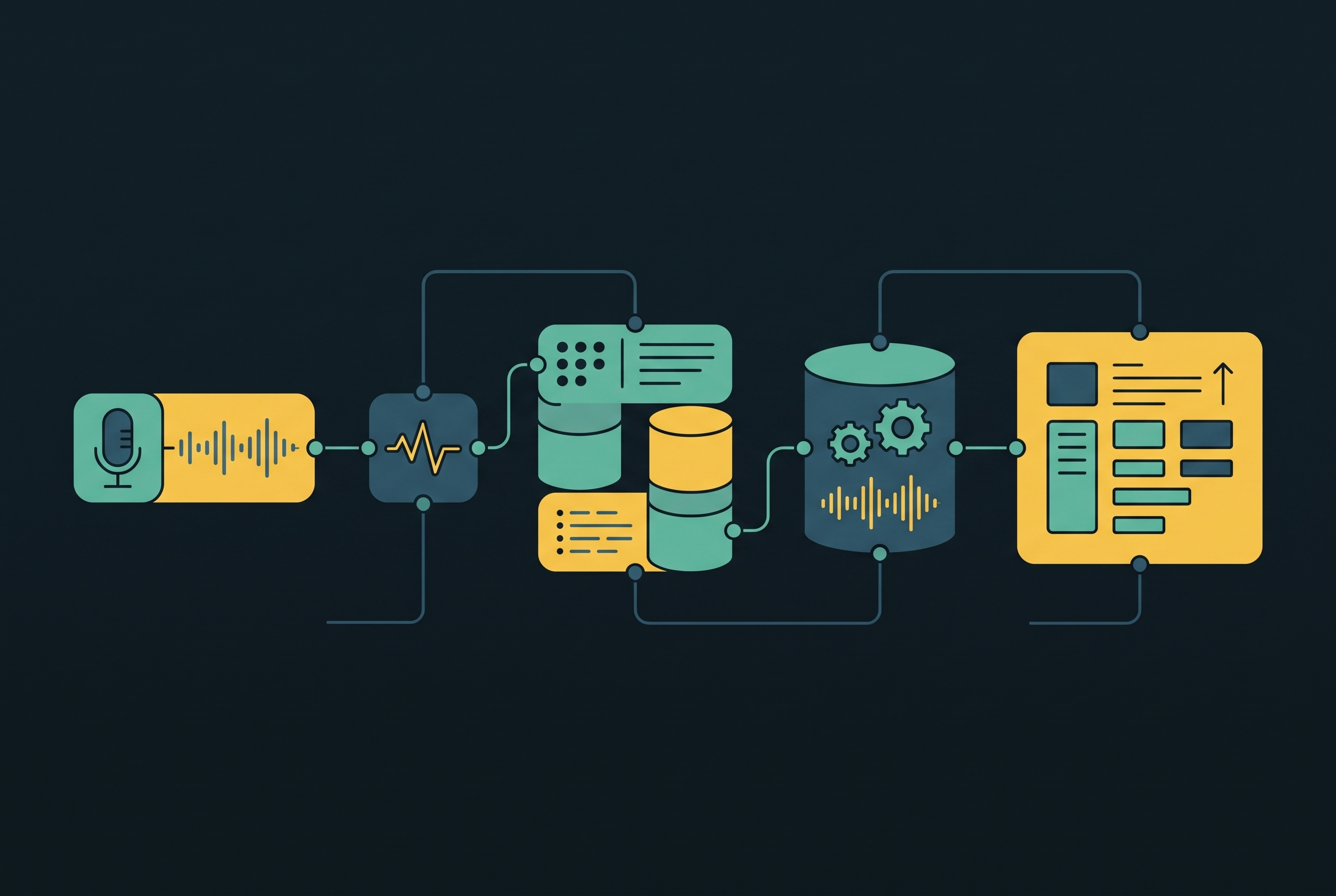
The sturdier foundation starts with async transcription that includes speaker diarization and word-level timestamps, producing a structured artifact. Diarization is the prerequisite for any speaker-aware chunking strategy that follows, because without it a pipeline has no reliable boundary signal beyond an arbitrary count of tokens.
From there, summarization, action item extraction, and decision logging should run as separate LLM stages, each receiving context sized and shaped for its own task, rather than one monolithic call forced to hold the full transcript, a summarization instruction, and an extraction schema all at once. A meeting pipeline needs to treat a summarization pass and a structured extraction pass as different document types that deserve different chunk shapes. This separation also means a bad transcript segment can be flagged and reprocessed at the transcription stage without restarting the entire pipeline behind it. Every chunking strategy that follows in this piece assumes this separation already exists; none of them work as well bolted onto a single undivided LLM call.
Speaker-aware segmentation as the baseline chunking unit for meeting data
With the architecture in place, the first concrete chunking decision is choosing the right atomic unit, and for meeting transcripts that unit is the speaker turn, not the sentence, the paragraph, or a fixed token window. The speaker turn is the smallest unit that preserves both attribution and conversational coherence at once, which makes it the natural building block everything else gets layered onto.
In practice, a speaker-aware chunk record carries a speaker label (name or ID), a timestamp range marking start and end, the turn's text, and a token count. That metadata belongs at the chunk level rather than folded into the text itself, so retrieval and aggregation stages can filter and sort by speaker without re-parsing the chunk's content every time. The rule that follows from this is simple and nearly absolute: never split a chunk mid-turn. The multimodal chunking survey treats this as a structure-preservation requirement on par with respecting object boundaries in image data: splitting a speaker turn is a category error, not a parameter to tune away.
Turns run long sometimes, and when a single speaker's turn exceeds the practical chunk size, the fix is to split at the nearest sentence boundary within that turn and carry the same speaker label onto both resulting sub-chunks. General-purpose chunking libraries ship token-based, sentence-based, and semantic chunkers, but none of the common ones model conversational speaker structure as a built-in constraint. So if you build meeting pipelines, you need to add speaker-aware segmentation yourself as a pre-processing step, before the transcript ever reaches a standard chunking tool.
Semantic chunking over fixed-size splitting for topically coherent transcript segments
Speaker-aware segmentation solves attribution, but it doesn't solve topic coherence on its own. A fixed-size token window run over a speaker-segmented transcript can still mix unrelated topics into the same chunk, because meeting conversations shift subjects mid-stream with no structural marker announcing the change. Semantic chunking addresses this directly: it groups turns by meaning rather than by position, keeping each chunk anchored to a single topic.
The mechanics follow a pattern Pinecone's chunking documentation lays out clearly: embed each speaker turn, measure cosine similarity between consecutive turns, and insert a chunk boundary wherever that similarity drops below a tuned threshold, marking a shift in topic. The resulting chunks vary in length and correspond to actual discussion topics instead of arbitrary windows of text, which makes them far more useful when a retrieval system later needs to answer a targeted question about one specific part of the meeting.
This comes at a cost. Semantic chunking needs an embedding model running at chunking time, which adds latency and compute that fixed-size token splitting doesn't require. For async pipelines processing a recording after the fact, that cost is easy to absorb. If a pipeline runs in real time while the meeting is still happening, you have to choose between lower-quality fixed chunking in the moment or delayed semantic chunking once a segment has finished.
Time-windowed chunking for real-time pipelines and the rolling-context requirement
Real-time pipelines must run semantic boundary detection before a finished transcript exists, so they need a different strategy: time-windowed chunking, built around fixed intervals. Run it naively, though, and fixed-interval chunking severs context across its own boundaries in exactly the way the earlier sections warned against, unless you design it to carry state from one window into the next.
Three things need to survive each boundary. The previous chunk's summary or tail has to carry forward so the next LLM call can resolve pronouns and references that cross the interval line. Open action items and unresolved decisions flagged in earlier windows need to stay visible, so a later window can close them out once a speaker confirms or rejects them. And speaker identity needs continuity across the boundary, so a speaker who starts a thought in one window and finishes it in the next isn't treated as two separate contributors to the conversation.
The Re-FRAME approach operationalizes this directly. No single interval length is correct for every real-time pipeline. What matters is pairing whatever interval you choose with an explicit context-carry mechanism; without one, time-windowed chunking reproduces the same attribution and reference failures that plain fixed-size splitting produces.
Aggregation strategies after chunking: map-reduce, refine, and hierarchical approaches
Producing good chunks is only half the job. The relationships between chunks, and the decisions that depend on those relationships, survive into the final output only based on what happens to those chunks afterward.
Map-reduce summarizes each chunk independently, then merges the resulting summaries. Its map calls run concurrently, and a failure in one chunk can be isolated and retried without restarting the whole pipeline. Its weakness for meetings is specific: a decision made in chunk 2 that gets qualified or reversed in chunk 7 may not survive compression into two independent, disconnected summaries. As more chunks are pushed through map-reduce, the volume of map outputs grows until it exceeds what the reduce stage can practically take in, requiring an additional hierarchical reduction pass.
Refine processes chunks sequentially, with each one handled alongside the accumulated summary of everything that came before it. Cross-chunk connections survive this process better than they do under map-reduce, because the running summary carries them forward, so each chunk's context doesn't die at its own boundary. A 2023 arXiv study found refine consistently outperforms map-reduce on accuracy across evaluation levels, but you pay an efficiency cost for that accuracy gain, and you have to budget for it.
Hierarchical aggregation, in the style of one recursive-summarization approach, builds a recursive summarization tree, preserving coherence across levels of the structure. It earns its cost when a meeting runs long enough that map-reduce's intermediate summaries overflow the reduce stage's window, or when a query needs reasoning across several distinct thematic clusters. Choosing among the three comes down to fit: if the full chunked transcript fits under the model's practical window, use refine or stuff the chunks directly; if it doesn't, use map-reduce; if the structure spans multiple levels or the question is genuinely global, use hierarchical aggregation.
Prompt ordering and chunk prioritization to counteract positional attention bias
Good chunks and a well-chosen aggregation strategy still run into the positional bias described earlier if the final prompt assembly ignores it. A highly relevant chunk buried in the middle of a long prompt is less likely to shape the model's output than a less relevant chunk placed first or last, simply because of where it sits.
The mitigation is a concrete ordering rule applied at assembly time. Put the single most relevant chunk first in the prompt. Put the second-most relevant chunk last. Distribute everything else by descending relevance, accepting that whatever lands in the middle will get less of the model's attention regardless of how it's ordered. This doesn't eliminate the positional bias, but it puts the highest-value content where the model is most likely to use it.
What counts as "relevant" depends on the task. For action item extraction, chunks carrying explicit commitment language, phrases like "I'll take that" or "let's do X by Friday", should move to the front of the queue. One more addition helps: a brief global summary, covering the speaker roster, the stated agenda, the meeting type, prepended to each chunk call so the model can resolve references and understand scope without leaning on positional memory across chunks it may not reliably have.
A decision framework for choosing chunking strategies in meeting pipeline design
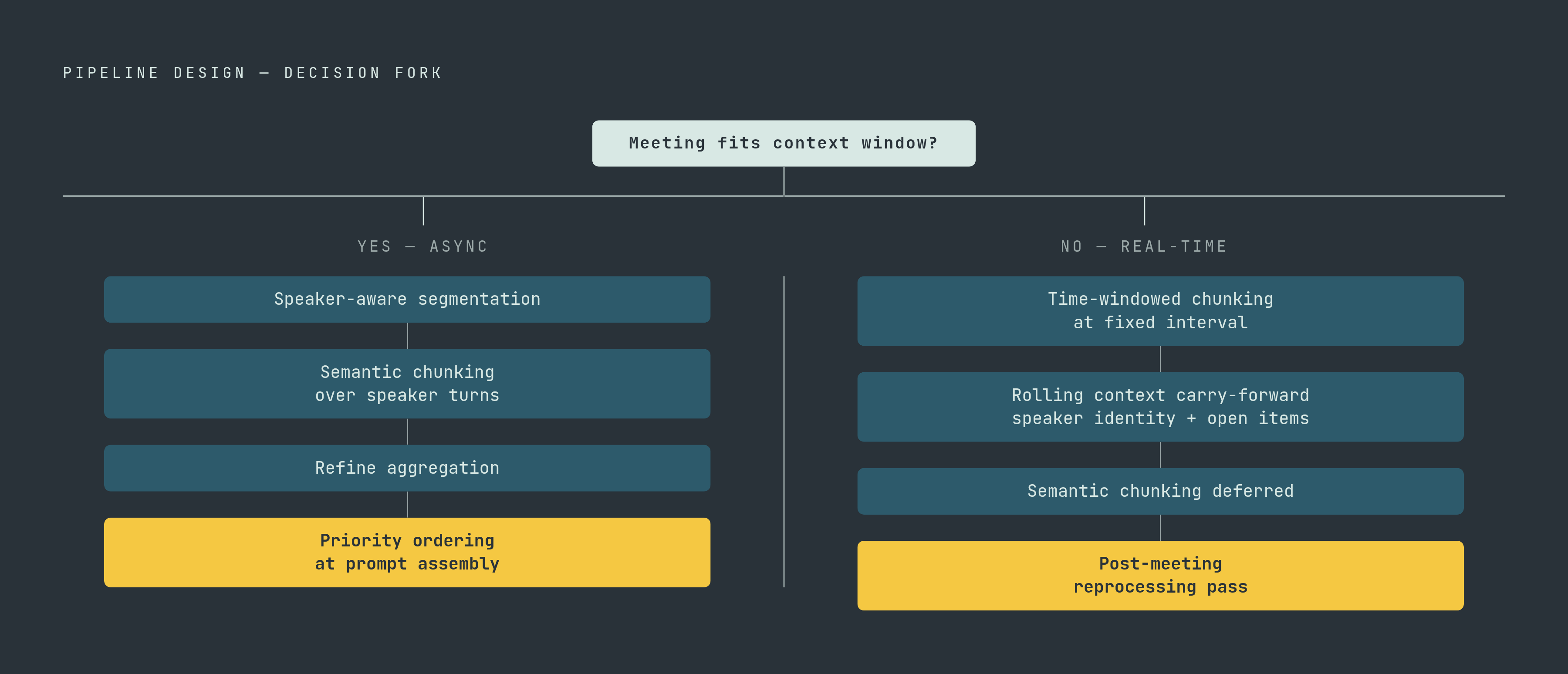
No single chunking strategy works for every meeting pipeline. The right combination depends on three variables: whether the pipeline runs real-time or async, whether the downstream query calls for targeted retrieval or global summarization, and how the meeting's length compares to the model's practical context window.
For an async pipeline handling a short meeting that fits inside the practical window, the path runs through speaker-aware segmentation as the base unit, semantic chunking layered over speaker turns to group by topic, refine aggregation for the strongest cross-chunk accuracy, and priority ordering at prompt assembly. For a real-time pipeline, you run time-windowed chunking at a fixed interval with explicit rolling context carried forward, speaker identity and open-item state maintained across windows, and semantic chunking deferred to a post-meeting reprocessing pass if full-record accuracy is needed afterward.
Running through all three paths is a single calibration point: the practical context window is not the advertised one. Context management research documents performance degrading before a model hits its hard limit, and Redis's production analysis finds that context rot appears in production before truncation does. Pipeline design needs to target the window where the model performs reliably, not the maximum it will technically accept. Meeting transcripts fail generic chunking pipelines in specific, predictable ways, scattered salience, long-range dependency, low density, positional bias, and every strategy in this piece exists to answer one of those failures directly. Design for the structure the transcript actually has, and the failure modes stop being surprises.
Sources
- Chunking Strategies for Multimodal AI Systems
Provided the framing of speaker turns as structural units that chunkers must respect, used to support the speaker-aware segmentation argument.